



Press release
Wearable Computing Devices Market to Reach USD 274.2 Billion by 2036 as Health Monitoring and Enterprise AR Adoption Accelerate; China Leads at 9.0% CAGR
11-20-2026 11:10 AM CET | IT, New Media & Software
Press release from: factmr
Wearable Computing Devices Market
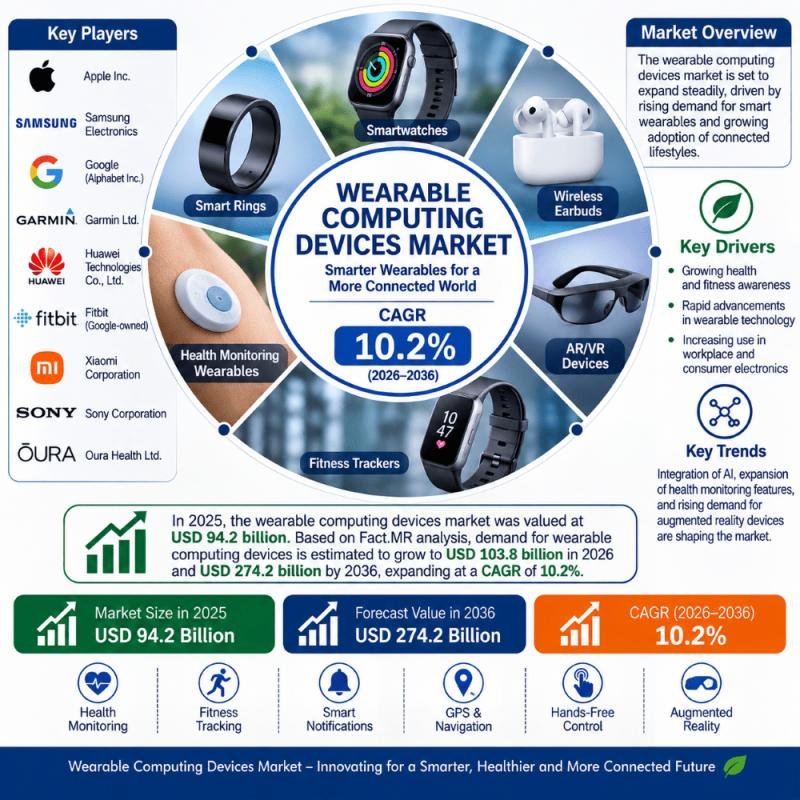
Rockville, MD, November 20, 2026 – The global Wearable Computing Devices market is valued at USD 103.8 billion in 2026 and is projected to reach USD 274.2 billion by 2036, expanding at a 10.2% CAGR from 2026 to 2036, according to Fact.MR. Rising adoption of health monitoring, growing demand for fitness tracking, medical wearable approvals, enterprise augmented reality deployment, and expanding digital health programs are supporting market expansion. Smartwatches remain the leading product category, while fitness and wellness applications account for the largest application share as consumers and enterprises increasingly use wearable devices for continuous monitoring and hands-free computing.
Request a FREE Sample Report: https://www.factmr.com/connectus/sample?flag=S&rep_id=14535
The Short Version
USD 103.8 billion to USD 274.2 billion: The Wearable Computing Devices market is projected to expand at a 10.2% CAGR from 2026 to 2036, supported by consumer health monitoring, digital healthcare, enterprise AR deployment, and continued wearable technology innovation.
64% Smartwatches share: Smartwatches represent the leading product category in 2026, combining health tracking, notifications, payments, fitness monitoring, and smartphone connectivity.
58% Fitness and Wellness share: Fitness and wellness applications account for the largest application segment as consumers increasingly use wearables for activity tracking, heart-rate monitoring, sleep analysis, and personal health management.
9.0% China CAGR: China records the fastest forecast growth among the country markets covered by Fact.MR, followed by the United States at 8.8% and South Korea at 7.8%.
Three Numbers That Matter
USD 274.2 billion by 2036 – The projected market value reflects the expanding role of wearable devices across consumer wellness, clinical monitoring, industrial applications, and hands-free computing.
64% Smartwatch share – Smartwatches dominate the product landscape because they combine multiple functions within a single connected device, including fitness tracking, health monitoring, notifications, payments, and smartphone integration.
9.0% China CAGR – China is projected to record the strongest country-level growth through 2036, supported by smartwatch adoption, Huawei and Xiaomi device expansion, and enterprise AR deployment in manufacturing.
Market Segmentation and Demand Analysis
The Wearable Computing Devices market covers body-worn electronics equipped with sensors, processors, and wireless connectivity. Products include smartwatches, head-mounted displays, smart clothing, ear-worn devices, fitness trackers, body cameras, and exoskeletons used across consumer, healthcare, enterprise, industrial, and defense applications.
By product type, Smartwatches account for approximately 64% of market share in 2026, making them the leading category. Their combination of health monitoring, notifications, payments, fitness functions, and smartphone integration continues to support broad consumer adoption.
Apple Watch, Samsung Galaxy Watch, Huawei, and Xiaomi products are expanding the functionality available through wearable platforms. ECG, sleep monitoring, blood oxygen measurement, temperature sensing, and other biometric capabilities are helping smartwatches move beyond conventional fitness tracking.
By application, Fitness and Wellness accounts for approximately 58% of demand. Activity tracking, heart-rate monitoring, sleep analysis, and wellness coaching remain the main reasons consumers purchase wearable devices.
Medical and Healthcare applications represent another high-value opportunity as regulatory approvals and reimbursement programs enable wearable devices to support clinical monitoring and remote patient care.
Industrial and Defense applications are also expanding. Head-mounted displays can provide hands-free access to instructions, remote assistance, inspection information, and training content, while body-worn systems support worker safety and situational awareness.
Where Growth Is Strongest
China
China’s Wearable Computing Devices market is projected to expand at a 9.0% CAGR from 2026 to 2036, making it the fastest-growing country market covered by Fact.MR.
Smartwatch adoption is being supported by strong domestic brands such as Huawei and Xiaomi, while government-backed Industrial Internet initiatives are encouraging enterprise AR deployment in manufacturing environments.
Huawei Vision Glass and Rokid AR devices are expanding enterprise applications, while Xiaomi is targeting price-sensitive consumers with affordable smartwatch models.
Suppliers that combine competitive pricing with health monitoring, enterprise connectivity, and localized software can strengthen their position in China’s expanding wearable ecosystem.
United States
The U.S. market is projected to grow at an 8.8% CAGR through 2036. Strong consumer adoption, medical wearable approvals, insurance-linked health monitoring, and enterprise AR deployment are supporting demand.
Apple Watch medical features are helping expand the role of smartwatches in health monitoring, while Medicare Advantage wearable benefits are creating additional opportunities for connected health devices.
Enterprise AR deployments are also strengthening demand. Microsoft has delivered HoloLens-based systems for defense applications, demonstrating the potential of head-mounted computing beyond consumer electronics.
Companies that combine regulatory approvals, health platforms, and recurring digital services can benefit from the U.S. market’s high-value demand.
South Korea
South Korea is forecast to expand at a 7.8% CAGR through 2036. Samsung remains a major force in premium wearable health technology through its Galaxy Watch ecosystem and advanced BioActive sensors.
Enterprise AR adoption is also increasing, supported by government digital initiatives and industrial applications. Hyundai has deployed AR smart glasses for manufacturing quality inspection.
Suppliers offering advanced sensors, industrial AR solutions, and integrated health platforms can benefit from South Korea’s technology-intensive market.
United Kingdom
The U.K. Wearable Computing Devices market is projected to grow at a 7.6% CAGR through 2036. NHS digital health initiatives and remote patient monitoring programs are supporting adoption of connected health technologies.
Wearable ECG monitoring, smartwatch health-data integration, and remote monitoring can help healthcare providers track patients outside traditional clinical environments.
Companies that secure UKCA or relevant medical approvals and establish integration with healthcare platforms can benefit from the expanding clinical wearable opportunity.
France
France is projected to expand at a 7.5% CAGR through 2036. Connected health reimbursement programs and EU MDR certification are supporting the adoption of clinical-grade wearable devices.
Withings and other wearable health companies are developing devices with ECG and biometric monitoring capabilities, while enterprise AR is gaining traction in engineering and industrial applications.
Suppliers that combine regulatory compliance with clinical-grade sensors and enterprise software integration can address growing demand.
Germany
Germany is expected to grow at a 7.5% CAGR through 2036. Digital health regulation, DiGA coverage, and industrial AR adoption are supporting market expansion.
Volkswagen has deployed HoloLens 2 and RealWear AR headsets across manufacturing facilities, demonstrating the role of wearable computing in industrial workflows.
Wearable health devices with appropriate medical certification and industrial AR solutions are positioned to benefit from Germany’s technology-focused market.
Japan
Japan’s market is forecast to grow at a 7.0% CAGR through 2036. An ageing population, remote health monitoring requirements, and government digital health initiatives are supporting demand.
Wearable devices that monitor health conditions, detect falls, and support elderly care are gaining importance as healthcare providers seek remote monitoring solutions.
Suppliers that combine long battery life, reliable sensors, and medical-grade monitoring capabilities can address Japan’s ageing-population needs.
Explore the Full Market Research Report: https://www.factmr.com/report/wearable-computing-devices-market
Market Dynamics: Drivers, Trends and Challenges
Growth Drivers
The increasing consumer demand for continuous health monitoring is supporting Wearable Computing Devices market growth. Smartwatches and fitness trackers can continuously collect activity, heart-rate, sleep, and other biometric information.
The expansion of medical wearable applications is another major driver. Regulatory approvals for ECG and sleep-related monitoring are helping selected consumer devices move closer to clinical applications.
Enterprise AR adoption is also increasing demand. Manufacturing, logistics, engineering, defense, and maintenance organizations are deploying head-mounted displays for hands-free workflows, training, inspection, and remote assistance.
The development of digital health reimbursement programs is further expanding opportunities for wearable devices. Insurance and public healthcare programs can improve the commercial viability of clinically useful wearable technologies.
Emerging Trends
The adoption of AI-powered health coaching is emerging as a major market trend. Wearable platforms are increasingly combining biometric data with AI-based analysis to provide personalized activity, sleep, and wellness recommendations.
Another trend is the expansion of clinical-grade smartwatches. ECG, sleep-apnea detection, blood oxygen monitoring, and other health features are allowing selected consumer wearables to enter regulated medical applications.
Industrial AR wearables are also gaining traction. Head-mounted displays can provide workers with real-time instructions, digital overlays, inspection data, and remote expert support without requiring them to stop their physical tasks.
The integration of wearables with healthcare platforms and insurance programs is further increasing the value of collected health data. Companies are developing subscription-based health services around device-generated biometric information.
Miniaturization and sensor development are also expanding wearable functionality. Smaller sensors and improved processing capabilities allow manufacturers to add more health and computing functions without substantially increasing device size.
Challenges and Opportunities
Battery life limitations remain a major challenge. Compact wearable devices must balance sensor activity, processing power, wireless connectivity, display brightness, and battery capacity.
Consumer privacy concerns are also increasing as wearable devices continuously collect biometric and behavioral information. Manufacturers must provide secure data storage, transparent consent mechanisms, and strong cybersecurity.
Healthcare reimbursement fragmentation can slow clinical adoption. Regulatory approval does not automatically translate into reimbursement, creating different commercial pathways across the United States, Europe, Asia, and other regions.
Price competition remains intense in fitness trackers and mid-range smartwatches. Chinese manufacturers are competing aggressively on hardware specifications and pricing, while premium brands differentiate through ecosystem integration and health features.
These challenges create opportunities for suppliers offering longer battery life, advanced sensors, privacy-focused health platforms, regulatory support, AI analytics, and industry-specific AR solutions.
Who Is Moving
The competitive landscape includes consumer electronics companies, wearable specialists, technology platforms, and health-focused device manufacturers. Key companies profiled by Fact.MR include Apple Inc., Samsung Electronics, Google (Alphabet Inc.), Garmin Ltd., Huawei Technologies Co., Ltd., Fitbit (Google-owned), Xiaomi Corporation, Sony Corporation, and Oura Health Ltd.
Apple Inc. leads the premium smartwatch segment through the Apple Watch ecosystem, integrating hardware, software, health data, and the Apple Health platform.
Samsung Electronics competes closely in the Android ecosystem through Galaxy Watch devices, advanced sensors, and integration with Samsung’s broader health platform.
Garmin Ltd. maintains a strong position in sports and outdoor wearables through GPS technology, fitness tracking, and long battery life.
Huawei Technologies Co., Ltd. and Xiaomi Corporation compete strongly in entry and mid-range smartwatch categories, particularly in price-sensitive markets.
Oura Health Ltd. focuses on health-oriented wearable technology through its smart ring platform, while Google and Fitbit combine wearable hardware with health and activity tracking capabilities.
Competition centers on sensor accuracy, ecosystem integration, health platform capabilities, battery life, regulatory approvals, AI functionality, pricing, and software services.
Recent Developments
The Wearable Computing Devices market is increasingly shaped by the convergence of consumer electronics, healthcare technology, artificial intelligence, and enterprise computing.
Apple received FDA clearance for sleep-apnea detection on Apple Watch Series 10, strengthening the role of smartwatches in regulated health monitoring.
Samsung introduced Galaxy Watch 7 and Galaxy Watch Ultra with updated BioActive sensors and advanced health monitoring capabilities.
Garmin expanded its Garmin Health platform and established partnerships with employer wellness programs in Germany, the United Kingdom, and Switzerland.
Oura Health introduced Oura Ring Generation 4 with improved sensing capabilities and expanded integration with health data platforms, including glucose monitoring through its Dexcom partnership.
These developments demonstrate the industry’s transition from basic activity trackers toward connected platforms combining biometric monitoring, AI-driven insights, clinical applications, and digital health services.
Where to Act / Where to Be Careful
Where to Act
Prioritize Smartwatches, which account for approximately 64% of the product segment.
Target Fitness and Wellness, representing approximately 58% of application demand.
Develop medical-grade wearable features supported by appropriate FDA, EU MDR, UKCA, or other regional approvals.
Expand in China, where demand is projected to grow at a 9.0% CAGR.
Explore the United States and South Korea, which are projected to grow at 8.8% and 7.8%, respectively.
Build AI-powered health coaching and personalized wellness platforms.
Develop enterprise AR solutions for manufacturing, logistics, engineering, and defense applications.
Invest in longer-lasting batteries and energy-efficient sensor architectures.
Create recurring revenue through health subscriptions, enterprise software, and digital monitoring services.
Where to Be Careful
Account for privacy and cybersecurity requirements when handling continuous biometric data.
Factor medical-device approval timelines into healthcare wearable development.
Assess reimbursement policies before relying on clinical adoption forecasts.
Avoid competing solely on hardware specifications in price-sensitive smartwatch and fitness tracker segments.
Validate health-related claims through appropriate regulatory pathways.
Consider battery performance and device comfort when adding new sensors and computing functions.
Analyst Perspective
Shambhu Nath Jha, Principal Consultant at Fact.MR, notes that the wearable computing market is moving beyond fitness tracking as healthcare reimbursement, medical approvals, and enterprise AR adoption create new commercial opportunities. The strongest opportunities are emerging where device manufacturers combine reliable sensors with regulated health capabilities, connected platforms, and recurring digital services.
Questions for Your Next Planning Meeting
How quickly will medical approvals convert consumer wearables into reimbursable healthcare tools?
Which wearable category offers the strongest opportunity beyond smartwatches?
How can manufacturers balance continuous biometric monitoring with battery-life requirements?
Should suppliers prioritize China’s 9.0% CAGR opportunity or the higher-value U.S. market?
How can enterprise AR platforms generate recurring revenue beyond hardware sales?
Top Trending Reports
Related Fact.MR Reports:
Time-Sensitive Networking Modules Market https://www.factmr.com/report/time-sensitive-networking-modules-market
C-Band LNB Market https://www.factmr.com/report/c-band-lnb-market
Screen-Free AI Learning Devices Market https://www.factmr.com/report/screen-free-ai-learning-devices-market
Optical Transceiver Modules Market https://www.factmr.com/report/optical-transceiver-modules-market
– Contact Us –
11140 Rockville Pike, Suite 400, Rockville,
MD 20852, United States
Tel: +1 (628) 251-1583 | sales@factmr.com
About Fact.MR
Fact.MR is a market intelligence and business research firm providing market intelligence, competitive analysis and forecasting across global industries. Its research covers market sizing, demand trends, competitive landscapes, and strategic insights to support business and investment decisions.This release was published on openPR.
Permanent link to this press release:
Copy
Please set a link in the press area of your homepage to this press release on openPR. openPR disclaims liability for any content contained in this release.
You can edit or delete your press release Wearable Computing Devices Market to Reach USD 274.2 Billion by 2036 as Health Monitoring and Enterprise AR Adoption Accelerate; China Leads at 9.0% CAGR here
News-ID: 4695340 • Views: …
More Releases from factmr
11-20-2026 | Advertising, Media Consulting, …Factmr
Hydrogen Fuel Cell Control Unit Platforms for Vehicles Market to Reach USD 8.2 B …Rockville, MD, November 20, 2026 – The global Hydrogen Fuel Cell Control Unit Platforms for Vehicles market is valued at USD 1.5 billion in 2026 and is projected to reach USD 8.2 billion by 2036, expanding at a 18.2% CAGR from 2026 to 2036, according to Fact.MR. Rising deployment of hydrogen fuel cell buses and trucks, government-backed hydrogen mobility programs, zero-emission commercial vehicle mandates, and growing demand for integrated electronic…
11-20-2026 | Consumer Goods & RetailFactmr
Jewelry Display Stands Market to Reach USD 1.13 Billion by 2036 as Store Upgrade …Rockville, MD, November 20, 2026 – The global Jewelry Display Stands market is valued at USD 685 million in 2026 and is projected to reach USD 1.13 billion by 2036, expanding at a 5.1% CAGR from 2026 to 2036, according to Fact.MR. Rising store renovation activity, collection-level merchandising, online jewelry selling, exhibition activity, and demand for coordinated retail presentation are supporting market expansion. Necklace and bust stands remain the leading…
11-20-2026 | Chemicals & MaterialsFactmr
High Purity Quartz Sand Market to Reach USD 945.6 Million by 2035, Expanding at …Rockville, MD, November 19, 2026 – The global high purity quartz sand market is projected to increase from USD 651.2 million in 2025 to USD 945.6 million by 2035, expanding at a compound annual growth rate (CAGR) of 3.8% during the forecast period, according to Fact.MR’s industry analysis
Request for PDF Report Sample Pages: https://www.factmr.com/connectus/sample?flag=S&rep_id=699
The Short Version
USD 651.2 million to USD 945.6 million: The market is forecast to expand at…
11-20-2026 | Food & BeverageFactmr
Aquaculture Market to Reach USD 574.6 Billion by 2036 as Global Protein Demand a …Rockville, MD, November 20, 2026 – The global Aquaculture market is valued at USD 342.9 billion in 2026 and is projected to reach USD 574.6 billion by 2036, expanding at a 5.3% CAGR from 2026 to 2036, according to Fact.MR. Rising seafood consumption, limited scope for additional wild-catch production, growing demand for shrimp and salmon, and investment in controlled aquaculture systems are supporting market expansion. Aquaculture feed remains the leading…
All 5 Releases
More Releases for Wearable
11-26-2024 | Fashion, Lifestyle, TrendsVerified Market Research
Wearable Manicure MarketThe “Wearable Manicure Market” is expected to reach USD xx.x billion by 2031, indicating a compound annual growth rate (CAGR) of xx.x percent from 2024 to 2031. The market was valued at USD xx.x billion In 2023.
Growing Demand and Growth Potential in the Global Wearable Manicure Market, 2024-2031
Verified Market Research’s most recent report, “Wearable Manicure Market: Global Industry Trends, Share, Size, Growth, Opportunity and Forecast 2023-2030,” provides an in-depth examination…
08-31-2023 | Business, Economy, Finances, B …Persistence Market Research
Wearable Biosensors Industry: Unveiling Health Insights through Wearable Technol …The wearable biosensors market is predicted to rise to US$ 65,400.2 Million by 2033 from an estimated US$ 29,648.8 Million in 2023. From 2023 to 2033, the market for wearable biosensors is anticipated to expand at a CAGR of 8.2%.
The wearable biosensors market is revolutionizing personalized healthcare by enabling real-time monitoring of health parameters and providing valuable insights for individuals. Wearable biosensors, integrated into devices such as smartwatches, fitness bands,…
03-31-2023 | Business, Economy, Finances, B …Report Ocean
Pet WearableGlobal Pet Wearable Market is valued approximately USD $$ million in 2021 and is anticipated to grow with a healthy growth rate of more than $$ % over the forecast period 2022-2028. The Pet Wearable can be defined as smart wearable devices intended for pets. These devices are utilized for identification and tracking of pets. Pet wearable comprised of different devices such as Smart Collar, Smart Vest, Smart Harness, and…
07-01-2021 | Health & MedicineTransparency Market Research
Wearable Injectors Market | On-body Wearable Injectors, Off-body Wearable Inject …A report by Transparency Market Research (TMR) throws light on the key dynamics operating within the global market for wearable injectors. The competitive landscape of the global market for wearable injectors has witnessed the entry of several newbie players over the past decade. This abrupt influx of new vendors can be attributed to the large market gap and lucrative growth opportunities floating in the global wearable injectors market. In order…
02-09-2019 | Health & MedicineResearch N Reports
WEARABLE TECHNOLOGY REVOLUTION IN THE HEALTHCARE INDUSTRY BY DEVICES (WEARABLE M …The various scientific advancements are constantly transforming the healthcare industry to improve patient care and diagnosis. The advent of smart wearable technology is modifying the healthcare industry in the form of wearable medical devices. Let’s take a look at some of the most trending gadgets that are enhancing the lives of patients using this user-friendly wearable technology:
Biopatches, Bands, and Phone Pads for Heart Rate Monitoring:
Biopatches are lightweight, wireless diagnostic wearable…
08-28-2018 | Advertising, Media Consulting, …MarketResearchReports.biz
Wearable Electronic Devices Market,Wearable Electronic Devices Industry, Global …Latest industry research report on: Global Wearable Electronic Devices Market : Industry Size, Share, Research, Reviews, Analysis, Strategies, Demand, Growth, Segmentation, Parameters, Forecasts
This report studies the global Wearable Electronic Devices market status and forecast, categorizes the global Wearable Electronic Devices market size (value & volume) by manufacturers, type, application, and region. This report focuses on the top manufacturers in United States, Europe, China, Japan, South Korea and Taiwan and other…
