


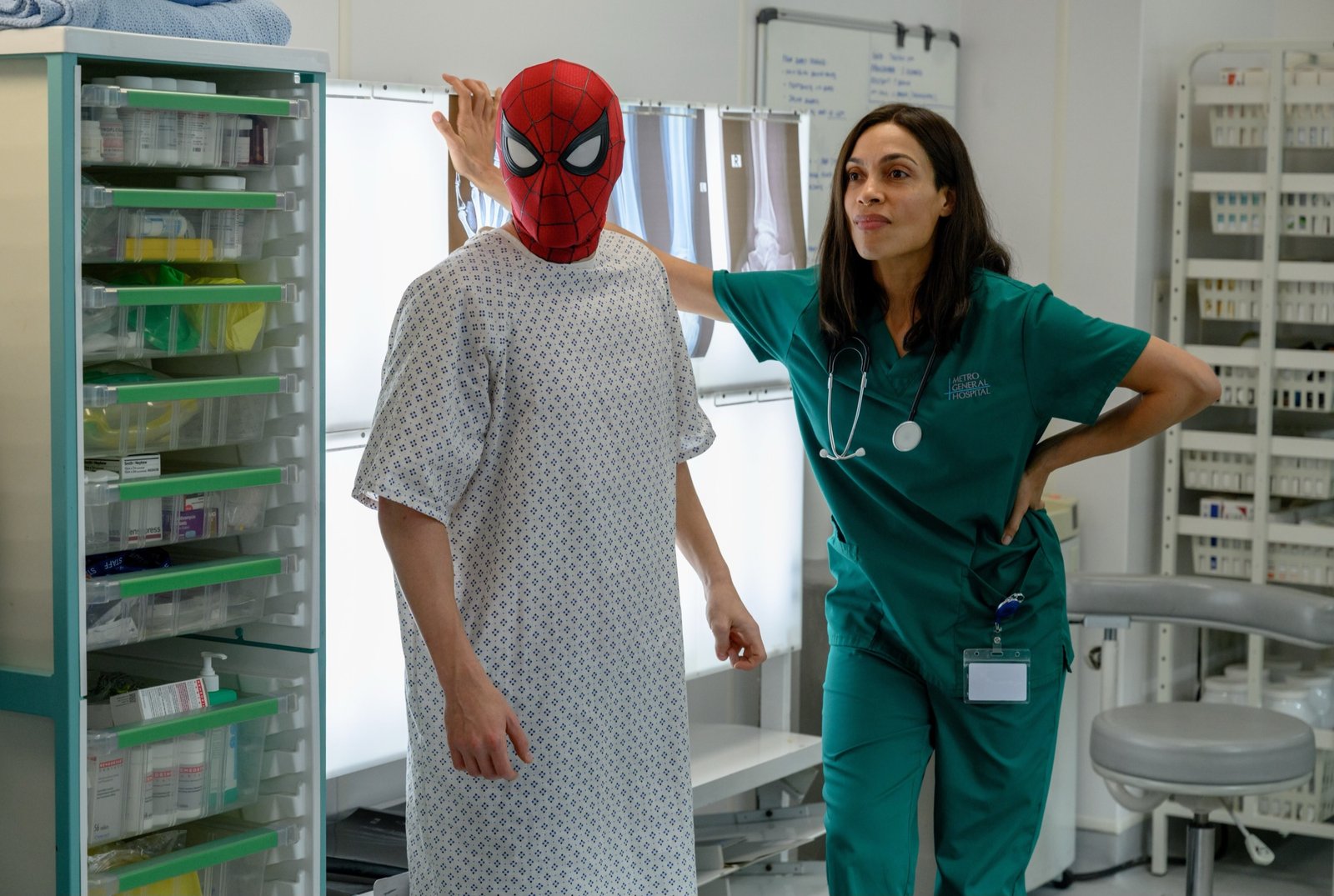
Rosario Dawson posted the first official image of her restored Claire Temple scene on Thursday, Nov. 19, previewing the Dec. 4 extended cut of Spider-Man: [Brand New] Brand New Day, whose tickets went on sale that day. The restoration matters beyond Marvel continuity: US law binds a nurse like Claire to confidentiality duties it generally does not impose on a wearable AI like E.V., the assistant Peter builds to monitor his biosignals.
Anyone who wears a fitness tracker, a smart ring or an AI health feature can borrow the test applied here: ask who receives the data and under what duty. Privacy scholar Helen Nissenbaum’s framework of contextual integrity supplies that test
Dawson’s Instagram Post Confirms Claire Temple Returns in Restored Hospital Scene
Dawson wrote that it is “a brand new BRAND NEW DAY with our friendly neighborhood Spider-Man!”
The scene is a restoration. Dawson told fans at GalaxyCon Raleigh in July that she shot a scene but was cut. TheWrap reported that the scene had Claire helping Peter Parker in a hospital, while writers Chris McKenna and Erik Sommers have since described the scene’s placement differently, so accounts of what it contains differ
Sony announced the extended cut Nov. 16 with “new scenes and a couple more surprises.” Reports put the added footage at seven minutes to 10 minutes of footage, but Sony has not published a runtime or said where the Claire Temple scene falls, so this analysis treats its content as unconfirmed beyond the hospital setting
Nissenbaum’s Contextual Integrity Says Claire’s Hospital and E.V.’s Sensor Feed Follow Different Rules
Nissenbaum argued in a 2004 Washington Law Review article that privacy is appropriate information flow, not secrecy: a flow is appropriate when it fits the norms of the context where it arises. Her later framework describes each flow with five parameters, as Wikipedia describes them: the data subject, the sender, the recipient, the type of information and the transmission principle that governs the exchange.
Medical settings fit the framework cleanly. A patient shares details of her condition with a clinician, the flow is not reciprocal, and the clinician’s duty of confidentiality is long settled. In Claire’s scene the subject is Peter, the recipient is a nurse, the information is clinical, and the transmission principle is confidentiality
The nursing profession writes that principle down. The American Nurses Association’s Code of Ethics, in Provision 3.1 on confidentiality, defines confidentiality as nondisclosure of personal information communicated within the nurse-patient relationship. The same provision allows disclosure of information relevant to clinical care for continuity of care under defined protocols, and it acknowledges that some state laws mandate reporting. Claire’s duty is strong, but it is not absolute.
E.V. is a different kind of recipient. In the film E.V. is an AI Peter built himself, voiced by Naomi Watts. This comparison therefore concerns a real-world product like E.V., not the film’s plot: for such a product, the recipient is a company and the transmission principle is its terms of service
Does HIPAA Protect Data From Wearable AI Like E.V.?
Generally not. HIPAA’s Privacy Rule governs covered entities and business associates: health plans, clearinghouses and providers that transmit health data electronically, along with their contractors. Consumer wearable makers are generally outside that group, a gap TechTimes has documented for fitness trackers and for consumer AI health products
Other rules fill part of the gap. The Federal Trade Commission’s amended Health Breach Notification Rule covers health apps outside HIPAA, requiring notice when health data is disclosed without permission; the commission approved it 3-2, with two commissioners arguing it exceeds the agency’s authority. Its first enforcement action produced a $1.5 million civil penalty against GoodRx in February 2023; GoodRx said it did not agree with the allegations and admitted no wrongdoing. Washington’s My Health My Data Act, in effect since March 31, 2024, lets consumers sue.
Marks’s Emergent Medical Data Names What AI Like E.V. Infers From Peter’s Biosignals
Health-law scholar Mason Marks defines emergent medical data as health information that artificial intelligence infers from ordinary digital traces. He argues it is typically not covered by HIPAA, which creates a regulatory gap, and he cites Facebook’s suicide-risk flags that sometimes prompted police wellness checks
A real E.V. would sit squarely in that territory. TechTimes’s earlier analysis lists biosignal monitoring among E.V.’s tasks, and any system that reads a body continuously can infer conditions its owner never reported
The regulatory frame has begun to absorb the idea. The FTC’s amended rule counts “emergent health data” within the health information it covers, such as information inferred from location data and health-related purchases. Marks’s options for responses include banning or restricting trace collection, regulating the mining algorithms and restricting how the data can be used once produced
Night Nurse Has Real Counterparts: Jim Withers Began Street Medicine With Night Calls in Pittsburgh
Night Nurse began as a four-issue Marvel comic that ran from November 1972 to May 1973, created by Jean Thomas and Win Mortimer as a medical drama with no superheroes. Linda Carter later returned in Daredevil #58 in 2004, treating injured heroes off the books. Claire Temple is a composite of the two characters, and she appeared in every series of Marvel’s Netflix shows except The Punisher, linking them.
The real-world version started in 1992, when Dr. Jim Withers began making house calls under bridges in Pittsburgh, sometimes dressing as a homeless person to earn trust. His Operation Safety Net grew with support from Mercy Hospital, and the Street Medicine Institute, founded in 2009 according to its own history, now helps communities build programs worldwide
Evidence of benefit is arriving. A UCLA study in the Journal of General Internal Medicine followed nearly 900 unhoused adults and found the share with controlled blood pressure rose from 35% to 45%, though the study had no comparison group and cannot firmly attribute the gain to the program. Withers’s model rests on trust, which is what contextual integrity predicts will matter when patients decide what to disclose.
When the extended cut opens Dec. 4, viewers will see how Sony stages a nurse and a patient in a hospital. The more durable lesson sits outside the theater: a nurse’s confidentiality is an institution with written ethics and legal limits, while an AI assistant’s data flow is a product with terms. Before enabling any wearable or AI health feature, ask which of those regimes holds your data, who the recipient is, and what duty governs what it does next.
Frequently Asked Questions
What is contextual integrity, and how does it apply to health data?
Contextual integrity is Helen Nissenbaum’s theory that privacy means information flowing in ways that match the norms of its context. Applied to health data, it asks who the subject, sender and recipient are and what principle governs the transfer, so the same heartbeat reading can be appropriate in a clinic and inappropriate in an advertising pipeline, as Nissenbaum’s 2004 article frames it
Does HIPAA protect health data collected by wearables and AI assistants?
Generally not, because HIPAA attaches to covered entities and their business associates rather than to the data itself. The FTC’s Health Breach Notification Rule and state laws such as Washington’s My Health My Data Act cover some of the gap, mostly through breach notice and consent
When does the Spider-Man: Brand New Day extended cut open, and what is new?
It opens in theaters Dec. 4, and tickets went on sale Nov. 19 Sony promises new scenes and “a couple more surprises,” including Dawson’s restored Claire Temple scene, but it has not published a runtime or a full list of additions
Is Rosario Dawson in the original Spider-Man: Brand New Day?
No. Her scene was cut from the version released July 31, and the extended cut restores it, as Dawson’s own account describes
ⓒ 2026 TECHTIMES.com All rights reserved. Do not reproduce without permission
Tags:Spider-ManPrivacyWearablesFTC
