


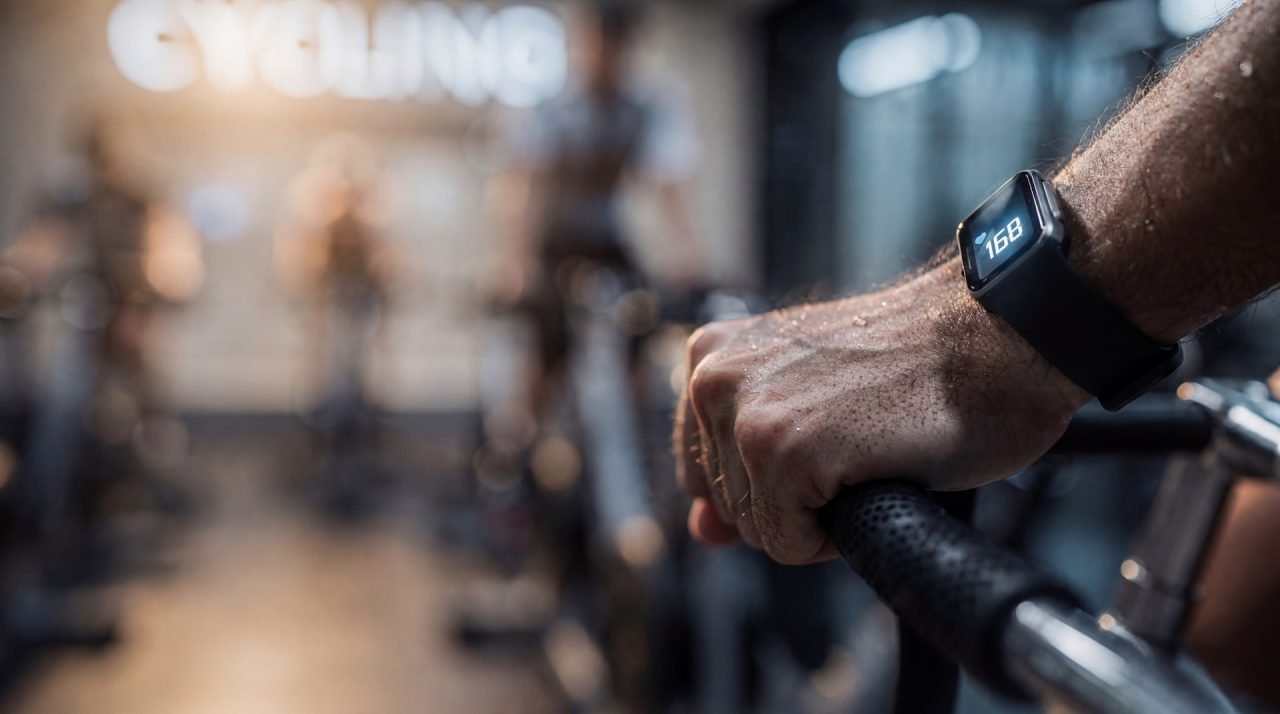
Three minutes after completing a high-intensity indoor cycling workout, the man collapsed. His wife heard the fall from another room and rushed in to find him unconscious, without a pulse. A physician, she immediately started CPR and used his smartwatch to call 911. The emergency medical team that arrived shortly thereafter confirmed ventricular fibrillation, a lethal heart rhythm. Despite nearly 40 minutes of advanced cardiac care including defibrillation shocks, they could not restart his heart.
The patient’s case is the subject of a new study from Stanford Medicine researchers. It’s one of the most extensive individual profiles ever gathered from wearable device data, which revealed a dramatic change in the patient’s overall health months prior to his death. Besides his smartwatch, the patient also wore a smart ring, and his exercise bike had recorded seven years’ worth of data over 530 sessions.
The patient’s wife provided this wealth of information to the researchers because of the highly personal and relevant nature of the case: Her husband was studying wearable devices and longevity and was collaborating with Michael Snyder, PhD, the senior author of the paper
“The patient was a close colleague, and his family entrusted us with his data,”said Snyder, the Stanford W. Ascherman, MD, FACS Professor in Genetics and the director of the Stanford Center for Genomics and Personalized Medicine. “We felt a deep obligation to find the root causes of his death.”
The researchers discovered comprehensive and almost simultaneous deterioration in the patient’s health in a range of metrics, including gait, resting heart rate, heart rate variability, sleep patterns and breathing rate. The findings suggest that had this data been made available to clinicians, it could have prompted earlier evaluation and appropriate treatment and led the patient to change his habits — for example by exercising less strenuously.
Michael Snyder
“There were multiple strong indicators that something was off. Where the system needs improvement is in relaying that information,” Snyder said. “Clearly that’s the lesson of the story — we can do health tracking, but we also need an alert system, something like a check-engine light for your health.”
“The promise here is that if wearables can detect these changes in advance of serious events, we can save people’s lives,” said Ziv Lautman, PhD, lead author of the study, who earned a degree in bioengineering in Snyder’s lab and is now a lecturer at Stanford Medicine
Wearables to tackle heart disease?
The researchers plan to conduct a clinical trial to see if other people who use wearable technology to track their health show the kinds of unnoticed warning signs that their colleague did. The need for improved monitoring of this sort, leading to earlier interventions, is particularly acute. Heart disease is the leading cause of death globally: Every 34 seconds in the United States, someone dies from the condition, according to the Centers for Disease Control and Prevention and the American Heart Association. That’s nearly 2,500 deaths a day, which is more than cancer and accidents combined. Of those fatalities, about 1,000 are cardiac arrests, with the vast majority resulting in the so-called sudden cardiac death that struck down the researcher’s colleague.
Ziv Lautman
“Most of those deaths still arrive without warning,” Snyder said. “This case suggests that a critical alert may already be sitting in the data on people’s wrists.”
Millions of Americans use wearable devices, with a recent study showing use among U.S. adults surging from around 30% in 2020 to over 40% by 2024. The same research also reveals that only about 20% of users share data with their physicians
On the clinician side, a recent survey finds that 86% of U.S. physicians reported reviewing at least one type of wearable patient data and that a similar percentage think that having such information can improve patient care. But only about 6% said they have incorporated reports about patient wearables into their clinical workflows
“Wearables have become extremely powerful medical devices, but they’re not connected yet to physicians,” Lautman said. “We’re hoping our study can help make the case for integrating patient wearable data into the clinic. Doing so might have saved our colleague.”
What the wearables captured
Although the patient in question was not young — he died at 76 — he was active and healthy in appearance. Accordingly, his death in March 2025 came as a surprise to all of those who knew him
“He was a super nice guy, very fit, very sociable,” Lautman said. “Everybody loved him. I worked closely with him for more than two years.”
Through medical records the family provided going back to 2018, the researchers learned the patient had developed structural heart disease, which is characterized by abnormalities in the physical architecture of the heart muscle. It’s a lesser-known and less common kind of heart disease compared with coronary heart disease, where plaque builds up in the heart’s blood vessels
In examining the patient’s wearables data and exercise bike logs, the researchers found what they refer to as a “coordinated step-change,” with most of the significant alterations in health data clustering approximately five months prior to his death
Those alterations included a halving of heart rate variability, a measure of the variation in time between heartbeats, with lower variability associated with lack of sleep, stress and heart conditions overall. The patient’s resting and nocturnal heart rate also increased, an indication of the heart having to overwork itself when it should be resting
He showed a decline in deep sleep, a metric wearables pick up by tracking heart rate and breathing patterns. Another metric showing a decrease was in six-minute walk distance data, which tracks the maximum distance someone can cover when walking on a flat surface in six minutes. This is inferred through wearable data including step counting, stride length, acceleration and pace, and is considered a reflection of the ability to perform everyday tasks.
“We observed the deterioration of our colleague’s data in late 2024,” Lautman said. “Rather than gradual, it was an abrupt, synchronized shift across interdependent physiological systems that was captured by two independent wearable devices.”
At the peak of the captured deterioration, the patient had reported feeling fatigued, prompting a primary care visit that detected a heart murmur — a whooshing sound heard prompted an echocardiograph, which documented advanced structural heart disease in early November 2024
The patient continued exercising often and vigorously on his indoor bike amid the hidden worsening signs. For example, the night before he died, his average heart rate reached one of the highest measured points — and, more importantly, it had been consistently climbing since the step-change event five months earlier. Then, on the evening of his death, according to data from his wearables and exercise bike, the patient engaged in one of his most intense workouts on record. His heart rate reached 150 beats per minute, exceeding age-based recommendations.

Healthy habits for your 60s, 70s & beyond
Healthy habits for your 20s & 30s

Healthy habits for your 40s & 50s
- 8
- 9
- 2
“The whole idea is that these devices can tell us, ‘Hey, you’re pushing yourself too much,’” Lautman said
“Had the step change from his wearables been apparent to him, maybe he would have not worked out as intensely, given that things didn’t seem quite normal,” Snyder said. “We feel that integrating digital physiology monitoring into traditional cardiology could help clinicians provide far more timely evaluations and interventions.”
Snyder has long been a proponent of people taking a more active role in their health and well-being through wearable biosensors. In 2012 he discovered the onset of his own Type 2 diabetes through a self-analysis that relied on capturing billions of bits of data including his complete set of genes, expressed proteins, metabolites and more. Snyder subsequently diagnosed his own early-stage Lyme disease in 2015 with the aid of wearables. “We should be able to make much more accurate health recommendation systems with wearables data,” Snyder said.
A trial to help others live longer
For their clinical trial, Lautman, Snyder and others at Stanford Medicine hope to recruit up to 1,000 patients, including some with retrospective wearables data and not just prospective data, to look for similarly dire signals ahead of major cardiovascular events, or — if caught early — before such events come to pass
“By running this trial and connecting the dots, we expect that some people will already show resting heart rate increases, that their gait is deteriorating, that their sleep is changing, that their mobility is lessening and that these shifts can all happen pretty much simultaneously,” Lautman said. “If we can broadly capture these changes, that could be a game changer because most of the cardiac events that can follow are preventable with modern treatments.”
Snyder and Lautman hope that analyzing their colleague’s data could help preserve life for countless others and their families
“We want to learn from it,” Snyder said. “His wife wants us to learn from it. She wants and we want the world to learn from it.”

INSIGHTS: Going beyond the headlines
Sharing the informed perspectives of those leading medical research, patient care and education at Stanford Medicine

The science of addiction

Seed oils: What should you know

Sunscreen fact & fiction

Kids, teens and antidepressants

The science behind sunscreen

Understanding the gut-brain connection
- Insights
- 8
- 9
- 2
- 3
- 4
- 5
