
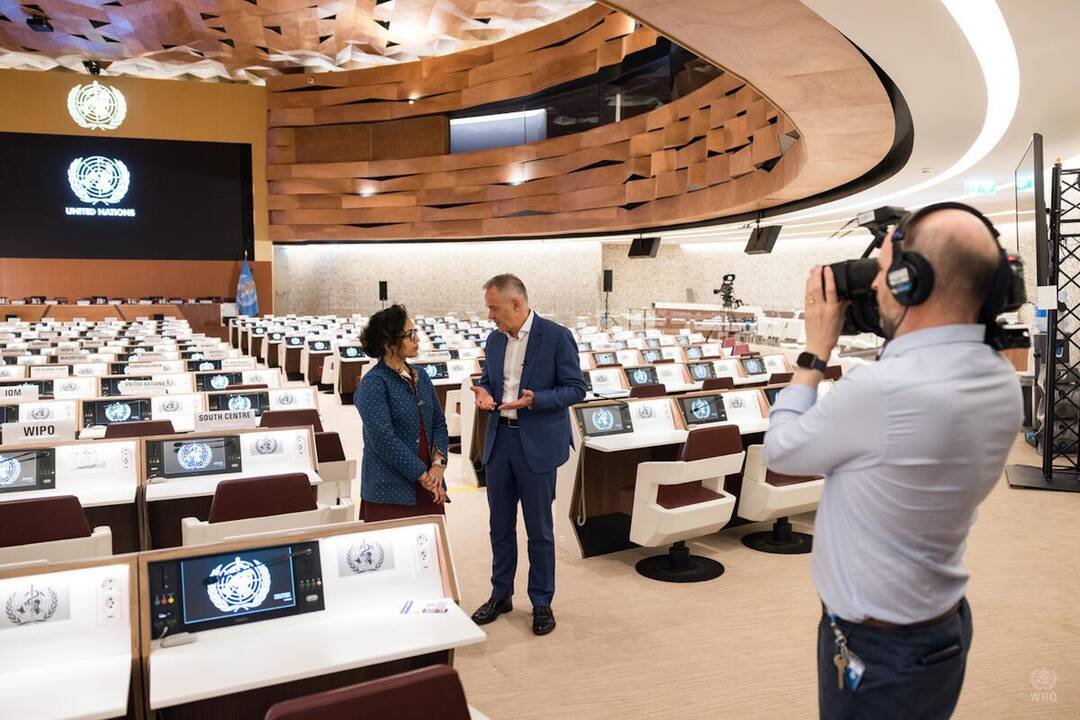

A year after the United States announced its departure from the World Health Organization and funding from Washington and other major donors dropped, assistant director general Jeremy Farrar speaks about the painful decisions the UN agency was forced to make, and its move to refocus on its core mandate
Having assumed his role to lead WHO’s health promotion, disease prevention and control division, Farrar, former head of the Wellcome Trust, one of the world’s biggest charities, became a key voice in the organisation’s overhaul. His appointment in 2025 was itself part of a senior management shakeup, when the number of divisions was reduced from 10 to four
By June, the WHO says 2,400 jobs will have been cut at the agency, of which over 800 in Geneva. But beyond the organisation, the financial cuts and withdrawal of the US are expected to be felt far afield, as the sharing of scientific expertise is disrupted and emergency assistance reduced
Le Temps: Where does WHO stand today in terms of reforms?
Jeremy Farrar: 2025 was a very difficult year. When you imagine any organisation — public or private — reducing its workforce by 30 per cent, it is extremely painful. Many institutions usually do this gradually: 10 per cent one year, another 10 per cent the next. Doing it all in a single year was awful, and the organisation lost many good people. Human re
During Covid, however, the emergency programme grew considerably.
Yes, the emergency programme expanded the most because of the Ebola outbreak in 2014 and Covid. But many other areas also grew. We therefore needed to get smaller. We need to refocus on our core mandate at the heart of the global health system: our work on norms and standards, coordination, technical support, and assistance to countries
How do you see the evolution of the global health ecosystem in Geneva with Gavi, the Vaccine Alliance and the Global Fund to Fight AIDS, Tuberculosis and Malaria?
We need to ask what each organisation’s comparative advantage is, because resources are limited. No single organisation can do everything. The Global Fund has enormous strengths in procurement — purchasing medicines, diagnostics, and many other products — and it has very strong links with civil society. We do not need to replicate that. Our role is to advise the Global Fund on the best treatments and the best diagnostic tests.
What impact will the US withdrawal have?
We should never underestimate the potential loss of expertise. The United States has been a scientific powerhouse for decades and has been incredibly generous through institutions such as the Centers for Disease Control and Prevention, the National Institutes of Health, and the Food and Drug Administration. I sincerely hope it will still be possible to encourage US agencies, universities, and public institutions to continue working with WHO. At the same time, this withdrawal also creates an opportunity for experts from other regions of the world to make their voices heard.
Has WHO been strategic enough in its reforms? Some in Geneva doubt it.
I participated in the architectural overhaul and organisational redesign of WHO. It is far from perfect, but the reform we have undertaken is as strategic as possible to ensure the organisation is better adapted to the health challenges of the next 20 years. There has been a significant reduction in senior management positions in order to preserve technical and scientific expertise
Will WHO remain a normative power?
This function must not only be preserved but strengthened. At this particular moment in history, marked by so much disinformation, it is absolutely essential that the organisation’s future remains that of a technical and scientific agency. If we lose sight of the quality of scientific evidence, we will lose the trust of member states
In recent years, health has no longer been the sole responsibility of health ministries. Is this lasting progress?
Health represents a major share of every country’s budget. In the United States, for example, it accounts for around 18 per cent of GDP. In poorer economies, the budgetary burden of financing health systems is also very high. But without health, there can be no economic growth. We saw this during the Covid pandemic: when health concerns took precedence and industries shut down, the economic consequences were immediate. Moreover, the determinants of health go far beyond the health sector. They also depend on taxation, education, transport, air quality, and policies such as regulations on diesel or petrol use in cars.
This article was originally published in French in Le Temps. It has been adapted and translated into English by Geneva Solutions. Articles from third-party websites are not licensed under Creative Commons and cannot be republished without the media’s consent
