


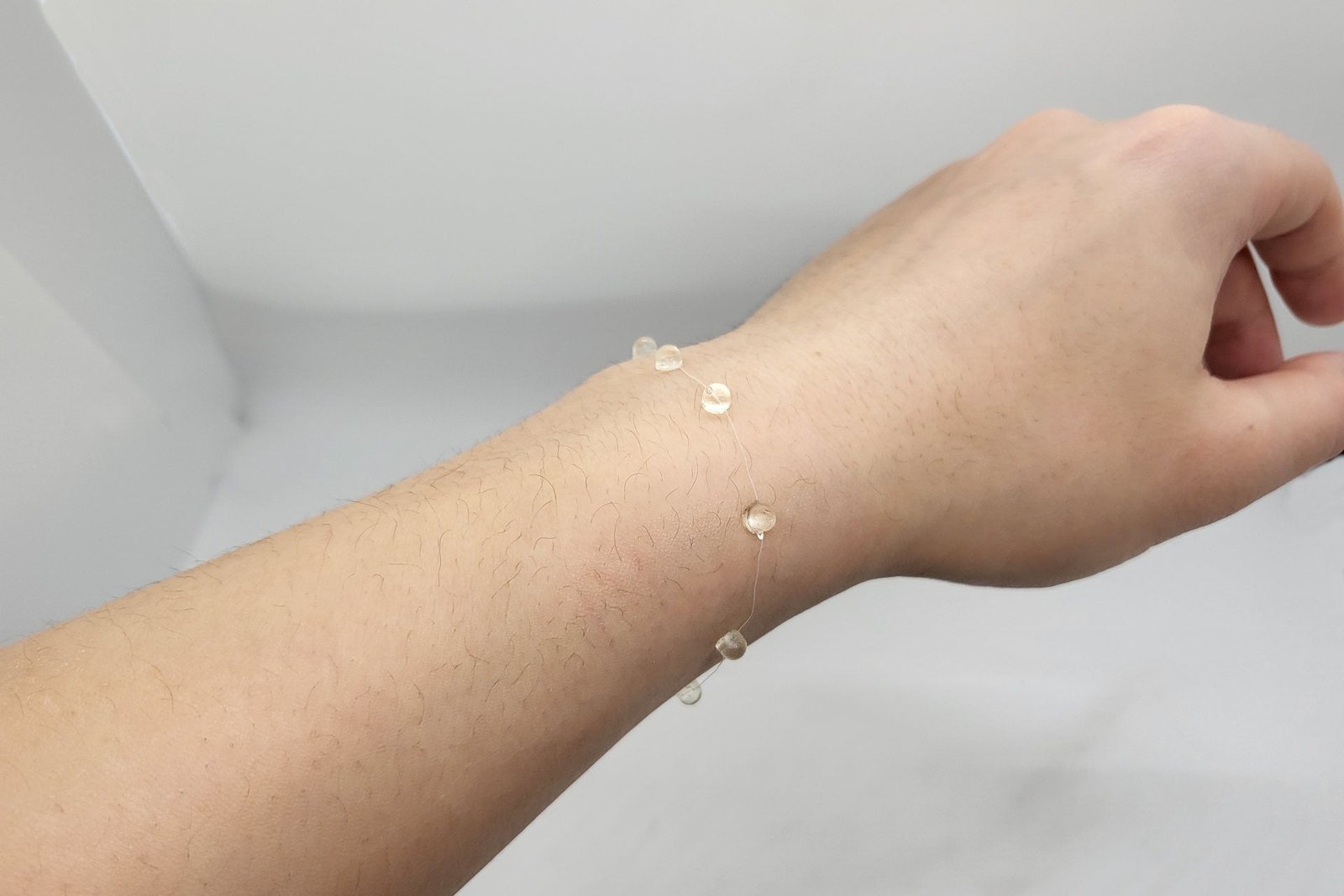
Flexible organic eutectogel transistors arranged in a complete thread-based circuit. The free-form circuits can easily conform to body contours to monitor health and movement.
Photo: Wenxin Zeng
Biomedical Science
And You Thought a Smart Ring Was Discreet
Imagine using a wearable device that is so thin and discreet that you’d hardly be aware that you were wearing it. Now Tufts engineers have created flexible electronics that could do just that. Made of thread-based integrated circuits that can bend, coil, stretch, and conform to the body’s contours and movements, the devices are designed to exist in free form, sewn into clothing or wrapped around curved and moveable surfaces.
These kinds of devices worn on the body or adhered to the skin could potentially track a wide range of biomarkers or environmental conditions, while AI-driven applications could synthesize the resulting data into useful insights for fitness, healthcare, and recovery from injury or disease
To accomplish this, Sameer Sonkusale, Jon A. Levy School of Engineering Professor, and his colleagues, includingMatt Panzer, E Ink Professor of Engineering, created each of the components of complex integrated circuits—from transistors to sensors—in the form of threads. The devices are described in the journalApplied Materials and Interfaces
Wearable devices like smartwatches and smart rings are popular—more than a third of U.S. adults use them—and many offer health tracking. Thread-based integrated circuits could help make wearable health monitors more comfortable and discreet, incorporated into clothing, soft interfaces, or skin-contacting threads that move naturally with the body.
Other health-related applications could be sutures to track wound healing or monitoring for movement indicators of cognitive decline, fall risk for the elderly, and breathing in infants
“They will be soft, stretchable and able to follow the body’s shape rather than forcing the body to accommodate the device.”
“By moving electronics from planar patches to free-form threads, we have opened a path toward wearable bioelectronics that are more like fibers than hardware,” said Sonkusale. “They will be soft, stretchable and able to follow the body’s shape rather than forcing the body to accommodate the device. They could even potentially be used like sutures to monitor processes inside the body.”
The researchers demonstrated circuits capable of amplifying signals from sensitive sensors, and as a proof-of-concept for wearable monitoring, they created a device that can be placed on the temple to detect blinking, and another device near the diaphragm to detect changes in breathing patterns and rates. These demonstrations suggest that the technology could one day support soft wearable systems for monitoring health, stress, and other conditions.
“The technology platform is still in early stages,” said Wenxin Zeng, Ph.D. candidate in electrical engineering at Tufts and lead author of the study, “but we expect to improve the speed and precision of fabrication, and the ability of the thread-based integrated circuits to carry out more complex functions.”
Transformative Materials
Running throughout the device circuit are thin threads coated with gold. Tiny and entirely flexible transistors—the basis of any digital device—are attached to the thread, which includes a conducting plastic-like material that bridges the gold thread leading into and out of the transistor. The flow of electrons at the transistor can be turned on and off like a spigot, depending on a second current that controls a “gate,” which acts like a valve.
An important innovation making the thread devices possible is something called a eutectogel. The gel can help create a gap, less than a millimeter, between two ends of the electronic thread where the flow of electrons can be controlled, whether in a thread-based resistor, capacitor, sensor or other component. Others have used hydrogels to connect the wires, which can dry up. In contrast, the eutectogel is stable, soft, and compatible with being in contact on or in the body.
The eutectogel also gives the transistor a “self-repair” capability. If the gel breaks, the researchers showed that bringing the pieces back together and applying gentle heat can restore its mechanical and electrical function. The thread itself is not repairable if cut, but the gel components can be rejoined
Unlike traditional integrated circuits that require photolithography—depositing patterned layers of material on a surface—or high temperature processing, no clean room is needed in their fabrication, making the approach more compatible with soft polymers and textile-like materials and making possible development with low-cost manufacturing
