
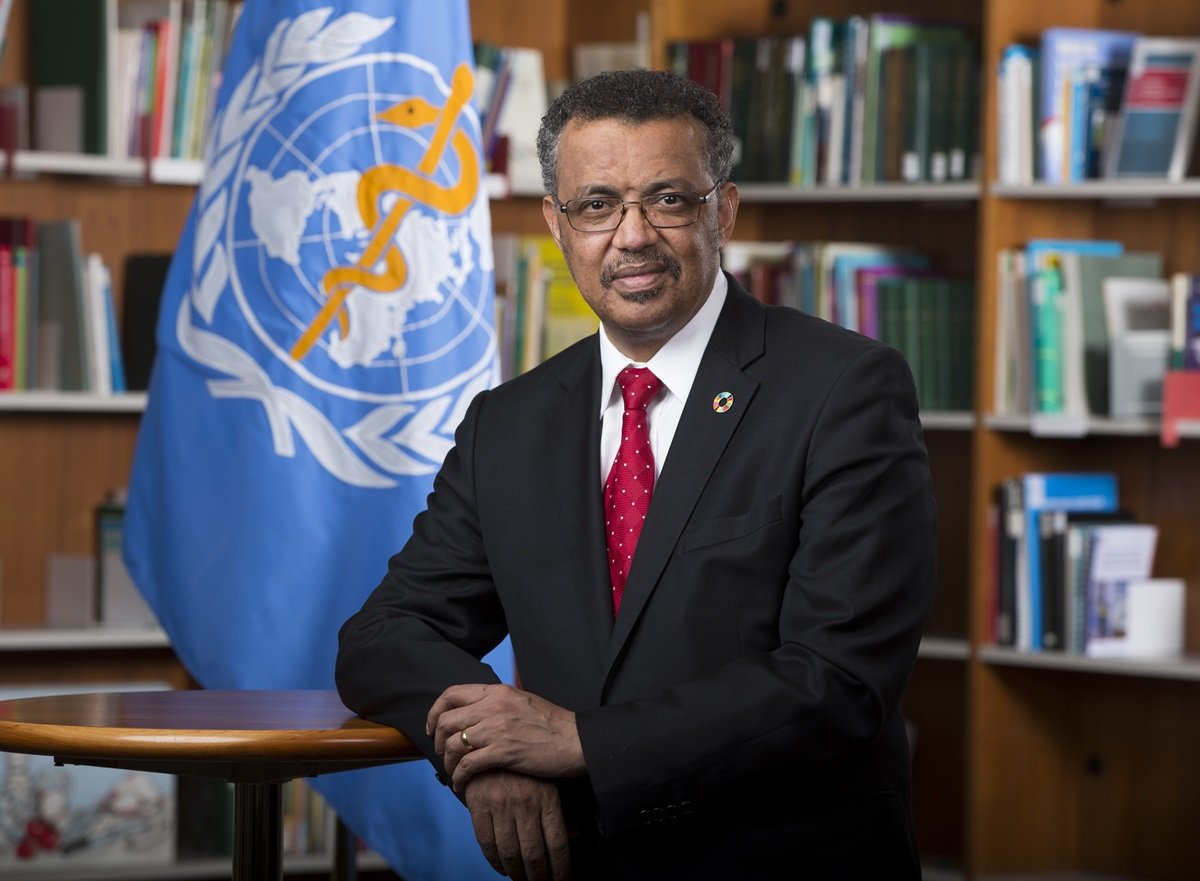
Honourable President of the World Health Assembly, Dr Victor Atallah
Excellencies, Honourable ministers, dear colleagues and friends
Mr President, I offer my deep gratitude for your leadership of the 79th World Health Assembly
I have very much appreciated the way you have led this Health Assembly with wisdom, a steady hand, good grace, a dose of humour and Dominican style
It gives me great pleasure to present you with the ceremonial gavel as a token of our appreciation. Thank you once again for your leadership
[THE DIRECTOR-GENERAL PRESENTED MINISTER ATALLAH WITH THE CEREMONIAL GAVEL]
I would also like to offer my sincere thanks to the Chairs of Committees A and B:
First, Dr Timur Sultangaziyev, the First Deputy Minister of Health of Kazakhstan, for your leadership as Chair of Committee A
You managed a large agenda reflecting the huge range of WHO’s work
I invite you to come forward to receive the ceremonial gavel as a token of our appreciation. Thank you again for your leadership. Rakhmet
[THE DIRECTOR-GENERAL PRESENTED DR SULTANGAZIYEV WITH THE CEREMONIAL GAVEL]
Second, I thank Honourable Mintah Akandoh, Minister of Health of Ghana, for your leadership as Chair of Committee B
You also managed a very large and diverse agenda, covering a range of important technical, political and administrative issues
I invite you to come forward to receive the ceremonial gavel as a token of our appreciation. Thank you again for your leadership
[THE DIRECTOR-GENERAL PRESENTED MINISTER AKANDOH WITH THE CEREMONIAL GAVEL]
I would also like to use this opportunity to thank the EB Chair Mr Blair Comley of Australia and the PBAC Chair, Dr Aspect Maunganidze of Zimbabwe
Please join me once again in thanking everyone who has contributed to the success of this Assembly
Mr President, Excellencies, dear colleagues and friends
We have come to the close of this year’s World Health Assembly
As always, it has been a demanding week, with long days and difficult negotiations
I would especially like to thank President Mahama of Ghana and Prime Minister Sánchez of Spain for honouring us with their presence this week
I also thank President Al-Sharaa of Syria, Prime Minister Mottley of Barbados and UN Secretary-General António Guterres for the video messages they sent
At the President’s reception on Tuesday night, I used a Dominican expression I learned this week:
De poquito a poquito se llega lejos
Mr President, I hope you will forgive my pronunciation, but I have a daughter who speaks excellent Spanish
It means step by step, you go far
That’s what the World Health Assembly is about
We haven’t solved every problem this week. That’s not the point
But on each one, we have taken a step forward.
You have adopted resolutions and decisions on key health issues:
Diagnostic imaging; emergency, critical and operative care; haemophilia and other bleeding disorders; NTDs; pharmacovigilance; precision medicine; radiation; steatotic liver disease; stroke; transplantation; tuberculosis – and more
You also agreed to reform the global health architecture through a Member State-led, WHO-hosted joint process
As President Mahama said in his address on Monday, “We are witnessing the end of an era, and we must have the courage to build the next one. An order defined by agency, not aid, and by partnership, not paternalism.”
Every resolution you adopt, every agreement you reach, only has value when it changes what happens in a clinic, in a community, or in a household;
When a health worker has what they need to do their job; when a child is vaccinated;
When a mother survives childbirth; when an outbreak is contained before it spreads
That is now the task before us
What has been agreed here must be implemented, country by country, system by system
It will require political commitment, sustained financing, and continued cooperation between Member States, partners and communities
This Assembly has shown that progress is still possible, even when the wider context is difficult
You have met this week against a backdrop of outbreaks, conflict, division, uncertainty and constrained re
That is exactly the point of multilateralism: not to pretend the difficulties of our world are not there, but to address them together;
Not to erase divisions, but to transcend them;
Not to supercede national sovereignty, but to reinforce it
Because every nation is healthier and safer when all nations are healthier and safer
Many of you represent countries under immense pressure. And yet, throughout this week, you have found ways to work through differences, and to reach common decisions
That is not automatic. It is a choice:
A choice to prioritize health;
A choice to recognise that no country can address today’s health challenges alone;
A choice to work through WHO, not only as an institution, but as a shared platform for shared action
I thank you for that choice
And I thank all delegations – ambassadors, ministers, negotiators, technical experts and support teams – for the preparation and discipline that made this week possible
Behind every intervention, every draft, every compromise, there has been a great deal of work. I’m so proud to witness that
That work is often not visible, but it is essential
I would also like to acknowledge my WHO colleagues, whose expertise and dedication underpin everything this Organization does;
From supporting this Assembly in Geneva, to fighting hantavirus and Ebola on the ground, and to strengthening the foundations of health systems in so many of your countries
For the women and men all around the world, who like me are proud to be WHO, I ask you to show your appreciation
===
Mr President, Excellencies, dear colleagues and friends
As you return home, the real work resumes: translating global agreements into national policies, aligning reeach those who need them most
The Secretariat stands ready to support you in that work
Although the work of this Health Assembly is ending, there is still one outstanding agenda item that demands your full attention. I know you guess what that is: finalizing the PABS annex
Four and a half years ago, you committed to negotiating a landmark international agreement, based on the painful lessons the COVID-19 pandemic taught us
The adoption of the Pandemic Agreement last year was a monumental achievement. It was a proud moment
But without the PABS annex, the world is not truly ready for the next pandemic
The current outbreaks of Ebola and hantavirus remind us why the world needs the Pandemic Agreement;
And why the task of finalizing the PABS annex – the last piece of the puzzle – is so urgent
The coming months are the time to bring all of your hard work to fruition
I know there are obstacles to overcome, but I have every confidence that you will overcome them
So I have a simple ask: please, get this done, because you can
I told you a story in my speech earlier about “Malaysia boleh boleh.” So I say to all Member States, boleh boleh. You can do this
President Mahama also liked it, and he said, “Ghana boleh boleh.”
As Prime Minister Sanchez said this week:
“The COVID-19 pandemic left us with an impossible lesson to ignore: we cannot protect health within our borders if we are incapable of protecting it beyond them. Because viruses do not understand borders, flags, or passports.”
===
This week, you have proved why the world needs a strong, empowered, independent and sustainably financed WHO
The work you have given the Secretariat to do is essential, and its impacts are enormous
They affect the health of individuals, families, communities, societies, economies and nations
Over the past nine years, we have transformed the Organization to make it the WHO that the world needs and deserves
And over the past year, we have restructured it to make it able, stable and sustainable.
This is not an Organization in crisis. Far from it. This is an Organization that is moving forward with confidence and purpose
But our work is not done. Our commitment to you is that we will continue to change; we will continue to transform. I have said it many times: change is a constant for us
To sharpen our focus on our core mandate, and to continue our journey towards being an Organization that is leaner, more effective and more efficient. This is what we’re doing, based on your guidance
I ask Member States to support us on that journey. It’s only together that we can have the best outcome
The best way you can do that is by honouring your commitment to approving the three remaining increases in assessed contributions, starting with the next increase at this Assembly next year
I should thank you for the first two, in May 2023 and May 2025
They helped to cushion the impact of last year’s shock;
They show why the journey we started nine years ago, and the destination we set was the right one, and why we must continue down the same road
It’s a journey that we can only make together, as Secretariat and Member States, walking side by side, with our eyes fixed on our destination:
A world in which all people enjoy the highest possible standard of health, not as a luxury, but as a right
Thank you once again for your commitment to that vision
Safe travels, and hasta la próxima
Thank you so much.
