


LOCAL
The rise of mindful tech, how wearables are reshaping mental-health

Jennifer M. TorresFlorida Today
Dec. 1, 2025, 5:03 a.m. ET
- Wearable technology like rings, bands, and headbands are being used to track biometrics and improve mental health.
- Research suggests these devices show promise in managing depression, stress, and other mood disorders.
- Products like the Oura Ring, Apollo Neuro, and Muse headband use data to provide insights and interventions for users.
Jenn Bischof of Odessa, Florida, never imagined technology would become such a central part of her personal health journey — yet today, she’stracking everything from her sleep cycles to stress levels with the help of artificial intelligence
The latest addition to her well-being routine sits quietly on her finger, collecting real-time insights about her body and transforming them into daily guidance
“As someone who lives with chronic pain, my mental health is tightly tied to how well I care for my body,” Bischof said. “Seeing how the Oura Ring interprets my high-pain days — through my stress levels, sleep and readiness scores — is going to help me use this data to support my shifting capacity.”
Technology designed to support mental health is evolving rapidly, with increasingly sophisticated wearables and devices aimed at improving sleep, alle
Research on pioneering products like the Ōura Ring 4, the Apollo Neuro band and the Muse headband has found that wearable technology shows promise for managing and treating depression and other mood disorders
“I’ve found comfort in data — in the numbers that reassure me I’m caring for myself as best I can,” Bischof said. “As I enter perimenopause, or truer yet — as menopause knocks me over the head — I find data is more my friend than ever. I’ve always been in tune with my body, mentally and physically, but being able to measure my sleep and stress has been genuinely enlightening.”
What is wearable technology?
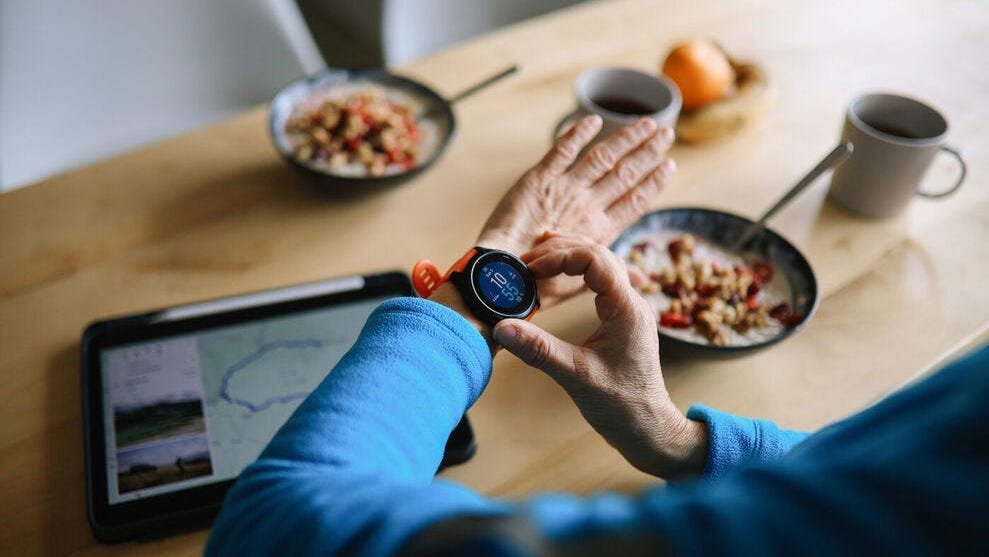
Wearable technology refers to devices equipped with sensors that collect data on various physiological and behavioral parameters, such as heart rate, sleep patterns, physical activity and even emotional states. Worn on the body as accessories or as part of clothing, they’ve become increasingly popular and more advanced in recent years
A review published in the National Library of Medicine found that wearable health devices — including smartwatches, fitness trackers and smart rings — show promising benefits for managing and treating depression and other mood disorders. Also, their ability to continuously monitor things like heart rate, sleep and activity provides users and healthcare professionals with a constant flow of information that can help detect problematic issues earlier. But researchers also acknowledge several challenges — especially around data privacy and managing the large amounts of information these devices collect.
What your finger can reveal about your health
Created to be less intrusive than a wrist band, the Oura Ring fits securely on a finger and tracks more than thirty biometrics 24/7, including heart rate, body temperature, sleep quality, stress and metabolic health. The first-generation ring launched on Kickstarter in 2015, followed by generation two in 2018, generation three in 2021. The Oura Ring 4 was officially released in late 2024. According to the company, Oura Ring sales have surpassed $5.5 million since the product was first introduced 10 years ago — and about $500 million of those sales were in 2024.
The ring’s cost ranges from $349 to approximately $499. There’s also a $5.99 monthly subscription cost for access to an app that displays and interprets the data
Mandie Kollman, a licensed mental health counselor who runs a private practice in Zanesville, Ohio, said we can’t separate mental health from physical wellness, which is why she purchased an Oura Ring six months ago
“I was surprised to learn that I was lacking insight into my own body,” Kollman said. “I always thought I was so tune with myself.”
She said that realization led her to dive deeper into the connection between physical health and mental health — especially as a mental health provider — and now she occasionally will discuss her Oura app in therapy sessions and show clients her metrics
“I also use it as an education tool for demonstrating how our physical health — sleep disruption, lack of movement, elevated stress, etc. — impacts our mental health,” she said. “I find it to be a fascinating tool with a lot of utility within the mental health world.”
Soothing the nervous system
Marketed as either a wrist band or a clip-on device, the Apollo Neuro is unique because it’s not just about monitoring health or sleep — it also attempts to intervene and improve physiological stress responses through subtle, non-invasive vibration therapy. Created by a team of neuroscientists and physicians at the University of Pittsburgh, the vibrations are designed to activate the vagus nerve and restore balance to the nervous system.
The device typically retails for around $349 — and a separate membership, ranging in price from $80 to $100 a year, is available that gives users access to the “SmartVibes AI” app, which generates a customized schedule of vibrations or “vibes” depending on your mood, like “energy,” “focus,” “calm,” “social,” “recover,” “power nap” and others
“I started with the Apollo Neuro device and then recently paired it with the Oura Ring,” said Shawna Squibb of Fort Wayne, Indiana. “I have been impressed with the balance I am seeing from using the Apollo Neuro to calm my nervous system — and the ring lets me see the effects I am feeling — my sleep has definitely improved which impacts so much as we all know.”
The company recently launched Apollo Sessions, which incorporates vibrations into a user’s iPhone
In one study of medical and pharmacy students, the data revealed that those who used Apollo Neuro “demonstrated statistically significant improvements in wellbeing, burnout scores and stress scores.”
Headband helps train your brain to stay calm
In 2024, the Muse headband generated about $1.04 million in revenue — a figure that is expected to more than double to $2.85 million by 2030
The Muse headband is a wearable EEG device that tracks brain activity and uses real-time audio feedback to help users calm their mind, improve focus and build a consistent meditation practice. The headband itself retails for $479.99 — or $519.98 for a bundle that includes a one-year premium subscription
Michael Rock of Spalding, Michigan, said that as a business owner he often faces stressful days, so he researched a wide range of health wearables — from smartwatches to fitness trackers to rings
“I have found that meditating has helped, but it wasn’t until I started using the Muse meditation headband that I could really see a difference,” Rock said. “Wearing this headband and using these apps have helped me quite a bit to manage my stress and keep me healthier.”
A 2022 study found that when people used the Muse headband during mindfulness practice, they got steadily better at staying calm and focused — and they also became better at noticing when their mind drifted and bringing their attention back
Why privacy matters with mental health wearables
As more devices collect personal health data from our bodies, there’s a growing risk that this information could be hacked, shared without permission, or used in ways that harm people — including discrimination against vulnerable groups or even new forms of surveillance
The authors of a 2025 study stated, “that despite regulatory frameworks designed to protect consumers, the commercial ecosystem surrounding wearable devices continues to pose substantial privacy risks.”
In a recent analysis of privacy practices among 17 major wearable makers, Oura was rated among the lowest-risk companies, with only two high-risk flags out of 24 criteria evaluated — primarily tied to transparency around government data requests and security vulnerability reporting. Muse and Apollo were not included in the study
Legislation over “brain data” is still evolving
While most people tend to click “agree” without reading the fine print — that fine print often allows companies to collect, analyze and even sell highly personal brain-related information. So, before signing up for any service, users should carefully read the privacy policies for the company and any related app, in order to understand what data is being collected and how it will be used
Also, keep in mind that many wearables require a paid subscription for enhanced services and data interpretation. For example, while the Apollo Neuro device comes with a free limited selection of vibes, including “good vibes” and “hug” — in order to access additional vibes, like energy, social, focus and power nap — a premium paid “SmartVibes” membership must be purchased
This reporting is supported by a Journalism Funding Partners grant. Mental Health Reporter Jennifer Torres can be reached at JMTorres@gannett.com
