


Key points
Penn State researchers developed a conductive paint-on ink that functions as wearable health sensors
The customizable ink adheres directly to skin, improving sensor accuracy and comfort
These sensors can monitor heart, muscle, and brain activity during daily movements
Wearable health tech uses electrodes on the skin to record electrical signals from the heart, muscles, and brain. These signals are processed into EEG, ECG, and EMG readings, which help monitor and interpret health and activity. Taking the concept one step further, engineers at Penn State have developed customizable, paint-on tattoos that can spot heart attacks early, power robotic prosthetics, and read brain waves. The team patented a conductive ink that powers sensors and can be painted directly onto skin in any design. This ink bonds more strongly with skin, making the sensors more sensitive, durable, and accurate than those of other wearables.
Traditional electrodes use rigid metals that often lose adhesion during movement. Some newer designs use hydrogels, which match skin movement but can dry out and lose stickiness over time. Sensor accuracy suffers if electrodes peel off or are poorly applied, and many commercial sensors struggle to adhere properly on hairy or sweaty skin
“Most commercial electrodes are prefabricated in a lab or factory and then layered on the skin, meaning there is an air gap between the skin and the electrode, which negatively impacts sensing performance,” said Zhang. “To address this, we’ve developed conductive ink that can be painted directly to the skin. After drying, it acts as a functional electrode.”
The ink, made from polymers and acidic additives in water, dries on skin in under 10 minutes and can be sped up with a hair dryer
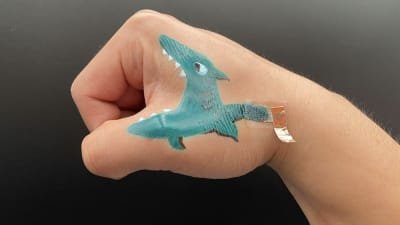
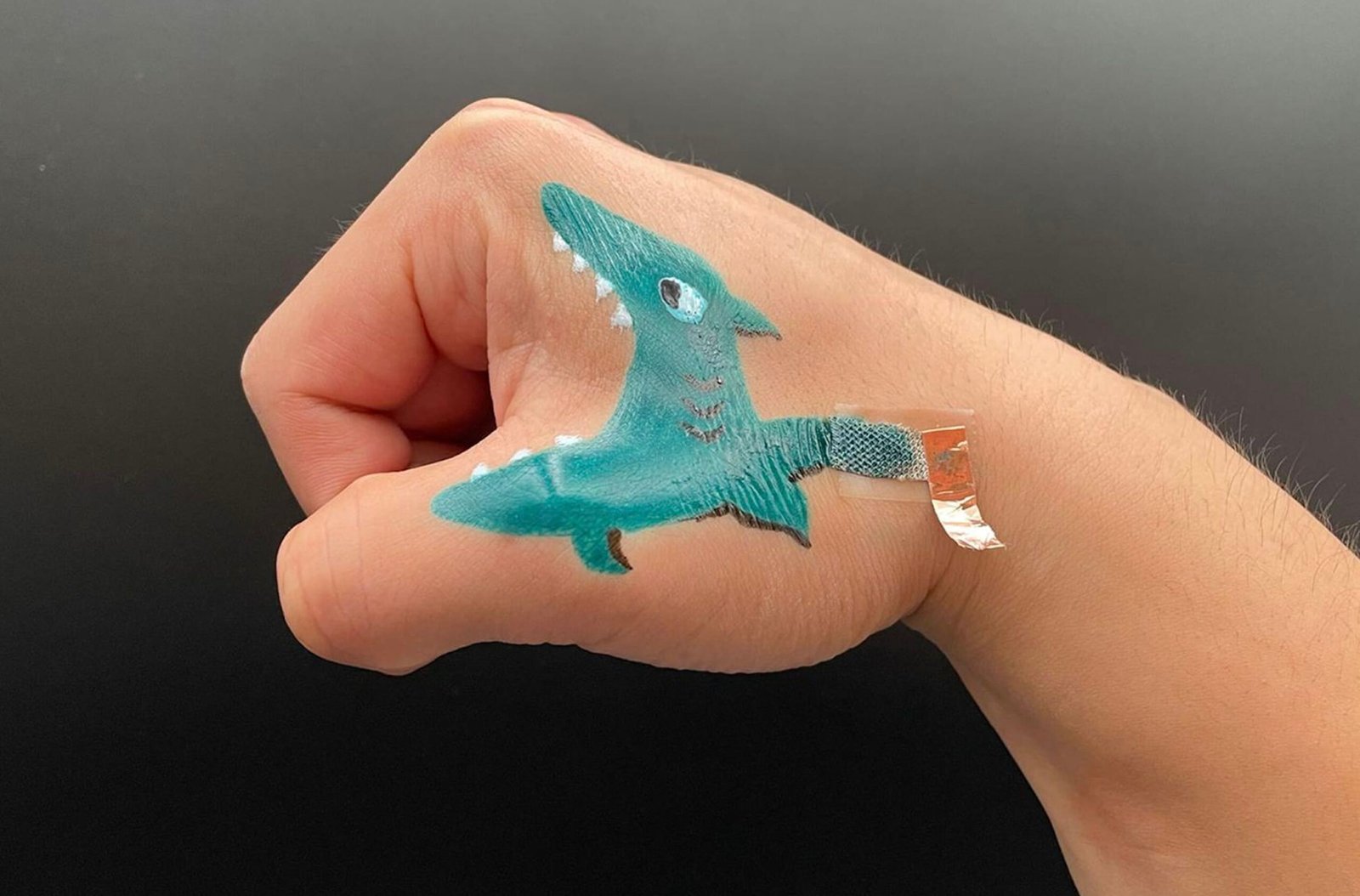
“The ink itself almost behaves like face paint,” said Cheng. “It starts out almost transparent, but you can use food dye to pigment the ink into whatever colors you need to paint whatever design you have in mind — like a cartoon or Superman. This allows us to completely personalize the wearable to a person’s preference.”
Painted directly onto the skin, the sensors conform closely to the skin and improve measurement accuracy. A conductive region is added to a porous textile on the skin, which connects to an electric module taped under clothes. This module wirelessly sends data via Bluetooth. The porous textile allows electrodes to stretch by over 150% without breaking while maintaining strong adhesion and signal quality.
“Over multiple days with other materials, sweat and moisture will accumulate on the electrode interface, potentially causing irritation or disconnection from the skin,” said Cheng. “By using a porous structure, we can allow moisture or hair to better pass through the material, making the electrodes more conductive, adhesive and comfortable.”
Experiments showed that the painted electrodes tracked ECG signals for 12 hours of daily activity and during exercise, maintaining adhesion and accuracy. They also enabled control of a robotic prosthetic hand using EMG signals. The electrodes are designed for easy removal and reapplication, making them practical for daily use
“The big idea behind this is that in the future, you could potentially have a more expensive sensing module that remains separate from the system, but the electrodes themselves can be disposable. A single bottle of ink could provide enough material to paint multiple electrodes over the course of several days or a week,” said Cheng
Future work includes expanding the technology to detect additional biomarkers for commercial healthcare applications and even for “smart plants” to monitor environmental chemicals
Topics:
