



Key Takeaways
- PTSD and PFAS exposure may increase the risk of earlier menopause.
- Gaps in menopause training and uneven VA menopause care can leave that risk overlooked.
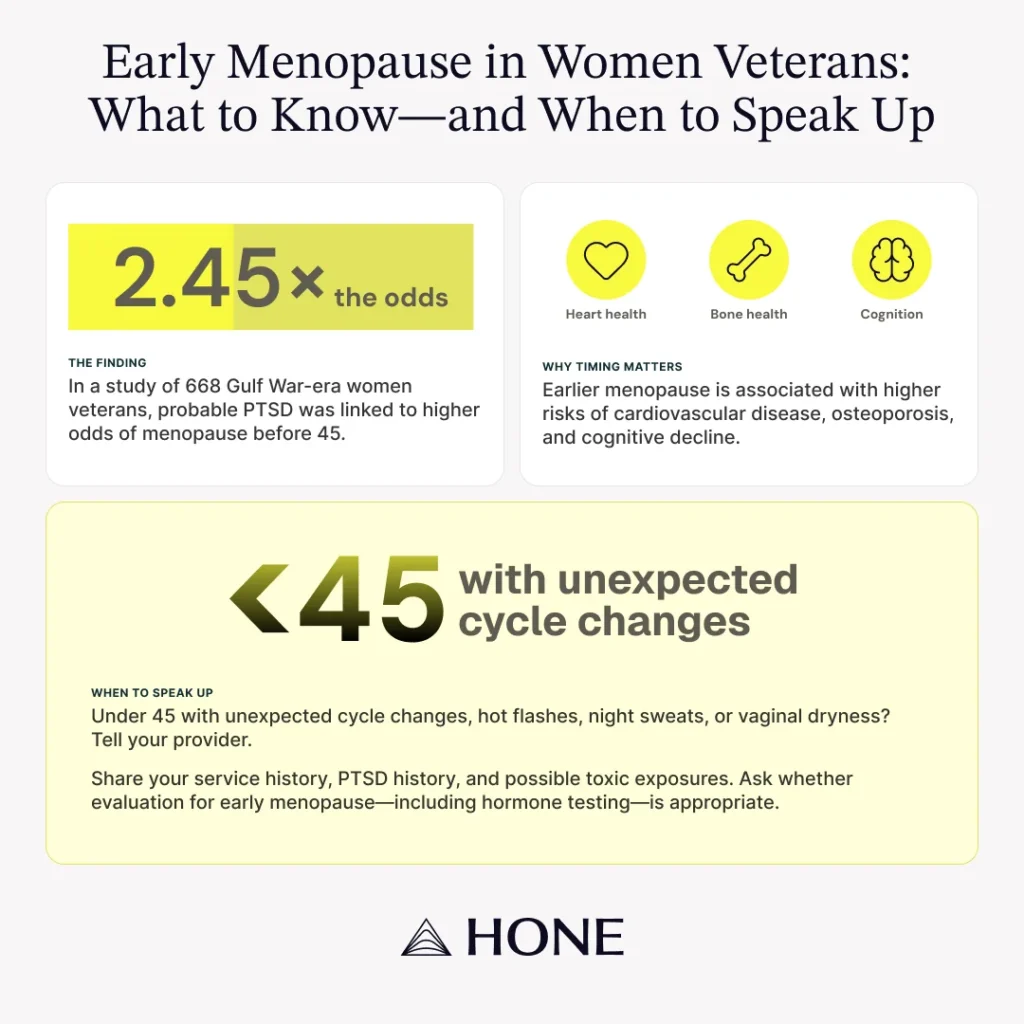
- Earlier menopause is associated with higher risks of cardiovascular disease, osteoporosis, and cognitive decline.
- Veterans with perimenopause symptoms before age 45 should share their service history — including PTSD and potential PFAS exposure — and ask whether hormone testing is appropriate.
Veterans Day is a time to honor service members — and an opportunity to recognize the health challenges some face long after their service ends. For women veterans, emerging evidence suggests that military-related experiences and exposures may be associated with earlier menopause.1
Compounding the problem is that neither VA clinicians nor civilian OB-GYNs routinely consider the possible impact of military service on reproductive health. That care gap leaves women veterans who experience earlier menopause to face both the discomfort of untreated perimenopause symptoms and a higher long-term risk of cardiovascular disease, osteoporosis, and cognitive decline.234
“Military service history should be part of a woman’s reproductive and hormonal health history,” says Hone Health-affiliated OB-GYN Shelly Chvotzkin, M.D. “PTSD and environmental exposures may have implications for ovarian function and reproductive aging, and more research is definitely needed to establish these relationships. Women should not have to wait until their periods become irregular or stop before their symptoms are taken seriously.”
About the Experts
- Shelly Chvotzkin, D.O., F.A.C.O.O.G., is a board-certified OB-GYN.
- Anastasia Jandes, M.D., PharmD, IFMCP, is a hormone management physician and consultant focus on the interplay between the environment, inflammation, and stress and their combined effect on the endocrine system’s ability to produce hormones.
Women veterans have a 13% lifetime rate of PTSD — more than twice the 6% rate among male veterans.5
Both combat exposure and military sexual trauma have been linked to PTSD in women. In a study in the journal Women’s Health Issues, women who experienced military sexual assault had about six times the odds of developing PTSD even after accounting for combat exposure.6
A 2025 study of 668 Gulf War-era women veterans found that those with probable PTSD had 2.45 times the odds of reporting possible menopause before age 45 compared with those without probable PTSD.7
Researchers are still trying to understand whether and how PTSD might affect menopause timing. One possibility involves changes in the hypothalamic-pituitary-adrenal (HPA) axis, the body’s main stress-response system, which interacts with hormones that regulate reproduction. Inflammation may also play a role.8910
Whatever the mechanism, Chvotzkin says she’s seen the association — especially between chronic PTSD and earlier menopause — numerous times in her practice over the past decade
Exposure to PFAS (per- and polyfluoroalkyl substances, or “forever chemicals”) has been linked to earlier menopause in civilian women.11 Veterans may have even higher exposure
Firefighting foam and contaminated groundwater at military installations can expose service members to PFAS.11 A 2026 analysis of national survey data (NHANES) found that blood levels of certain PFAS in veterans aged 20–39 were 13%–24% higher than those of civilians of the same age.12
A 2026 population-based analysis of U.S. women linked higher levels of certain PFAS with younger reported age at menopause.13
Researchers suspect that PFAS interfere with hormone signaling, which may alter follicle development and reduce ovarian reserve.14
The PACT Act requires the VA to screen enrolled veterans for possible toxic exposures, but it uses a veteran questionnaire rather than a blood test or other medical evaluation, so the results are incomplete at best.
When menopause begins earlier, the body spends more years with low estrogen levels. Studies link earlier menopause to higher risks for the heart, bones, and brain
- In a 15-year cohort study of more than 46,000 women, menopause before age 40 was associated with 36% higher odds of cardiovascular disease; menopause at ages 40–44 was associated with 15% higher odds compared with menopause at ages 50–52.15
- An Australian study found that women with premature ovarian insufficiency or early menopause (before age 45) had 37% higher odds of osteoporosis and 45% higher odds of fractures than those who reached menopause at age 45 or older.16
- A 2026 observational study of 2,603 older women in JAMA Network Open found an association between earlier menopause and faster declines in overall cognitive function and memory of personal experiences, as well as earlier onset of Alzheimer’s disease.17
“Estrogen protects the brain, the bones, the cardiovascular system, and metabolic health,” says Hone-affiliated physician Anastasia Jandes, M.D. “We want that protection for as long as possible.”
Recognizing early menopause gives women a chance to address symptoms and long-term health risks sooner. Research suggests hormone replacement therapy (HRT) has the biggest cardiovascular benefit and least risk when started before age 60 or within 10 years of menopause onset.18
Gaps in menopause training may leave both VA clinicians and community OB-GYNs without the context to connect service and reproductive health, Jandes says. Some women veterans may go from provider to provider looking for answers
Menopause care is available through the VA, but recognition, treatment, and patient education vary widely across facilities. In 2024, documented diagnosis rates among women ages 45–64 ranged from 6%–20%, while hormone-therapy prescription fills ranged from 3%–35%.19
VA officials have said that time constraints and providers’ discomfort managing menopause may contribute, and that patients may not feel comfortable raising symptoms.20 In a survey of 348 women veterans, 3 in 5 said they had not encountered any VA menopause re
In Jandes’ view, the VA’s toxic exposure screening is a good start but doesn’t go far enough. “It might bring attention to a possible exposure,” Jandes says, “but there’s no actionable protocol that then leads to blood work or a referral to someone who will ask the right questions to see if a woman’s symptoms suggest hormonal abnormalities.”
Community OB-GYNs may not have the context to connect perimenopause symptoms with aspects of military service that may affect hormones. “If you have exposures like PFAS or have had PTSD, no matter your age, providers need to ask about changes to your cycle, vaginal dryness, painful sex, and other symptoms that may indicate perimenopause or early menopause,” says Jandes
Veterans with menopause symptoms or unexpected cycle changes before age 45 should share their service history — including PTSD and possible toxic exposures — with their physician and ask whether evaluation for early menopause, including hormone testing, is appropriate.
Can PTSD cause early menopause?
Emerging research suggests that PTSD can impact ovarian function and reproductive aging. A study of Gulf War–era women veterans linked probable PTSD to higher odds of possible early menopause. More research is needed to confirm the connection
Can PFAS exposure lead to earlier menopause?
Some studies link higher blood levels of certain PFAS, or “forever chemicals,” to menopause at a younger age. Researchers are still investigating whether PFAS exposure itself can bring on menopause sooner and whether exposure during military service affects menopause timing in women veterans
Does the VA provide menopause care?
VA provides menopause care, and veterans enrolled in VA health care can ask their primary care team about an evaluation and whether a referral would be helpful
Gibson CJ, et al. (2025) Military Exposures and Early Menopause: Findings From the Gulf War Era Cohort Study (GWECS)
↑
Pant A, et al. (2025) Age of menopause, healthy lifestyle and cardiovascular disease in women: a prospective cohort study
↑
Jones AR, et al. (2024) Bone health in women with premature ovarian insufficiency/early menopause: a 23-year longitudinal analysis
↑
Campagna MP, et al. (2026) Age at Menopause and Brain Atrophy Among Older Women
↑
US Department of Veterans Affairs (2026) How Common Is PTSD in Veterans?
↑
Gross, Georgina M, et al. (2018) Does Deployment-Related Military Sexual Assault Interact with Combat Exposure to Predict Posttraumatic Stress Disorder in Female Veterans?
↑
Gibson CJ, et al. (2025) Military Exposures and Early Menopause: Findings From the Gulf War Era Cohort Study (GWECS)
↑
Ravi M, et al. (2019) Neuroendocrine pathways underlying risk and resilience to PTSD in women
↑
Raise-Abdullahi P, et al. (2023) Hypothalamus and Post-Traumatic Stress Disorder: A Review
↑
Levesque P, et al. (2023) Sex-specific immune mechanisms in PTSD symptomatology and risk: a translational overview and perspectives
↑
US Department of Veterans Affairs (n.d.) PFAS – Perfluoroalkyl and polyfluoroalkyl substances
↑
Hoover C, et al. (2026) Serum PFAS Concentrations Among US Veterans, NHANES 2003–2018
↑
Ning A, et al. (2026) Association between perfluoroalkyl and polyfluoroalkyl substances exposure and reproductive longevity for female in the United States: A population-based study
↑
Ding N, et al. (2020) Perfluoroalkyl and polyfluoroalkyl substances (PFAS) and their effects on the ovary
↑
Pant A, et al. (2025) Age of menopause, healthy lifestyle and cardiovascular disease in women: a prospective cohort study
↑
Jones AR, et al. (2024) Bone health in women with premature ovarian insufficiency/early menopause: a 23-year longitudinal analysis
↑
Campagna MP, et al. (2026) Age at Menopause and Brain Atrophy Among Older Women
↑
Khalifey, Hafsah Tajammul, et al. (2026) The impact of hormone replacement therapy on cardiovascular health in postmenopausal women: a narrative review
↑
American Society for Reproductive Medicine (n.d.) Evidence-based guideline: Premature Ovarian Insufficiency
↑
US Government Accountability Office (2026) VA MENOPAUSE CARE: Actions Needed to Help Ensure Quality Care and Patient Education
↑
US Government Accountability Office (2026) VA MENOPAUSE CARE: Actions Needed to Help Ensure Quality Care and Patient Education
↑
Navigate Menopause With Confidence
Get expert guidance and support on symptoms, treatments, and lifestyle changes, delivered every Monday

Editorial Policy: Science-Backed, Expert-Reviewed
The Edge upholds the highest standards of health journalism. We source research from peer-reviewed medical journals, top government agencies, leading academic institutions, and respected advocacy groups. We also go beyond the research, interviewing top experts in their fields to bring you the most informed insights. Every article is rigorously reviewed by medical experts to ensure accuracy. Contact us at support@honehealth.com if you see an error.
