


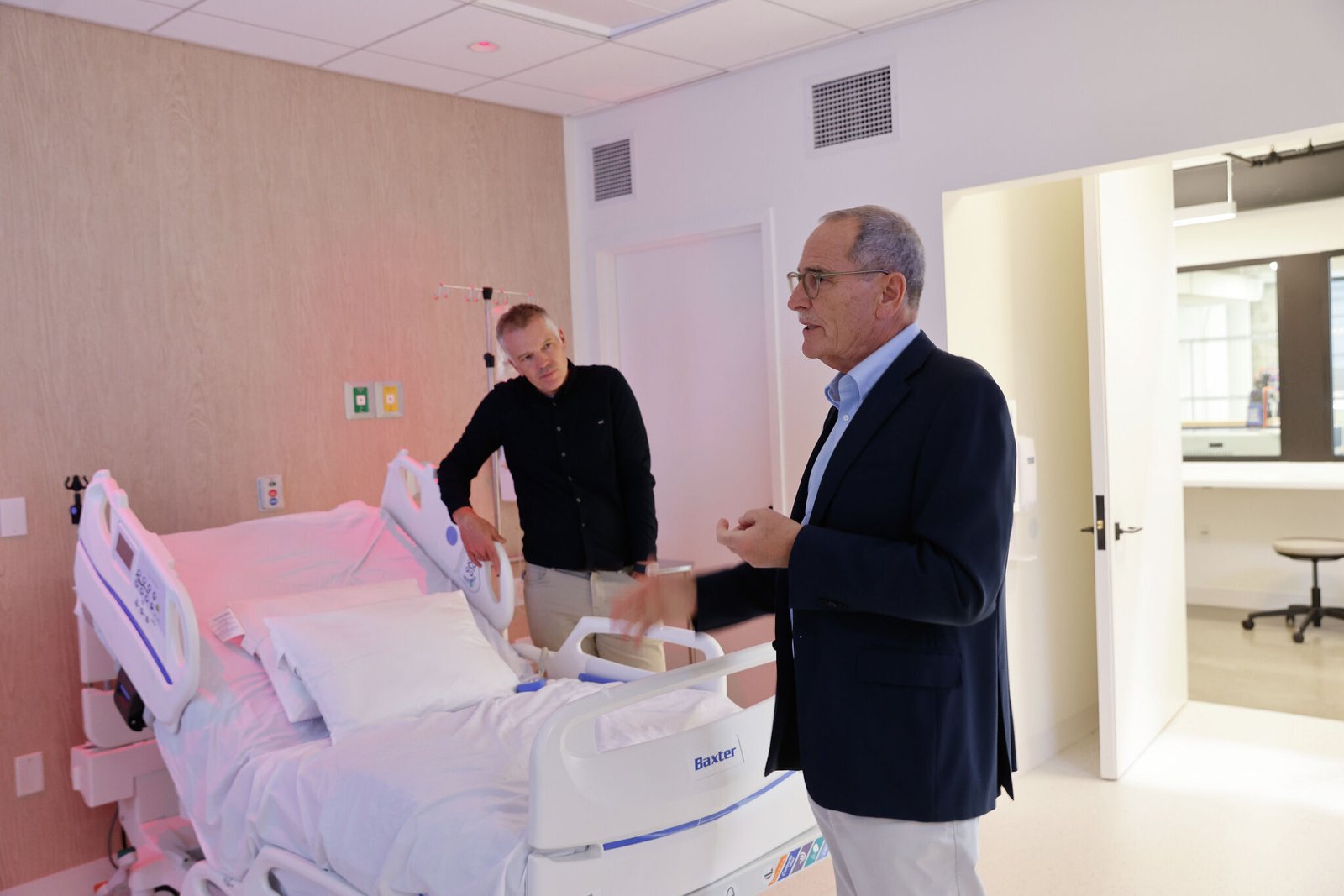
The prototype hospital room inside Sutter Health’s innovation center in San Francisco looks nondescript to the casual observer: it has a bed, IV drip and window, not unlike countless hospital rooms across the country
But a closer look reveals subtle features that Sutter leaders hope will one day become part of hospital rooms of the future, helping patients sleep better — an elusive goal in the noisy, hectic hospital environment.
There are red lights overhead, designed for nighttime use so they don’t disturb the patient’s natural circadian rhythm the way standard blue and white lights do. For rooms without an exterior window, a digital “window” displays images of the outdoors that sync with natural light — sunlight during the day and dark sky and stars at night — to help orient patients so they’re more primed to stay awake during the day and sleep at night. Sutter also hopes to add sound-monitoring devices in the hallway to alert staff if noise levels exceed a certain decibel.
Article continues below this ad
These are some of the sleep-friendly technologies that Sutter is looking to incorporate as it builds two new hospitals in Santa Clara and Emeryville, which are slated to open around 2030 and 2031, and as it remodels its CPMC hospitals in San Francisco. Some features could be implemented as soon as next year.
The movement toward sleep-friendlier hospital rooms, which other major Bay Area hospitals are also exploring, is backed by emerging research showing that better sleep in the hospital — both quantity and quality — can help patients recover faster, be less likely to be readmitted, and manage pain better.
“These are not small issues,” said Dr. Richard Milani, Sutter’s chief clinical innovation officer, who has studied how noise and lighting impact hospitalized patients’ sleep and health outcomes. “These are critically important for your health.”
The efforts mirror a growing interest in sleep among the health-conscious general public, who are increasingly recognizing the importance of sleep in potentially lowering risk of dementia, diabetes and other chronic diseases
Article continues below this ad
Hospitals are inherently stressful settings that can make restful sleep feel impossible. There’s constant noise from alarms and machines, 24/7 bright lights, unfamiliar beds, staff coming in and out to take vitals — not to mention the emotional and mental stress of being sick in the first place, and not knowing what might happen next.
“It’s a totally different environment,” said Dr. Clete Kushida, a neurologist and chief of the division of sleep medicine at Stanford. “And the individual themselves might be having a lot of pain, which in and of itself is not conducive to sleep.”
As a result, patients in the hospital tend to get less sleep, poorer quality sleep, “and on top of that, the circadian rhythm is disordered because they don’t get enough sleep at night, and might start taking naps during the day,” Kushida said.
Sleep in hospitals as a topic of research is relatively new but has grown rapidly over the last decade or so, Kushida said. Researchers have begun looking into what interventions might help hospitalized patients sleep better, including reflexology or massage, muscle relaxation exercises, music, light therapy (syncing hospital light with the naturally occurring light of the time of day), sleep masks, earplugs and cognitive behavioral therapy.
Article continues below this ad
Some of these have a modest effect on hospitalized patients’ sleep, though the data in general is sparse and can vary depending on patients’ baseline health and reason for being in the hospital, Kushida said.
“If they’re in short-term care and are relatively healthy, like an orthopedic procedure, that’s different from a person who’s in there for cardiac surgery or hospitalized for a psychiatric evaluation,” he said
For now, hospitals are focusing mostly on light and noise
Noise at night — which can disturb sleep — is one of patients’ top complaints, along with food quality, when Kaiser surveys its members about their hospital stay, said Dr. Melody Choong, chief of hospital medicine at Kaiser Permanente San Francisco.
Article continues below this ad
“It’s something we really want to change because sleep is such a critical part of the healing process, both for the physical body and the brain,” Choong said.
Kaiser hospitals have been reducing ambient light coming in from the outside and the hallways, especially at night; routing alarms for some low-risk patients to ring at the nursing station instead of inside the room; and clustering overnight care to minimize interruptions — like consolidating multiple visits into one when staff come in to check vitals or change bedding.
And Kaiser’s new hospital in San Francisco, which is slated for completion by 2033, will have all private rooms, which will reduce interruptions and noise from roommates’ families and doctors, Choong said.
Similarly, UCSF’s new Parnassus Heights hospital slated to open in 2030 will also have all private rooms, as well as nightlights on the farthest wall from the patient so nurses can avoid turning on all the overhead lights when they check on patients, said Elizabeth Polek, vice president of new hospital planning and optimization at UCSF Medical Center
Article continues below this ad
The floors will be rubber instead of linoleum or tile, which older hospitals used because they were “good for cleaning but terrible for noise,” Polek said.
And UCSF Benioff Children’s Hospital Oakland, which is building a new hospital slated to open in 2031, plans to install red lighting in some patient rooms and sound-absorbing ceiling tiles.
“I don’t know that we’ll ever be able to mimic the kind of sleep you’d get in your own bed,” Polek said. “That’s probably not a realistic goal. But (sleep is) an imperative part of healing and any effort we can make, we should be making.”
