



Learn more
Hormone therapy raises risk for autoimmune diseases in postmenopausal women
October 27, 2025
2 min read
Add topic to email alerts
Receive an email when new articles are posted on
Please provide your email address to receive an email when new articles are posted on .
Added to email alerts
You’ve successfully added to your alerts. You will receive an email when new content is published.Click Here to Manage Email Alerts
You’ve successfully added to your alerts. You will receive an email when new content is published.Click Here to Manage Email Alerts
We were unable to process your request. Please try again later. If you continue to have this issue please contact customerservice@slackinc.com.
‘);
notification.css({
‘position’: ‘fixed’,
‘top’: ’20px’,
‘right’: ’20px’,
‘background’: ‘#373D3F’,
‘color’: ‘white’,
‘padding’: ’10px 15px’,
‘border-radius’: ‘5px’,
‘z-index’: ‘9999’,
‘font-size’: ’14px’,
‘box-shadow’: ‘0 2px 8px rgba(0,0,0,0.2)’
});
$(‘body’).append(notification);
// Fade out and remove after 3 seconds
setTimeout(function () {
notification.fadeOut(300, function () {
notification.remove();
});
}, 3000);
}
//# sourceURL=social.js
Key takeaways:
- Hormone therapy was linked to a risk for autoimmune disease in postmenopausal women, but the risk was “relatively small.”
- An expert said hormone therapy is still the first-line therapy for menopause symptoms.
Postmenopausal women using hormone therapy were more likely to develop autoimmune diseases compared with nonusers, research presented at the Annual Meeting of The Menopause Society showed
But “the actual increase in absolute risk is relatively small and varies by condition,” XuezhiJiang, MD, PhD, MS, MSCP, FACOG, a professor of obstetrics and gynecology at Drexel University College of Medicine, said in a press release
“Because this was a retrospective database study, more research is needed before drawing firm conclusions,” Jiang added. “Hormone therapy remains a safe and important option for many women when used appropriately, but like any treatment, it should be individualized while we await more research on its possible links to autoimmune disease.”
According to Mayo Clinic, women are twice as likely as men to develop an autoimmune disease
The release noted several factors, such as environmental factors and stress, are possible contributors to recent increases in autoimmune diseases, but “the relationship with the development of autoimmune diseases in postmenopausal women remains poorly understood.”
Jiang and colleagues used data from the TriNetX Global Health Research Network to determine how hormone therapy, or HT, influences the risk for 17 autoimmune diseases
The study included two cohorts, each made up of 889,413 postmenopausal women (mean age, 60 years), with one cohort including HT-users and the other including non-HT users
Outcomes were measured at 5 and 10 years after HT initiation (for HT users) or menopause diagnosis (for non-HT users) and across the full postmenopausal period
The researchers found that HT users had a higher incidence of autoimmune disease at 5 years (6.7% vs. 5.3%), 10 years (8.6% vs. 6.7%) and across the full postmenopausal period (9% vs. 7.1%) vs. non-HT users
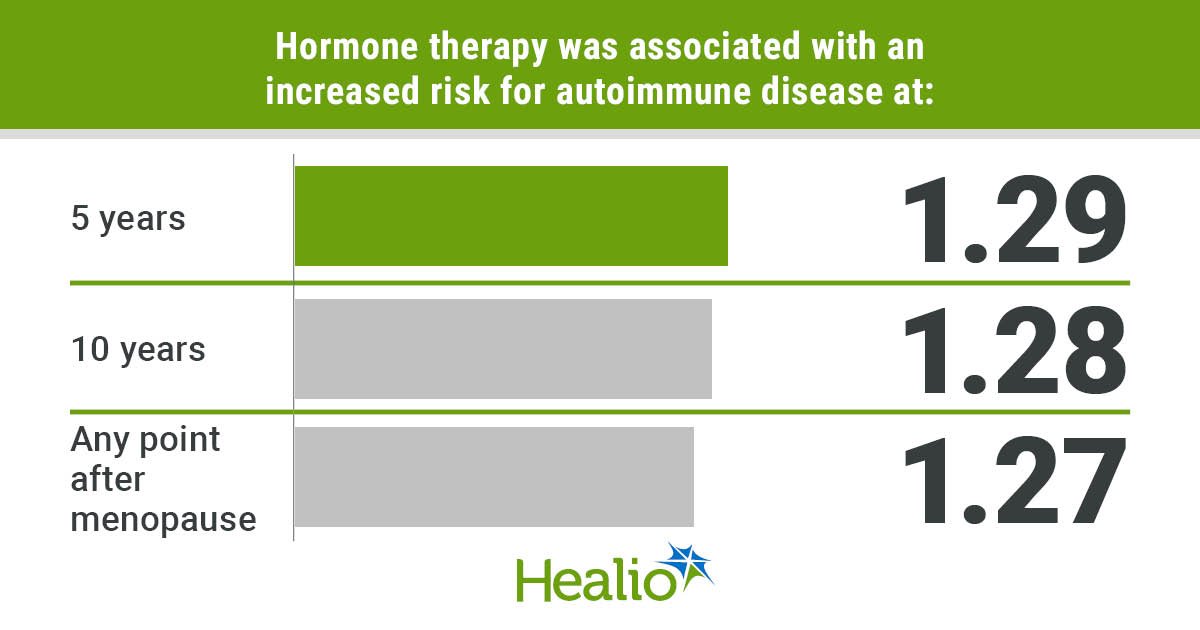
HT use was tied to a significantly increased risk for developing any autoimmune disease at:
- 5 years (RR = 1.29; 95% CI, 1.27-1.3);
- 10 years (RR = 1.28; 95% CI, 1.27–1.29); and
- any point after menopause (RR = 1.27; 95% CI, 1.25-1.28).
When Jiang and colleagues assessed individual autoimmune disease over the full postmenopausal period, increased risks were seen for all the diseases — with RRs ranging from 1.03 to 2.9 — except for Graves’ disease and autoimmune hepatitis
The researchers concluded further studies are warranted “to clarify the underlying mechanisms and temporal relationship between HT and autoimmune disease onset, and to support individualized risk-benefit evaluations in menopausal care.”
“Since more and more women are affected by autoimmune diseases, it’s important to consider all potential associations,” Stephanie S. Faubion, MD, MBA, medical director for The Menopause Society, said in the release. “That’s why we continue to recommend that health care professionals take a very individualized approach when prescribing HT. Although HT continues to be the first-line therapy for managing menopause symptoms, it is not for everyone.”
Continue Reading
