


Article
• •

Healthy holidays: Wearables and health data may tip the scales toward better nutrition
Health is on many people’s minds, especially at the start of a new year. Deloitte research shows more consumers are willing to share wearable device data for personalized health, even with their grocers
Article
• •
Many people start the new year resolving to undo the excesses of the holiday season and adopt healthy eating habits going forward. Technology can help. Many consumers with smartwatches use them to track exercise, count calories, and monitor their health in real time. Recent Deloitte research shows that many consumers surveyed are willing to share smartwatch data with grocers in exchange for personalized nutrition and food recommendations.
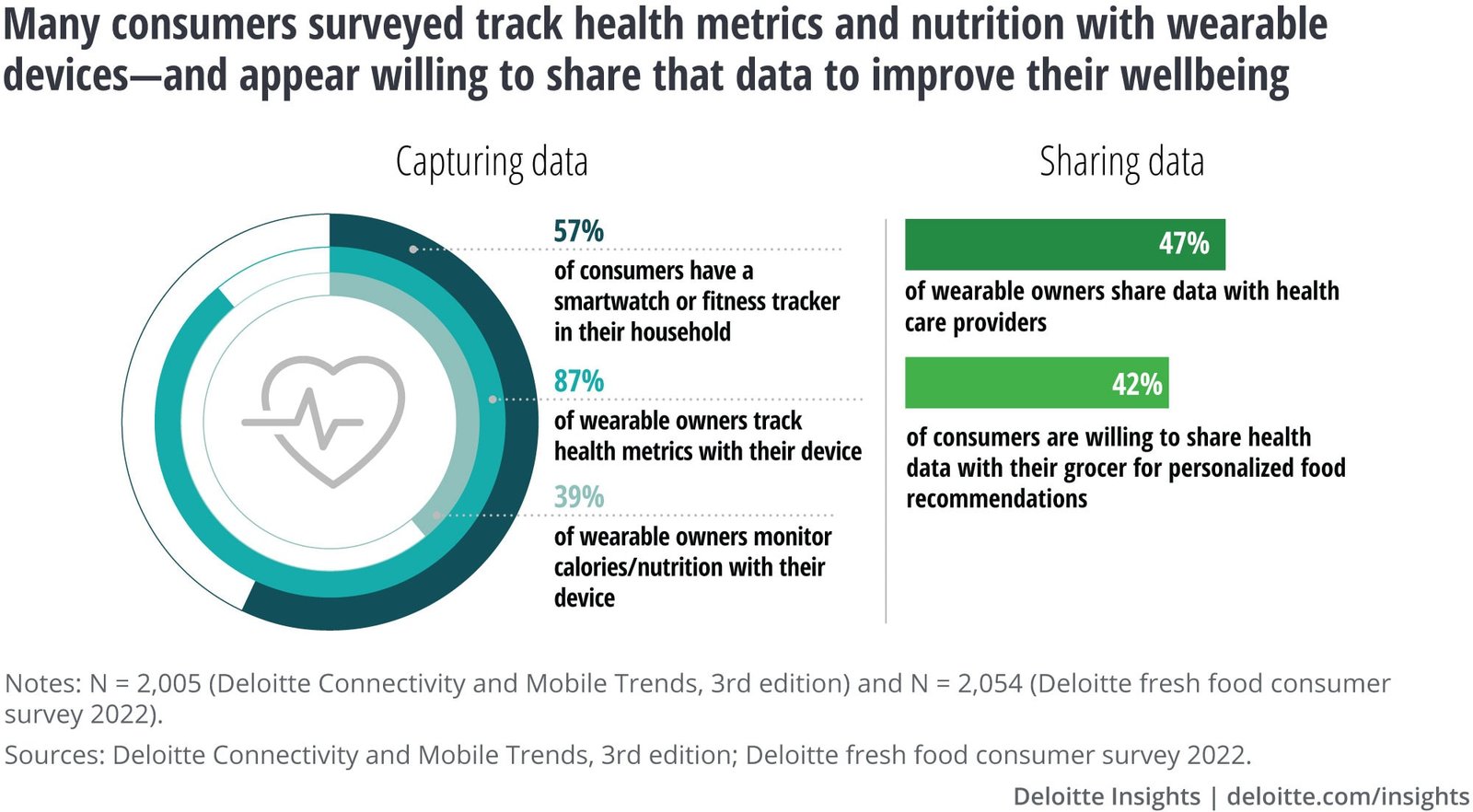
Deloitte’s 2022 Connectivity and Mobile Trends study1 revealed that many US consumers are taking charge of their well-being by using wearables. The study found that about six in 10 consumer households own a wearable device—either a smartwatch or fitness tracker—and the vast majority (87%) of surveyed wearable owners use them to track health metrics like heart rate, workout duration, and sleep quality. Nearly four in 10 (39%) report using their devices to monitor calories and nutrition, and almost half (47%) say they share the health data gathered by their wearables with their health care providers. Notably, at least seven in 10 wearable owners say their fitness and health have improved with the help of these devices and apps.
Today’s health apps integrate exercise plans, nutrition recommendations, and meal planning to drive goals like weight loss.2 But there is a potential to go even further. Deloitte’s Future of Fresh study3 examines the trend of food as medicine—a concept that recognizes the preventative and therapeutic benefits gained through personalized, healthy diets based on scientifically validated claims. The survey found that roughly half (48%) of surveyed consumers would use an app or website for personalized food recommendations, and 42% are willing to share health data with their grocer for personally tailored food recommendations.
Better eating through sharing health data with trusted grocers could make a big difference. A bad diet’s role—in cardiovascular disease, type 2 diabetes, and even some forms of cancer—contributes to one in every five deaths globally.4 More than 48 million US households have a member with a health condition that needs to be managed through diet.5 Using food as medicine may improve outcomes and reduce traditional health care usage and costs.6
Consumer technology could have a significant role to play in advancing this movement toward better personal health/nutrition and even community-level care. Some wearables are advanced enough to monitor health markers and even changes in metabolism in real time.7 Grocery websites and nutrition apps can enable shoppers to learn about the nutritional benefits of different foods, identify smarter alternatives to unhealthy items, and see recommendations based on health conditions or dietary needs.8 What’s needed is a way to integrate these silos of data and make them digestible and actionable at each point in the care, health, and wellness journey. To generate individualized recommendations that map to desired outcomes, wearable data should interoperate with the information systems used by clinicians and dietitians.9
oitte Insights, “2022 Connectivity and Mobile Trends,” August 2022
Fitbit, “How do I track my food with the Fitbit app?,” accessed November 2022
Justin Cook et al., Fresh food as medicine for the heartburn of high prices, Deloitte Insights, September 26, 2022
kan Afshin, “Health effects of dietary risks in 195 countries, 1990–2017: a systematic analysis for the Global Burden of Disease Study 2017,” The Lancet 393, no. 10184 (2019): 1958–72
Food Industry Association, “The food as medicine opportunity in food retail,” 2021
ah Downer et al., “Food is medicine: actions to integrate food and nutrition into healthcare,” BMJ 369 (2020)
Jeff Loucks et al., Wearable technology in health care: Getting better all the time, Deloitte Insights, December 1, 2021
ger, “OptUP: Eating Well. Simplified,” accessed November 2022
istered dietitians are employed by many grocery chains to provide nutrition guidance at the corporate and consumer levels—81% of food retailer respondents said they employ dietitians, with 65% at the corporate level and 31% at stores or virtually (Food Industry Association, “The power of health and well-being in the food industry 2022,” accessed November 30, 2022)
Deloitte Insights, 2022 Deloitte holiday survey, accessed November 30, 2022
ger, “OptUP: Eating Well. Simplified.”
Jana Arbanas et al., Mastering the new digital life: 2022 Connectivity and Mobile Trends, 3rd edition, Deloitte Insights, August 2022
Cook et al., Fresh food as medicine for the heartburn of high prices
The authors would like to thank Justin Cook,Wendy Gerhardt, Leslie Korenda, Jeff Loucks, Brooke Auxier, Gautham Dutt, Jaime Austin, Rithu Thomas, and Shubham Oza for their help in preparing this article
Cover image by: Jaime Austin
