


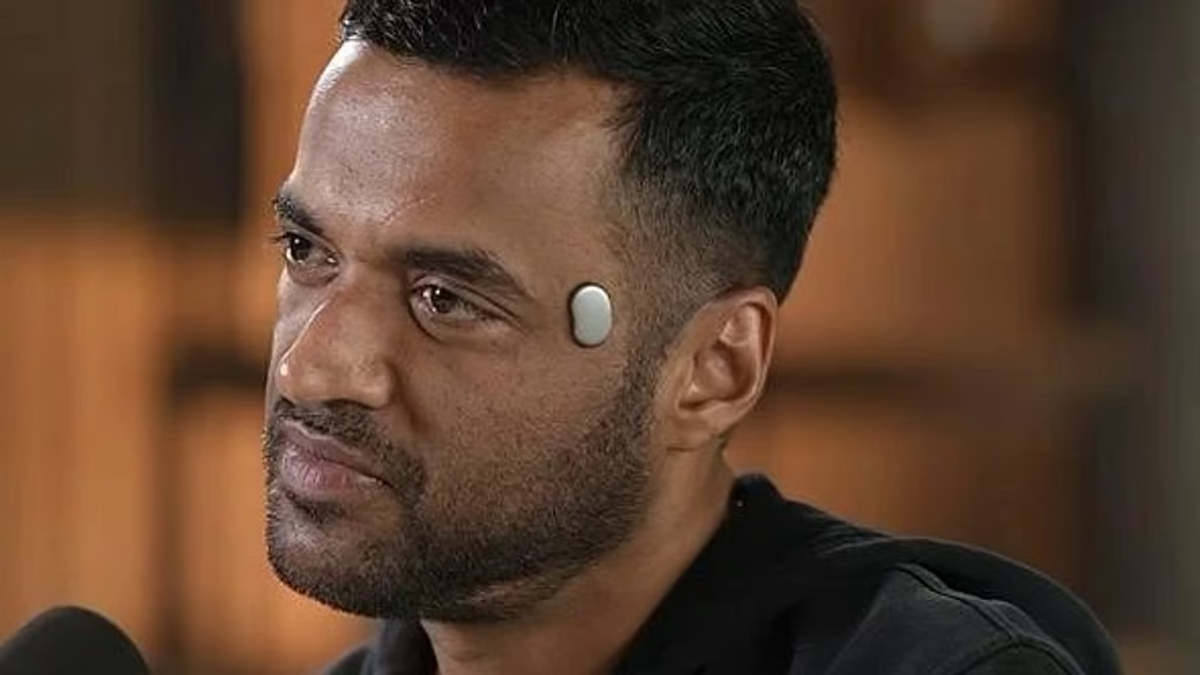
Temple, the forehead-worn wearable from Deepinder Goyal’s startup Continue Research, opened pre-orders in India on November 1, 2026, at ₹85,000 (~$890), making it the first consumer device to reach the market with an explicit claim to track cerebral blood flow continuously. Buyers considering a premium-priced device built on two unpublished preprints and contradicted by multiple named neurologists should understand precisely what the sensor at their temple is — and is not — measuring.
India’s First Brain-Flow Wearable Is Available to Pre-Order Now
Temple’s pre-order window opened November 1, 2026, at ₹85,000 (~$890), positioning the device firmly in the premium end of India’s fast-growing health-tech wearable market — above the Apple Watch Ultra and well above WHOOP and Oura Ring pricing. The device is sold through Continue Research, which Goyal founded after stepping down as CEO of Eternal, the parent company of Zomato and Blinkit
Continue Research raised $54 million at a $190 million valuation in February 2026, backed by Steadview Capital, Peak XV Partners, Vy Capital, and Info Edge Ventures, alongside more than 80 individual angels including the founders of Cred, Zerodha, and Paytm. Thirty Continue Research employees invested their own money in the round. Goyal has described Temple as an “experimental device to calculate Brain Flow accurately” — language the company has maintained throughout its public debut, signaling that this is an early-generation product rather than a finished clinical instrument.
The device comes in six color variants, ships domestically within India, and has been worn publicly by Goyal himself for over a year. Badminton star PV Sindhu was seen using one at the 2026 Uber Cup in April — an association that generated celebrity-level attention in India without constituting a formal clinical endorsement
What Temple Actually Measures at the Scalp
The central question about Temple’s technology is anatomical, and it matters before any consumer parts with ₹85,000 (~$890)
Temple uses photoplethysmography — PPG, the same optical sensing principle in every modern smartwatch — positioned at the temple, over the superficial temporal artery. PPG works by shining light into tissue and measuring how much is absorbed, which varies with blood volume changes. At the wrist (where Apple Watch, WHOOP, and Garmin measure), this captures changes in the radial artery territory. At the temple, it captures changes in the superficial temporal artery — a terminal branch of the external carotid artery.
The physiological problem: the brain’s cortex is fed by the internal carotid artery and the vertebral arteries, not the external carotid. These are separately regulated vascular beds. Changes in scalp blood flow and changes in deep cerebral blood flow can correlate under specific conditions, but they are not the same measurement. True cerebral blood flow is measured clinically using Transcranial Doppler (TCD) ultrasound — a technique that requires a sonographer, a purpose-built probe positioned against the temporal bone, and approximately 30 minutes of examination. It measures blood-flow velocity directly in the middle cerebral artery.
Dr. Sudhir Kumar, Senior Consultant Neurologist at Apollo Hospitals, Hyderabad, flagged this anatomical gap publicly, advising Goyal that a sensor over the internal carotid artery in the neck would be more likely to correlate with cerebral circulation than the superficial temporal artery placement. He has also stated that the device “cannot yet be considered a medical tool.”
Temple’s answer to this challenge is BrainFlow — a proprietary multiwavelength sensing and signal-processing system that the company says extracts a signal correlated with cerebral blood flow changes from the scalp PPG reading. The company’s position is that BrainFlow does not claim to directly measure deep brain blood flow; it measures a scalp proxy that correlates with cerebral flow under the conditions studied.
What the Validation Data Actually Shows — and What It Doesn’t
Continue Research has published two preprint studies to support BrainFlow’s claims. Neither has yet completed peer review
The first, a TCD validation preprint, enrolled 23 healthy adults and analyzed data from 20 who completed the full protocol. Participants wore Temple while performing cycling and postural-change tasks; the researchers compared Temple’s BrainFlow signal against simultaneous TCD readings of middle cerebral artery blood-flow velocity. The median within-subject correlation was approximately r≈0.8 across tasks. The study has not been peer-reviewed.
The second, a TD-NIRS validation preprint, enrolled 60 participants across three challenge conditions (head-down tilt, stand-to-squat, stand-to-supine) and found correlations of r=0.84–0.91 between BrainFlow and brain blood volume measurements. This study has also not been peer-reviewed
Continue Research has also self-published a heart rate accuracy study comparing Temple against the Polar H10 ECG chest strap — the wearable industry’s standard heart rate reference device — across 43 healthy participants. Temple achieved a mean absolute error (MAE) of 1.18 beats per minute against the Polar H10, compared to Apple Watch Series 12 at 1.94 bpm MAE and Oura Ring 5 at 5.21 bpm MAE in the same study. This heart rate performance data is company-published and not independently replicated.
What r≈0.8 means in practice: roughly 64% of the variance in one signal is explained by the other, leaving 36% unaccounted. In the controlled exercise and postural-change conditions the preprints studied, scalp and cerebral blood flow were likely moving in the same direction for the same physiological reasons — making correlation relatively easy to achieve. Whether that correlation holds in older adults, in people with cerebrovascular disease, or during the kinds of cognitive and emotional experiences that Temple is ostensibly designed to monitor is not established by either study.
Dr. Satish Babu stated there is “currently no solid evidence demonstrating that the Temple device can reliably measure cerebral blood flow under different physiological conditions.” Dr. Datta, a physician-scientist at AIIMS Delhi, called Temple a toy with “zero scientific standing” — a characterization Goyal rebutted by telling skeptics to “be curious, and cheer Indian startups” and promising to publish the science when ready.
Dr. Arun L. Naik, an AIIMS-trained neurosurgeon, flagged deep-artery measurement limits and warned that Temple should not replace established neurological investigations
Is Temple Actually Measuring Ageing?
Temple’s scientific rationale rests on what Continue Research calls the Gravity Ageing Hypothesis — the proposition that gravity-driven reductions in cerebral blood flow contribute to cognitive decline and biological ageing over a lifetime. Goyal has described this as a research direction he has been personally exploring and tracking through Temple
The hypothesis does not have a peer-reviewed publication behind it. Dr. Datta of AIIMS Delhi has explicitly stated there is “currently no scientific evidence to support the idea that gravity-driven changes in brain blood flow cause ageing.” The relationship between cerebral blood flow and cognitive ageing is a legitimate and active research area — CBF does decline with age, and that decline correlates with cognitive performance in some studies. What remains unestablished is whether monitoring scalp PPG at the temporal artery can detect these changes, and whether any intervention based on such readings could slow the process.
Goyal’s response to the criticism has consistently been: wait for the peer-reviewed data. He has positioned Temple as an instrument for generating that data — implying that consumers who buy at ₹85,000 (~$890) are, in some sense, participants in the research rather than purchasers of a validated clinical tool
Is This a Medical Device or a Wellness Gadget?
No CDSCO (India’s Central Drugs Standard Control Organization) approval has been sought or granted for Temple; it has no FDA or CDSCO clearance. The device is positioned and sold as a wellness product — a category in India that does not require CDSCO pre-market approval, provided the manufacturer makes no specific clinical diagnostic claims
Dr. Subhash Kaul, Senior Consultant Neurologist at KIMS Hospital, Secunderabad, described Temple as “an encouraging concept” that “must be approached with caution” — a summary that captures the device’s position in the market precisely. The encouraging concept is real: continuous, affordable cerebral blood flow monitoring outside a clinical setting does not currently exist from any validated commercial product. The caution is equally real: none of the validation work that would establish Temple as that product has been published in a peer-reviewed journal.
How Does Temple Stack Up Against Existing Wearables?
Existing consumer wearables — Apple Watch Series 12, WHOOP 5.0, Oura Ring 5, Garmin Forerunner — do not claim to measure cerebral blood flow. They measure heart rate, heart rate variability, sleep stages, blood oxygen saturation (SpO2), and skin temperature. Temple’s differentiation claim is not that it does these things better; it is that it measures something none of them measure: a proxy for what the brain’s blood supply is doing.
On heart rate accuracy alone, Temple’s company-published figure of 1.18 bpm MAE competes favorably with the Apple Watch Series 12 (1.94 bpm MAE) and Oura Ring 5 (5.21 bpm MAE) in the same study. But heart rate accuracy from a temporal PPG sensor is not the device’s core proposition — and the fact that this comparison is made in a self-published study rather than an independent one limits its evidentiary weight.
The category Temple is entering — continuous, real-time cerebral monitoring as a consumer wearable — has no validated commercial equivalent. That is genuinely novel. Whether the novelty of the category justifies a ₹85,000 (~$890) purchase before peer review is a question each potential buyer must answer for themselves
Exchange rate as of November 2, 2026; currency conversions are approximate
Frequently Asked Questions
What exactly does the Temple wearable measure, and is it the same as cerebral blood flow?
Temple uses photoplethysmography sensors positioned over the superficial temporal artery — a branch of the external carotid artery, which supplies the scalp and face. True cerebral blood flow, as measured clinically, comes from the internal carotid and vertebral arteries supplying the brain’s cortex. Temple’s BrainFlow system measures a scalp signal that correlates with cerebral blood flow changes under controlled study conditions (r≈0.8 in a preprint TCD validation study), but this correlation has not been independently peer-reviewed, and multiple neurologists have pointed out that scalp and deep cerebral vascular beds are separately regulated. The short answer: it measures scalp blood flow that correlates imperfectly with brain blood flow — not brain blood flow directly.
Has Temple received any regulatory approval from FDA or CDSCO?
No. Temple has not applied for or received clearance from the US Food and Drug Administration or India’s Central Drugs Standard Control Organization. It is sold as a wellness device, a category that does not require pre-market regulatory approval in India provided clinical diagnostic claims are not made. The company has stated that future development will depend on peer review and regulatory approval pathways, but no specific timelines have been disclosed.
What would it take for Temple’s scientific claims to be independently validated?
Independent validation would require peer-reviewed publication of the existing preprint studies — including independent replication by researchers unaffiliated with Continue Research — and ideally, studies in populations beyond healthy adults aged 18–45, including older adults with varying degrees of cerebrovascular health. The company’s two preprint studies (TCD validation with 23 participants; NIRS validation with 60 participants) would need to pass editorial peer review, and the heart rate accuracy comparison would need independent replication to be treated as established rather than manufacturer-claimed.
What is the Gravity Ageing Hypothesis, and is it scientifically established?
The Gravity Ageing Hypothesis is Continue Research’s proposition that gravity-driven reductions in cerebral blood flow over a lifetime contribute to cognitive decline and biological ageing. It is the scientific rationale behind Temple’s development. Dr. Datta of AIIMS Delhi has publicly stated there is “currently no scientific evidence to support the idea that gravity-driven changes in brain blood flow cause ageing.” The relationship between cerebral blood flow decline and cognitive ageing is a legitimate research area, but the specific hypothesis that gravity is a primary driver of that decline is not established in peer-reviewed literature as of November 2026.
ⓒ 2026 TECHTIMES.com All rights reserved. Do not reproduce without permission
Tags:Wearable Device
