

Each night, your sleep comes in stages: After you drift off, you slip from light sleep into the deepest, most restorative type of sleep, and your brain waves hit their slowest point. About an hour later, your brain waves pick back up again in REM sleep, and that’s when your dreams might start to get weird. The cycle repeats four to six times until morning
You might be intimately familiar with your own sleep stages by now if you swear by your Oura Ring or other wearable sleep tracker. But such trackers are only guessing what’s going on in your brain based on different physiological characteristics, such as your blood oxygen, or your movement, such as tossing and turning.
Now a new era of sleep tech is here, with the arrival of sleep trackers that aim to peer into your brain without your even noticing. These devices, whether in the form of a headband or earbuds, track your brain waves to gauge your sleep stages. From there, the devices reportedly help you fall or stay asleep by piping through your ears sound pulses (which research shows may improve your sleep in certain circumstances) that are timed to the movement of your brain waves.
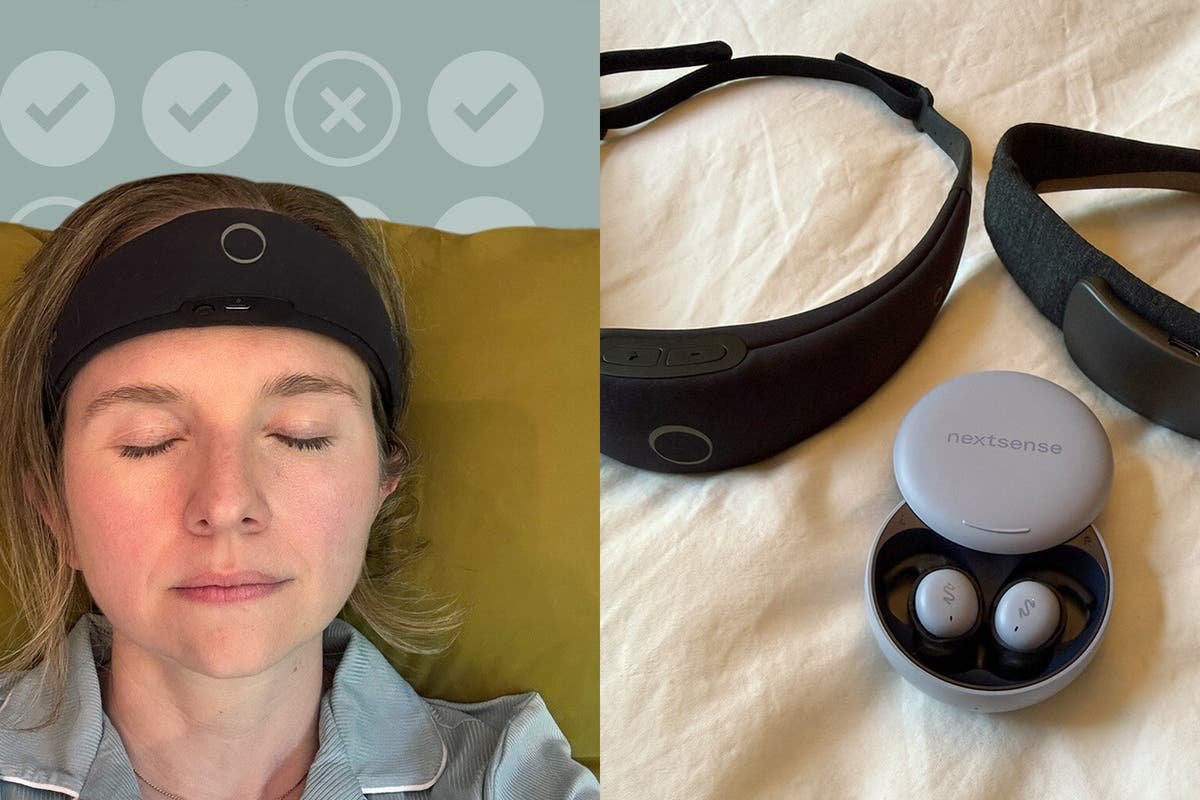
After speaking with experts and testing three of these devices, I can tell you that the tech is promising. But the devices are uncomfortable, and it’s hard for me to say whether they improved my sleep
These devices need a snug fit to work
EEG wearables must have constant contact with the wearer’s skin to function properly, which means headbands and earbuds need to be snug. Unsurprisingly, all the makers of the devices I tested warned that it takes about a week to get used to. I found that each device felt comfortable enough for a few minutes, but the question remained: Would they be comfortable all night long?
The headbands, the Muse S Athena and the Elemind band, are both covered in soft synthetic-blend fabrics that feel nice against the skin. But I have long hair, which hampered my ability to maintain a good connection to the EEG sensors, especially behind my ears. On two nights, I fell asleep comfortably with the Muse S Athena, but both times I woke up with a sizable red bump on my forehead. Each of the following mornings, the app reported zero minutes of REM sleep, so the connections were clearly having issues even though the band had felt snug. People on Reddit have reported similar sleep-tracking problems.
With the Elemind headband, the rubbery back portion of the strap was torturous — the experience felt like wearing swim goggles for hours. I threw it onto my nightstand at 1 a.m. The NextSense Smartbuds proved equally uncomfortable. They come with three sizes of wings (which hook around your ear) and tips (soft plastic that sits inside your ear canal) that attach to the bud, or body. You need to replace the wings and tips every 21 uses for the sensors to work. Even when paired with the best-fitting tips, the hard-plastic buds were especially irritating, like sleeping with AirPods in. After about two hours, I groggily woke up and plucked them out of my ears.
Call me Goldilocks, but I could not get any of these devices to feel just right
Pink noise may help your sleep, but with some caveats
On to the important question: Did these devices actually improve my sleep or help me fall asleep faster? My data is mixed.
The Muse and NextSense devices both use EEG to measure your brain waves, detect your sleep stage, and then play quiet pink-noise sounds at the right moment to improve your deep sleep.
During the deepest stage of your sleep cycle, which EEG registers as slow waves, sound bursts or audio stimulation can help intensify and elongate that sleep phase, said Gary Garcia Molina, a scientist at Sleep Number Labs and honorary fellow at the University of Wisconsin Madison. (Garcia Molina formerly worked for Philips on a device similar to the ones I tested, but that device is no longer available.) This sound functions as a conductor would in front of an orchestra, in that the noise pulse makes neural activity synchronize at the most restorative parts of sleep, he said.
Unfortunately, I wasn’t really able to enjoy the show, so to speak. Over the 10 total nights I conducted my tests, I was able to sleep through the night while wearing the devices on only three nights. One night, the Muse S Athena’s app indicated that the Deep Sleep Boost feature was active for about two hours; that night, an independent sleep tracker I was using (for my beloved Eight Sleep Pod 5) indicated that I had a higher-than-average amount of deep sleep. I can’t draw any major conclusions from one night of data, but it is a promising correlation.
I struggled with the NextSense earbuds, too. The one night I was able to sleep through the night without yanking them out of my ears, they did give me a slow-wave “boost.” However, the app said that deep sleep occurred before I woke up, which seemed like a red flag: Typically your best deep sleep occurs far earlier in the night.
The Elemind headband works similarly to help you fall asleep but suppresses alpha waves (which appear when you are relaxed but awake) rather than boosting slow waves. Auditory stimulation can weaken alpha waves, allowing slower sleep waves to take over and helping you fall asleep, said Garcia Molina.
According to its data, the Elemind headband worked like a charm: I fell asleep in only four minutes, in contrast to my usual 10 or so minutes. But I am a tired person with two kids, so I employed another Wirecutter writer and self-proclaimed night owl, Ayanna Redwood-Crawford, to try the device for a week. Though it cut her time to fall asleep from 21 minutes to 10 minutes, she, like me, did not enjoy sleeping with a band around her head. Ayanna already sleeps with a head scarf, and sometimes an eye mask, so getting the Elemind band to fit correctly felt “so suffocating.”
“Every morning I woke up with this device at the end of my bed after throwing it off in my sleep,” she said. “Even though it worked as intended, it might not be the best device for people who sleep with accessories.”
Overall, in my own experience, I found hints that the technology might be working, but the devices were so uncomfortable that I can’t imagine wearing them every night.
Garcia Molina also pointed out a number of caveats for both types of devices. First, the timing of the sound needs to be dead-on; even though these waves are called “slow,” they are actually practically quite fast. The stimulation must be accurate on the millisecond scale, he said.
He also noted that age, sleep disorders, and auditory sensitivity can affect whether this type of stimulation gives you any benefit. Beyond all that, some people are what Garcia Molina calls “non-responders,” meaning their brains may not respond as expected, and researchers don’t know why
Privacy issues with brain data are still unsettled
Headphone makers are increasingly interested in collecting people’s personal data, and the situation with these types of devices is no different. But it’s hard to know exactly what will be done with neural data now or in the future, or what the risks to your privacy are. In 2024, the Neurorights Foundation, a nonprofit neurotechnology watchdog, reviewed the privacy practices of 30 consumer neurotechnology companies and found that most had “ambiguous” data-collection and data-storage practices.
Additionally, the data that at-home sleep technology collects isn’t covered by the Health Insurance Portability and Accessibility Act (HIPAA). This means that you don’t know who might see your neural data — or what they can see. For example, EEG data is also used to diagnose epilepsy and other seizure disorders, so it’s possible that your sleep headphones could pick up an underlying condition you didn’t know you had. In most states, companies are allowed to sell that data to insurers, employers, or marketers, said Stephen Damianos, the executive director of the Neurorights Foundation. However, a handful of states have moved on legislation regarding the privacy of neural data specifically: In 2024, Colorado was the first state to pass a law to protect brain data, and Montana, California, and Connecticut have followed with the passage of similar legislation.
I asked Muse, Elemind, and NextSense about their privacy policies, and each company told me explicitly that it does not sell data. NextSense said that data from its Smartbuds is stored only locally on the user’s phone unless the customer specifically opts in to data sharing and cloud storage. Muse and Elemind said that brain data is stored securely on a server
We recommend that you thoroughly read the privacy policy of any EEG-equipped device you purchase and opt out of data sharing if you want to limit the information you’re sharing with companies. Know that those policies can change at any time, however, and as my colleague Lauren Dragan notes, if you get a notification that the privacy policies have changed, you should read it closely
Meet your guide
What I Cover
I write about pillows and other sleep gear. I dig into trends in sleep technology and talk to experts about the science behind the claims
SKIP ADVERTISEMENT
