

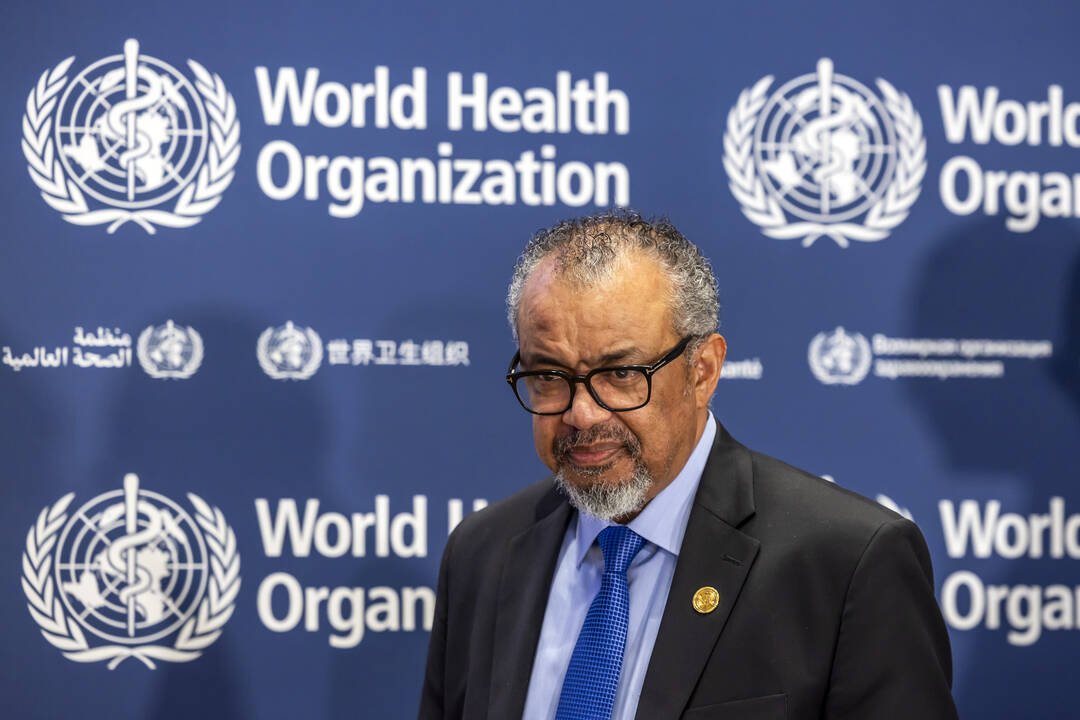

From its perch in Pregny overlooking Geneva, the World Health Organization (WHO) could appear somewhat removed. The newly built Route des Nations, giving it access to the airport in just a few minutes, allows it to remain nonetheless connected. But its iconic building — 152 metres long and 35 metres high — designed by Swiss architect Jean Tschumi in the early 1960s and recently rid of asbestos, may give the organisation an air of near indifference toward the turmoil destabilising the multilateral system.
When the building was constructed, the then president of the World Health Assembly, Russian Sergei Kurashov, quoted in the book International Geneva, 100 Years of Architecture by journalist Joëlle Kuntz, spoke of a noble, albeit utopian ambition.“The building that will be erected must be the symbol and the focal point of humanity’s hopes of one day being freed from disease,” he said
Thousands of staff departures
Founded in 1948, the WHO is now going through a far less serene period, having just weathered a real storm. Budget cuts had to be made following the withdrawal of the United States and a sharp reduction in contributions from other member states
In early February, WHO director general Tedros Adhanom Ghebreyesus — commonly known as “Dr Tedros” in spite of not being a medical doctor — admitted that “the past year has undeniably been one of the most difficult in the organisation’s history.”
Between January 2025 and June 2026, 2,400 employees will have left the organisation, according to its communications department. Those include 1,160 departures through retirement, early retirement, the end of temporary contracts or transfers to other institutions, and 1,240 being laid off. Only around 100 positions are being relocated to other UN sites
Overall staffing will fall from 9,401 employees globally in early 2025 to 7,364 by mid-2026, with headquarters in Geneva shrinking from 2,906 to 2,089 staff
Antoine Flahault, epidemiologist and emeritus director of the Global Health Institute at the University of Geneva, says the process has caused “real social suffering” with some international civil servants suddenly losing contracts, residency permits and the right to remain in Switzerland
“Programmes designed to save lives have been scrapped,” he adds
The global health specialist nonetheless put the situation into context: “We should remember that the WHO’s budget — equivalent to that of the Geneva University Hospitals — has steadily increased over the past twenty years,” Flahault says, noting that pandemic-era programmes such as COVAX, which distributed Covid-19 vaccines globally, have naturally wound down
After an explosion in emergency spending during the pandemic, he says the organisation is experiencing “a return to normal. So this is not a catastrophe.”
Emotions running high
During the austerity exercise that the UN agency had to carry out urgently, emotions among some employees ran high. “I devoted a large part of my life to this organisation, and this is how we are treated. It’s disgusting,” says a WHO ng of the crisis. “He made choices that were more political than rational.”
Flahault notes that when Tedros took over the organisation from China’s Margaret Chan, the organisation only had four assistant directors general. Under the Ethiopian leader, that number rose to eleven shortly before the cost-cutting measures, before falling back to four in 2025
“The rollback must not go too far,” the expert warned. “WHO has contributed enormously to eradicating certain diseases, including one that killed around 300 million people in the twentieth century: smallpox.”
In his view, it would be very worrying if eradication programmes for polio or measles were halted. Polio, he notes, caused around 350,000 cases of paralysis per year in the previous century. Today, only around 100 cases are reported worldwide. Life expectancy has increased dramatically almost everywhere due to coordinated public health efforts
The fate of international Geneva is also closely linked to the WHO. According to a 2024 study published by the Geneva Graduate Institute, global health, like humanitarian action, is a central element of Geneva’s international ecosystem. Between 2000 and 2020, it represented 48 per cent of all contributions paid to international organisations in Geneva, or $112.5 billion
The WHO’s presence in Geneva helped create a vast ecosystem of health-focused institutions and NGOs, notably Gavi and the Global Fund to Fight Aids, Tuberculosis and Malaria
US scientific contribution
Beyond the budget crisis, WHO suffered another major shock: the withdrawal of the United States, which came into effect in January, followed by Argentina
Washington previously accounted for nearly 20 per cent of the WHO’s budget, which amounts to $6.2bn for 2026 and 2027, a nine per cent decrease from the previous period. The US also left $260 million in unpaid contributions
But Flahault says the greatest loss is not financial. “In nearly 80 years of existence, the WHO has been shaped by the United States. They have profoundly influenced global health.” He points to the creation of the Centers for Disease Control and Prevention (CDC) in Atlanta. “Today there is a CDC in Europe, Africa and even China.”
The departure could weaken networks of WHO collaborating centres, many of which are based in large universities in the US, and provide expertise on emerging viruses, bacteria and toxins, free of charge. Their work has helped build key surveillance networks
“Many of them may no longer be able to work with WHO. Yet it was an extremely intelligent system,” Flahault says
Financing reforms underway
Despite the turbulence, some experts reject the idea that the WHO’s existence is threatened
“Yes, the United States was the largest contributor. But look at the bigger picture,” says Suerie Moon, co-director of the Global Health Centre at the Geneva Graduate Institute. ”The most significant reform implemented recently was the increase in mandatory member-state contributions (agreed in 2023).”
Increases are scheduled for 2027, 2029 and 2031, with the aim that 50 per cent of the WHO’s budget will come from mandatory contributions. Until now, the imbalance between mandatory contributions, which represented 14 per cent of contributions, and voluntary contributions, at 86 per cent, has made planning extremely difficult
Moon argues that the reform comes as middle powers and developing countries still see strong value in a functioning multilateral system. Such countries see multilateralism as protection against major powers that may not attach much importance to international law
“What I see among many member states, especially developing countries, is the feeling that they have taken ownership of WHO and rely on it to help them,” Moon says, noting that she would not be surprised to see more countries increase their contributions, particularly as development aid continues to decline. Until now, about a dozen countries have funded 80 per cent of the WHO’s budget
Critical role in global health
To understand WHO’s central role today, one only has to recall the evening of 30 January 2020. As he declared Covid-19 to be a Public Health Emergency of International Concern, Tedros appeared solemn. The organisation struggled at times, had some missteps and difficulty persuading China to cooperate, with Beijing initially refusing urgent visits by experts. Conspiracy theorists and the Trump administration accused it of numerous failings. But WHO held its course and its science-based independent recommendations proved meaningful.
“WHO receives alerts every day about the emergence of new viruses,” explains Flahault. “It makes recommendations but can be wrong, because predicting which strains of a virus will circulate months from now is always a gamble.”
Pandemic agreement
In that context, the pandemic agreement adopted last year is crucial. “It strengthens the WHO’s central role as a political actor capable of bringing states together to agree on common rules,” says Moon
Yet the agreement is currently held up by sensitive negotiations over the Pathogen Access and Benefit-Sharing System. A divide persists between wealthy countries wanting to retain control over vaccine and medicine production, and developing countries willing to share the genome of new viruses only if they receive financial or other benefits in return
For WHO, this is a critical moment. As the Covid pandemic showed, the faster a pathogen’s genome is shared, the better the global response can be organised
Unknown to many, the WHO plays a role in everyday life. One of its most important functions is normative, maintaining a list of 500 essential medicines used to treat cancer, cardiovascular and respiratory diseases, as well as vaccines and antibiotics. Even in Switzerland, those who call for abolishing the WHO tend to forget this
This article was originally published in French in Le Temps. It has been adapted and translated into English by Geneva Solutions. Articles from third-party websites are not licensed under Creative Commons and cannot be republished without the media’s consent
