


Russia’s state science foundation has ramped up its support for medical research into aging and life extension in recent years, the exiled news outlet Novaya Gazeta Europe reported Friday
The Russian Science Foundation (RSF), set up in 2013 to back basic and applied research, supported 43 projects on aging between 2021 and 2025 compared with just seven in 2016-2020, Novaya Gazeta Europe reported
One of the projects to receive funding was led by President Vladimir Putin’s alleged daughter
The foundation’s main grants currently range from 4 million to 7 million rubles ($47,000-$83,000) a year, with possible extensions. By comparison, the typical grant amount in 2017 ranged from 3 million to 6 million rubles ($36,000-$71,000)
Most of the projects were awarded in 2021-2023, including studies on the role of innate immunity in aging and research linking brain and eye changes to Alzheimer’s disease
In 2025 alone, five projects referencing aging received support, covering topics from stress-induced cellular senescence to changes in hypothalamic neuron activity
At least one additional 2025 grant went to a project on cell renewal and healthy longevity led by Maria Vorontsova, who media reports have identified as Putin’s eldest daughter
The exiled science outlet T-Invariant reported that Vorontsova’s application was approved under a program for “world-class scientific laboratories,” which carries awards of up to 30 million rubles ($357,000) — far larger than the RSF’s regular grants
The outlet noted her citation index was significantly lower than that of other grant winners
The RSF’s 2025 budget is about 40 billion rubles ($476 million), according to its website
Putin, 72, has previously voiced interest in life extension and anti-aging science
He and Chinese President Xi Jinping were caught on a hot mic discussing human longevity at a military parade in Beijing this month, with Xi predicting that humans could live to 150 years this century
Putin replied that advances in biotechnology could allow people to “live younger and younger, and even achieve immortality.”
Read more about:
Science
A Message from The Moscow Times:
Dear readers
We are facing unprecedented challenges. Russia’s Prosecutor General’s Office has designated The Moscow Times as an “undesirable” organization, criminalizing our work and putting our staff at risk of prosecution. This follows our earlier unjust labeling as a “foreign agent.”
These actions are direct attempts to silence independent journalism in Russia. The authorities claim our work “discredits the decisions of the Russian leadership.” We see things differently: we strive to provide accurate, unbiased reporting on Russia
We, the journalists of The Moscow Times, refuse to be silenced. But to continue our work, we need your help
Your support, no matter how small, makes a world of difference. If you can, please support us monthly starting from just $2. It’s quick to set up, and every contribution makes a significant impact
By supporting The Moscow Times, you’re defending open, independent journalism in the face of repression. Thank you for standing with us
Once
Monthly
Annual
Continue
Not ready to support today? Remind me later.
×
Remind me next month
Remind me
Thank you! Your reminder is set.
We will send you one reminder email a month from now. For details on the personal data we collect and how it is used, please see our Privacy Policy.
Anatoly Gubanov was accused of passing secret hypersonic development materials to Dutch colleagues with whom he collaborated on the world’s first civil…
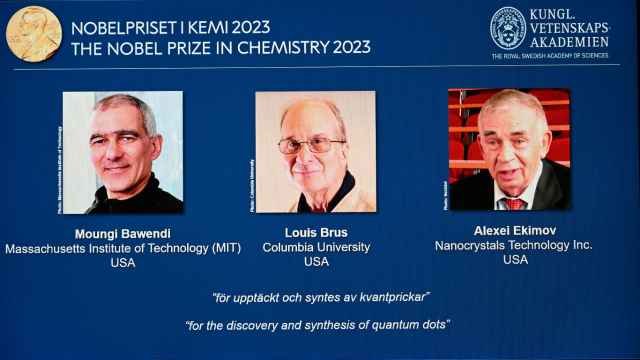
In 1981, physicist Alexei Ekimov discovered tiny particles, known as quantum dots, at St. Petersburg’s Vavilov State Optical Institute.
The launch of the Luna-25 lander is Russia’s first lunar mission since 1976, when the U.S.S.R. was a pioneer in space exploration.

“Only Russia — no other countries — has lost so many people working in the scientific field,” Russian Academy of Sciences Vice President Valentin…
