


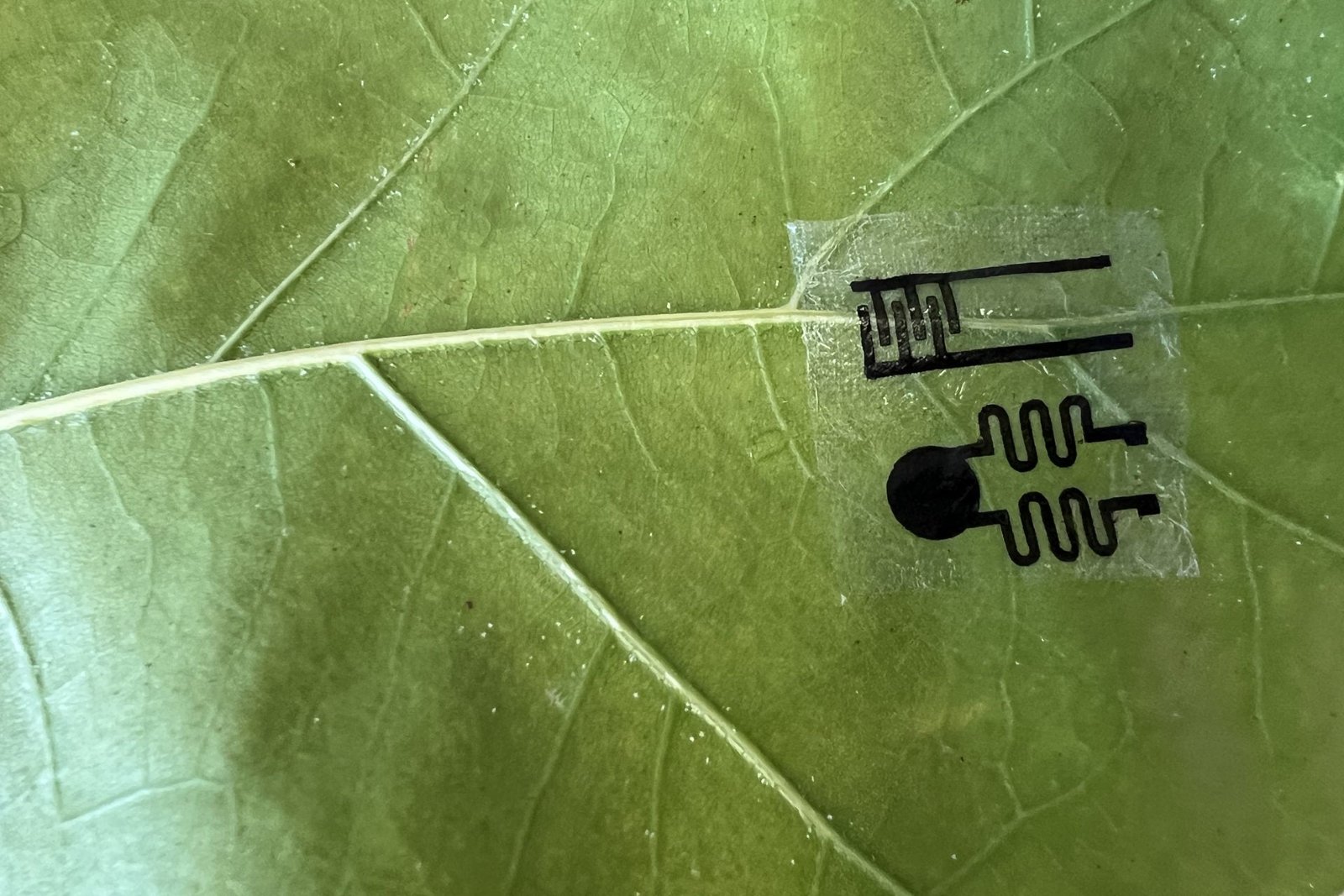
“The leaf sensor is more of an early warning system showing how the plant is responding in the moment, before visible signs appear,” said Nafize Hossain.
Photo: Courtesy of Nafize Hossain
Science & Technology
Plants Get Wearables to Track Their Health
A smartwatch can tell us the level of oxygen in our blood, when our sleep is restless, or the number of steps we take in a day. Now imagine that kind of tracking ability for plants.
In a recent study, researchers created tiny tattoo-like sensors that adhere to leaf surfaces and a stretchable band that wraps around stems. Together, they track two vital signs of plant life—the temperature and humidity beneath the leaf’s surface, and whether the stem is still growing. Even more striking, the system runs without an external battery, scavenging power from moisture evaporating from the plant itself.
“The larger promise is not merely that one plant can wear one sensor,” saidSameer Sonkusale, professor of electrical and computer engineering at Tufts and senior researcher in the project. “It is that fields could one day contain networks of plant-level monitors, each reporting early signs of thirst, salt stress, disease or nutrient imbalance. Satellites and drones already give farmers a bird’s-eye view. Plant wearables could provide something more intimate: the plant’s-eye view.”
Current methods in monitoring crops use satellite imagery and drones to get visible, infrared, and microwave data that map out greenness, uneven growth, temperature, pest damage, soil moisture, and other big picture measurements of crop stress. Soil sensors can measure moisture, temperature, pH, and some nutrient levels. And weather stations provide information on air temperature, humidity, rainfall, wind, and sun exposure.
While those measurements are useful, they focus on conditions that may affect the crops in the future or an assessment of damage already done. “The leaf sensor is more of an early warning system showing how the plant is responding in the moment, before visible signs appear,” said Nafize Hossain, a graduate student who led the research in the Sonkusale lab.
The sensors can also be extended to track other important indicators of plant health, such as levels of important nutrients and plant hormones that are early signals of root, leaf, stem, and fruit growth, as well as response to pathogens.
Stress Trackers
Resembling a temporary tattoo, the leaf sensor is thin, flexible, and can sit on uneven surfaces, allowing the plant to breathe and bend in the wind without damaging it. “Other plant sensors exist, but their ability to track multiple stressors and growth-related parameters is limited, and the technology often relies on external batteries, which complicate field deployment,” said Hossain
The sensor developed by the researchers provides information on the “vapor pressure deficit,” or VPD. It’s a technical term, but it describes something very intuitive—how likely the air is to pull water from the plant. When VPD is high, the air is dry and pulls moisture from leaves more aggressively. Plants respond by closing their stomata, the tiny pores that regulate gas exchange and water loss. That can protect them from dehydration, but it also slows photosynthesis and growth.
Leaf sensors, for example, can show if the plant is facing immediate conditions that drive water loss, while stem growth captures a slower biological process
The leaf moisture sensor uses vanadium pentoxide crystals separated into extremely thin “nanosheets.” The nanosheets are stacked into layers and arranged in a membrane. Another layer of graphene (made of carbon atoms) forms a sieve to let moisture through from the plant to the nanosheets. When that happens, the water forms ions, which sweep through sheets creating a current—and voila, it’s not only a sensor, but also a battery. The level of the current is directly proportional to the amount of moisture exchange with the air.
The power is tiny—microwatts—but enough, along with low-power electronics and energy storage, to support periodic sensing
The stem-based device borrows from kirigami, the Japanese art of cutting paper so it can stretch and deform in controlled ways. The sensor is coated with a eutectogel, a soft, ion-conducting gel that changes electrical resistance as the stem expands or contracts. In healthy growth, the stem diameter tends to increase. Under stress, growth may slow or the stem may even shrink
Pairing the two types of sensors is important, because plants can show stress on more than one time scale. Leaf sensors, for example, can show if the plant is facing immediate conditions that drive water loss, while stem growth captures a slower biological process
In tests on bell pepper plants, the system distinguished healthy plants from plants facing water deficit and salinity stress. Healthy plants showed rhythmic VPD changes over time, following normal daily cycles of air moisture.
Water-stressed plants showed a rising VPD trend. Salinity-stressed plants showed a different pattern, with reduced VPD compared with controls, likely linked to altered water uptake and stomatal behavior. Meanwhile, the stem sensor tracked growth in healthy plants and shrinking or reduced diameter in stressed plants
The sensors are built with field conditions in mind. The leaf sensor is designed to tolerate bending and stretching, while ethe stem sensor’s kirigami pattern helps distribute strain and reduces the effects of abrupt disturbances like strong winds
The team is currently working on a fully functional wireless communication platform for the sensors using LoRa—long range—or Bluetooth-based communication standards
