


Sufficient sleep quality and duration are essential for people’s health and well-being, but hotter nighttime temperatures are making it harder for people to get the rest they need
Globally, the average person lost nearly 56 hours of sleep per year due to high ambient temperatures during the 2020-2025 period, according to a new analysis from Climate Central
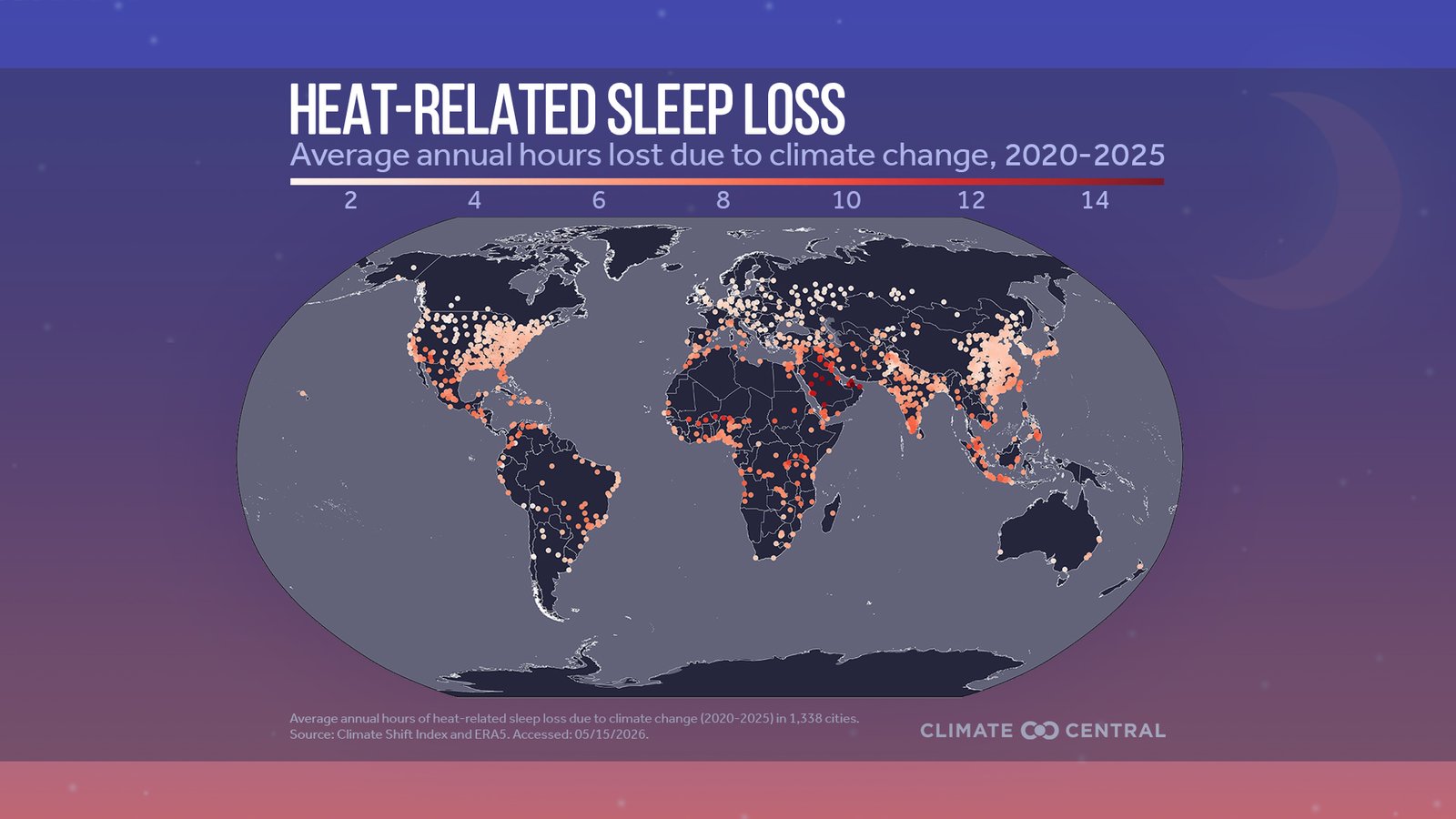
Cities across the Middle East experienced the highest levels of climate change-attributed sleep loss between 2020 and 2025
Across nearly every city analyzed, the amount of temperature-related sleep loss linked to climate change has at least doubled since the early 1970s
Air conditioning can help protect people from hot nights, but access to cooling is often tied to income, and high temperatures can still reduce sleep when cooling is available
Loading visual assets
July 15, 2026
July 15, 2026
Sleep is closely tied to the body’s ability to cool itself, and higher nighttime temperatures interfere with that cooling process. Warmer nighttime temperatures are associated with shorter sleep duration and reduced sleep quality, with stronger effects during the hottest periods, in warmer regions, and among more vulnerable populations.
Sleep plays a crucial role in human health and well-being. Poor sleep has been linked to impacts on mood, cognitive performance, productivity, and cardiovascular and immune health. While many factors influence sleep, nighttime heat is becoming an increasingly important environmental risk as temperatures rise globally, and as more people relocate to urban heat islands that further amplify nighttime temperatures. Because many people already get insufficient sleep and sleep loss can accumulate over repeated nights, even modest reductions can become harmful over the course of a hot season.
Climate change is increasing nighttime temperatures in many parts of the world and making extremely warm nights more common. To estimate how climate change is affecting sleep in cities globally, Climate Central applied an established relationship between nighttime temperature and sleep to both observed and counterfactual temperatures — or the temperatures that would have occurred in a world without carbon pollution. We analyzed two time periods: 2020 to 2025, and a historical period in the early 1970s. This allows us to estimate how much sleep the average person lost due to high nighttime temperatures and how much of this sleep loss was due to climate change.
Globally, the average person lost nearly 56 hours of sleep each year due to nighttime heat between 2020 and 2025. An estimated six hours of that annual sleep loss, or just over 10%, can be attributed to warming caused by climate change. That is equivalent to nearly seven nights’ worth of sleep lost each year due to higher nighttime temperatures, including about one night linked to climate change.
Although climate change accounted for a relatively modest share of total estimated heat-related sleep loss globally, its influence was substantially stronger in some regions and cities. The largest impacts were concentrated in places that already experienced extremely warm nighttime temperatures
Loading visual assets
During the 2020-2025 period, the cities with the greatest sleep losses linked to climate change were in the Middle East (see figure 1). We estimate that people in cities in Saudi Arabia, Oman, and the United Arab Emirates lost between 55 and 87 hours of sleep annually due to higher nighttime temperatures, with 12 to 16 lost sleep hours due to climate change. This is nearly two full nights’ worth of sleep each year lost due to the influence of climate change on nighttime temperatures.
Climate change-linked sleep losses were also high in other already-hot places: people in southern India and several countries in Southeast Asia lost 78 to 91 hours of sleep per year due to higher nighttime temperatures, including about eight to nine hours due to climate change. Similarly, people in some cities across West Africa, including selected cities in Niger, Nigeria, and Burkina Faso, lost 65 hours of sleep or more per year, including about 10 to 11 hours linked to climate change.
Loading visual assets
Similar climate change-linked sleep losses also appeared in some cities in the Americas, including the U.S. Southwest, Mexico, Guatemala, Colombia, and Venezuela. People in the 253 U.S. cities analyzed experienced an average of 36 hours of sleep loss per year from higher nighttime temperatures during 2020-2025, of which about four hours, or 13%, were due to human-caused climate change. The U.S. cities with the largest climate change-linked sleep losses (between seven and nine hours per year) were in Arizona, California, Florida, and Nevada.
Since the 1970s, the world has experienced rising temperatures as well as population growth, economic development, urbanization, and wider access to air conditioning.
To isolate the effect of climate change on sleep loss over time, we assume that the relationship between nighttime temperatures and sleep duration was the same in the 1970s as it was in 2015-2017 in high- and middle-income countries with likely access to cooling.
Holding all other factors constant, this analysis suggests that the role of climate change in temperature-related sleep loss has grown since the early 1970s.
Although the amount of temperature-related sleep loss due to climate change is relatively small, it has roughly doubled globally — from about two hours per year in 1970-1975 to about five hours per year in 2020-2025.
In the early 1970s, inhabitants of the average city we analyzed lost about 46 hours of sleep per year due to nighttime heat. By the 2020s, that rose to about 50 hours, and climate change accounts for a larger share of that burden. The climate change-linked portion of this sleep loss has at least doubled since the early 1970s in nearly every city analyzed (1,335 of 1,338) and has at least tripled in 840 of those cities.
Across the 253 U.S. cities analyzed, climate change-related sleep loss remained relatively small but grew faster than the global average, roughly tripling from just over one hour per year in the early 1970s to about four hours per year in the 2020s
The burden of heat-related sleep loss also does not fall evenly. For example, a recent study found that the effect of warmer nighttime temperatures is more than twice as large for adults over 65 as for middle-aged adults, and nearly three times as large for people in lower-middle-income countries as for people in high-income countries. The same study also found greater effects among women and people already living in hotter climates, with heat-related sleep loss likely to worsen as temperatures continue to rise.
Air conditioning can help people cope with hot nights, and it is widely used across the Middle East, where several highly affected cities in this analysis are located. Globally, however, household air conditioning ownership remains limited, with ownership reaching about 35% of households in 2021. Research shows that air conditioning access is strongly tied to income and remains highly unequal in many hot countries, including parts of South Asia and Africa. Even so, hotter nights can still cut into sleep, even in higher-income settings where cooling is more likely to be available.
At the same time, the sleep research underlying this analysis drew more heavily from people in higher-income countries, where access to cooling and other heat-coping reol, heat-related sleep losses may be greater than these estimates suggest, making these results conservative for some populations
As most adults have experienced at one time or another, work schedules, stress, health, caffeine, light, noise, bedroom conditions, and humidity can all shape how much sleep one gets and how strongly hot nights affect their sleep. But as this analysis shows, climate change and nighttime warming are increasingly impinging on the ability to get a good night’s sleep

Report
To request an interview with a Climate Central expert about this analysis, please contact Abbie Veitch, aveitch@climatecentral.org
Kelton Minor, Ph.D.Associate Professor of Planetary Behavioral Data ScienceUniversity of CopenhagenRelated expertise: effects of heat on sleep; climate adaptation; behavioral data scienceContact:kmi@sodas.ku.dk
We estimated sleep loss due to higher nighttime temperatures using a temperature-sleep response function derived from Minor et al. (2022). This model quantifies the relationship between daily temperature and changes in sleep duration using a piecewise linear spline. We applied the published spline coefficients to the daily minimum temperature, which reflects nighttime conditions most relevant for sleep. Although we refer to these estimates in some places as “heat-related sleep loss,” the underlying response function estimates sleep loss associated with higher nighttime temperatures across a wide range of temperatures, including nights that are warmer but not necessarily hot.
Daily sleep loss was calculated for each grid cell globally using observed and counterfactual temperatures. The difference between observed and counterfactual estimates represents the portion of this sleep loss that is attributable to climate change. We translate annual hours of sleep loss into “nights” of sleep using eight hours as a benchmark for a full night of sleep
For clarity, figures are rounded to the nearest significant digit. While the analysis used high-precision data, fewer decimals are shown, which may lead to minor arithmetic discrepancies but does not affect overall accuracy.
Based on research on the effects of temperature on sleep, we analyzed observed daily minimum temperatures using ERA5 Reanalysis data at 0.25° (~31 km). Actual bedroom temperatures can vary with housing, ventilation, retained heat, and access to cooling, but the underlying research estimates sleep responses in real-world settings where people may use cooling or other heat-coping behaviors, and statistically controls for access to air conditioning.
Additionally, the analysis utilized counterfactual temperatures, or the temperatures that would have occurred in a world without human-induced climate change. These are estimated using Climate Central’s Climate Shift Index (CSI) system. The system uses the latest peer-reviewed attribution science to quantify the influence of climate change on daily temperatures around the world
We typically express this influence as a change in the likelihood of the observed temperature due to climate change. However, it is also possible to use the CSI system to estimate the temperature without climate change. To do this, we find the probability of exceeding the observed temperature in the modern climate. We then find the temperature with the same probability in a climate with no global warming (global mean temperature change of 0°C relative to the pre-industrial period). We estimate these counterfactual temperatures using the CSI system’s two observation-based methods and a model-based method that draws on a 24-model CMIP6 ensemble, then combine the resulting estimates.
We analyzed 1,338 cities globally, drawn from GeoNames. We included any city that has a population of more than 500,000. We also included a selected list of 253 U.S. cities
This license grants permission to use, distribute, and reproduce all text, graphics, and multimedia content published on this page in any medium, provided that Climate Central is credited per theCC BY 4.0license
Permission to use data and other materials published on this page is granted for non-commercial uses, commercial news purposes, and educational purposes as governed by Climate Central’sTerms of Use
