


‘;
document.currentScript.insertAdjacentHTML(“beforebegin”, banner);
let giftListenerCb = function (e) {
let date = new Date(e.detail.expiration_date);
let formatted = date.toLocaleDateString(“en-US”, {
month: “long”,
day: “numeric”,
year: “numeric”,
});
document.querySelector(“.article__gift-banner-exp”).textContent = formatted;
document.querySelector(“.article__gift-banner”).hidden = false;
window.removeEventListener(“hasValidGiftLink”, giftListenerCb);
};
window.addEventListener(“hasValidGiftLink”, giftListenerCb);
}
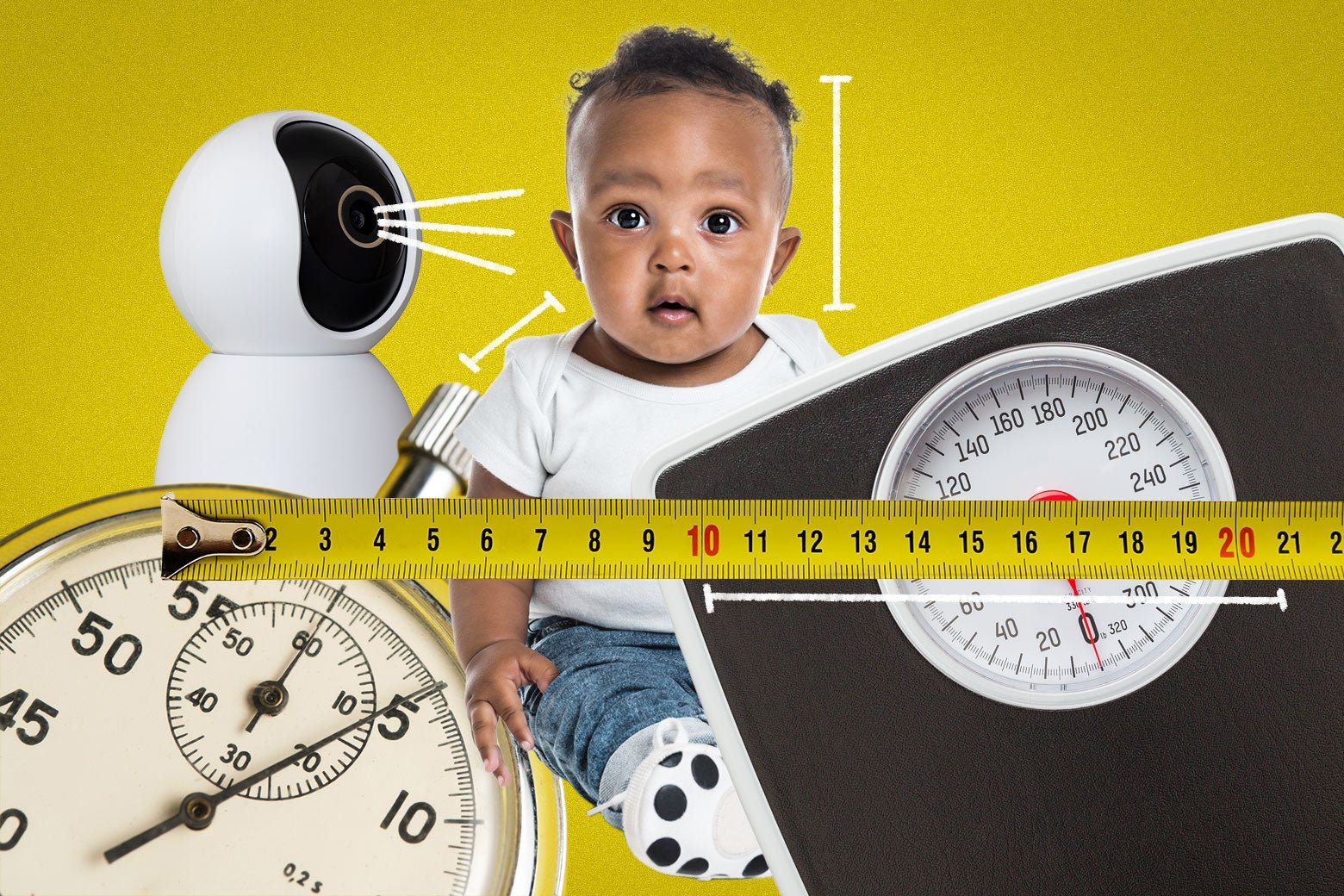
Parents today have access to more information than any generation in history. We can easily follow experts, the latest research, and a cacophony of influencers, all weighing in on matters as small as which bottle to use and the exact words to say when a child breaks a rule. We’ve got devices that monitor our kids—you can now buy your child a fitness tracker—and even babies, with devices spitting out oxygen levels, nighttime movement, and, in a nod to the wearables adults use, scores to let us know how well our child slept. As one of the baby monitoring companies states, its goal is “Turning infant health data into peace of mind for parents.”
And yet, we’re the first generation to receive a formal advisory on parental stress from the surgeon general. He presented data showing that nearly half of parents say their stress is overwhelming most days, versus a quarter for nonparents. In 2024 then–Surgeon General Vivek Murthy identified one of the main culprits: “A ‘culture of comparison’—often perpetuated online—around milestones, parenting and achievements, ‘has left many families feeling exhausted, burned out, and perpetually behind.’ ”
In turning our quest for optimization to the youngest among us, we’ve been promised that all this information and data will help keep our kids safe and on course. After all, the technology available for this is very similar to that which elite athletes use to sleep and perform better
But as an exercise physiologist who has spent a lifetime working with those same professional athletes, I think we’ve made a crucial mistake. We missed the hard lessons every athlete had to learn as they adopted this technology. When it comes to our kids, our quest for optimization is not so much lessening anxiety as feeding it
When working with elite athletes, there’s often a pattern that comes with looking at wearable data. At first, a new piece of technology is exciting, promising to help dial in your training or recovery and ultimately improve your performance. And there’s some truth to that—a tracker can help you clue into the fact that although you mean to go to bed at 9 each night, you typically spend a long time scrolling before your head hits the pillow. But often, the data that started as interesting information becomes a kind of dictator.
Take, for example, a runner whose preparation for a race has gone perfectly and who is confident and raring to go. But they wake up on race day with the dreaded red signal on their watch telling them they haven’t fully recovered from a shake-out run the day before. That assessment can send the mind spiraling, and anxiety increases. Then it’s up to their coach to talk them into dismissing the algorithm they’ve spent the past few months trusting. Their wearable is just making a guess. Even if the athlete knows this logically, however, they’ve still handed over their emotional state to a score that may not reflect reality.
The same thing happens with nonathletes. In a small study on people with insomnia, when they were given a false negative sleep score, those individuals reported sleepiness and fatigue, as well as lower levels of alertness and clear thinking. In 2017 researchers coined the term orthosomnia to describe the tendency to chase perfect scores with sleep tracking and the ensuing sleep problems, distress, and anxiety from not receiving a perfect score. This anxiety persisted even after scientists at a sleep lab informed study participants they had achieved quality sleep.
We value what we give attention to. And if we’ve consistently told ourselves that the score reflects something important, it makes sense to feel anxious about it. The wearable data isn’t just information that we look at; it becomes part of our brain’s inner calculation. If everything around us is telling us we are going to feel miserable, that we’re not recovered, we’ll start to believe it.
In the age of information overload, nearly every elite athlete has to figure out when to throw the watch away. Because if you don’t, the data essentially controls you, shifting your stress in response to whatever number pops up today
Now imagine that pull when the thing being scored isn’t your 5K time. It’s the person you care about most in the world
Imagine you were given a daily report on a proxy measure of your baby’s intelligence or their potential to become a football star. Chances are you’d either be overcome with stress or go on an optimization kick, attempting to do everything you could to move the needle on that number so you didn’t feel like a bad parent
Optimization culture sells us a false promise. It gives us a shiny number that has the air of “science” and promises that if you improve this, something good will happen. But it’s the same trap that longevity influencers set when they tell us to improve grip strength to extend our lifespan. The measure is a mere proxy to the thing we actually care about
Researchers refer to this phenomenon as Goodhart’s law: “When a measure becomes a target, it ceases to be a good measure.” The number starts out as a proxy for something meaningful that you care about. Your sleep score gives you a rough guess about your levels of rest and energy. But when you start to focus on improving the metric, it often disconnects from the thing you actually care about underneath. It’s achieving the perfect sleep score while spending all day worrying about the perfect sleep score. Or training for grip strength specifically, when that measure merely shows who generally exercises or is regularly active.
In parenting, the things you actually care about are largely unmeasurable. You want a child who feels secure and loved and is developing. So we reach for proxies: hours of sleep, number of words said, percentile growth chart. It’s not that any of these are bad. They have their place. But once we start training for the proxy metric itself, it loses its value. You start aiming to improve words read, which in turn moves you away from what actually matters: a kid who loves reading books.
This is exactly what the research tells us. In a series of experiments at Duke University, scientists found that the act of measuring an activity reliably reduces enjoyment, making it feel like work. It pushes us to focus on the outcome and takes us out of the experience itself. And according to lead author Jordan Etkin, “The very people who self-select into measurement are the ones who are hurt by it.”
Now think about how that might apply to our young kids. Do we really want to turn raising a child into the kind of job for which we get a data-driven performance review? One that not only looks at what our kid is doing but implicitly judges how we’re doing as parents? Turning our children’s rest and activities into a series of numbers is a recipe for feeding the anxiety doom loop. And it almost certainly won’t move the needle.
In the 1950s, D.W. Winnicott coined the term the “good enough” mother to express a radical idea: Perfection in parenting isn’t what we should shoot for. His claim was that a child needs the parent to fail in small, tolerable ways. If they don’t, then the child doesn’t gain the independence or ability to tolerate frustration that they’ll need in life
In the 1990s, Sandra Scarr provided research that partially validated and expanded on Winnicott’s ideas. She argued that once a threshold of basic safety, nutrition, love, and stimulation was met, the particular details of the style had a very small effect on a child’s personality or intelligence
This doesn’t mean, however, that parenting doesn’t matter, or that we should throw up our hands and say, “What’s the point?” The impact of parenting is still debated to this day. More recent work suggests that parenting style might not directly affect a child’s personality but can influence the paths they take or interests they pursue. If a child sees education modeled as important, that kid is more likely to go to college. Our expectations shape our children’s paths.
But what Winnicott and Scarr were getting at is that the expectations we place on parents—of having an overly outsized sway, in which every decision feels as if it’s fundamentally shifting their children’s potential—just aren’t true once we’ve satisfied kids’ basic physical and psychological needs. And parents feel that burden even more so today
Optimization culture tries to tell us the opposite story: that even the smallest details matter, and that it can track and measure them for you. That your kid doesn’t need justsleep (and for to address any problems like chronic tiredness). That they need you to check their sleep score each morning
I’ve watched that story play out many times with elite athletes. They start majoring in the minors, obsessing over measurable targets, even though those targets might not provide help where they need it (e.g., performance). It becomes a kind of optimization theater; the athletes overindex on the margins and forget what actually matters. Over time, they turn into an anxious mess, needing validation from the black-box algorithmic number.
I’m not anti-tech. I’m a science nerd who has tried every gadget under the sun. But it’s precisely that experience, and that of my wife, who was an actual world-class athlete, that helps me resist the temptation to go the path of data overload with our two daughters. The secret to almost every elite performance is to nail the basics, to figure out what truly moves the needle on the thing you care about, and, perhaps most importantly, to know when to settle for good enough. Because good enough is what allows us to stay in the game long enough to find out where our potential lies.
It’s even more true with parenting. Don’t fall for the optimization trap. You’ve got to know when to throw the watch away. And remember, you can’t optimize a relationship. You can only be present in one
- Family
- Kids
- Sports
