


Space habitat design could shape astronaut mental health on Mars missions
MIT engineers mapped how lighting, layout, privacy, and reconfigurable spaces can affect crews living far from Earth
Edited By: Joseph Shavit/
MIT Writer: Abby Abazorius
Published Aug 15, 2026 4:07 PM PDT
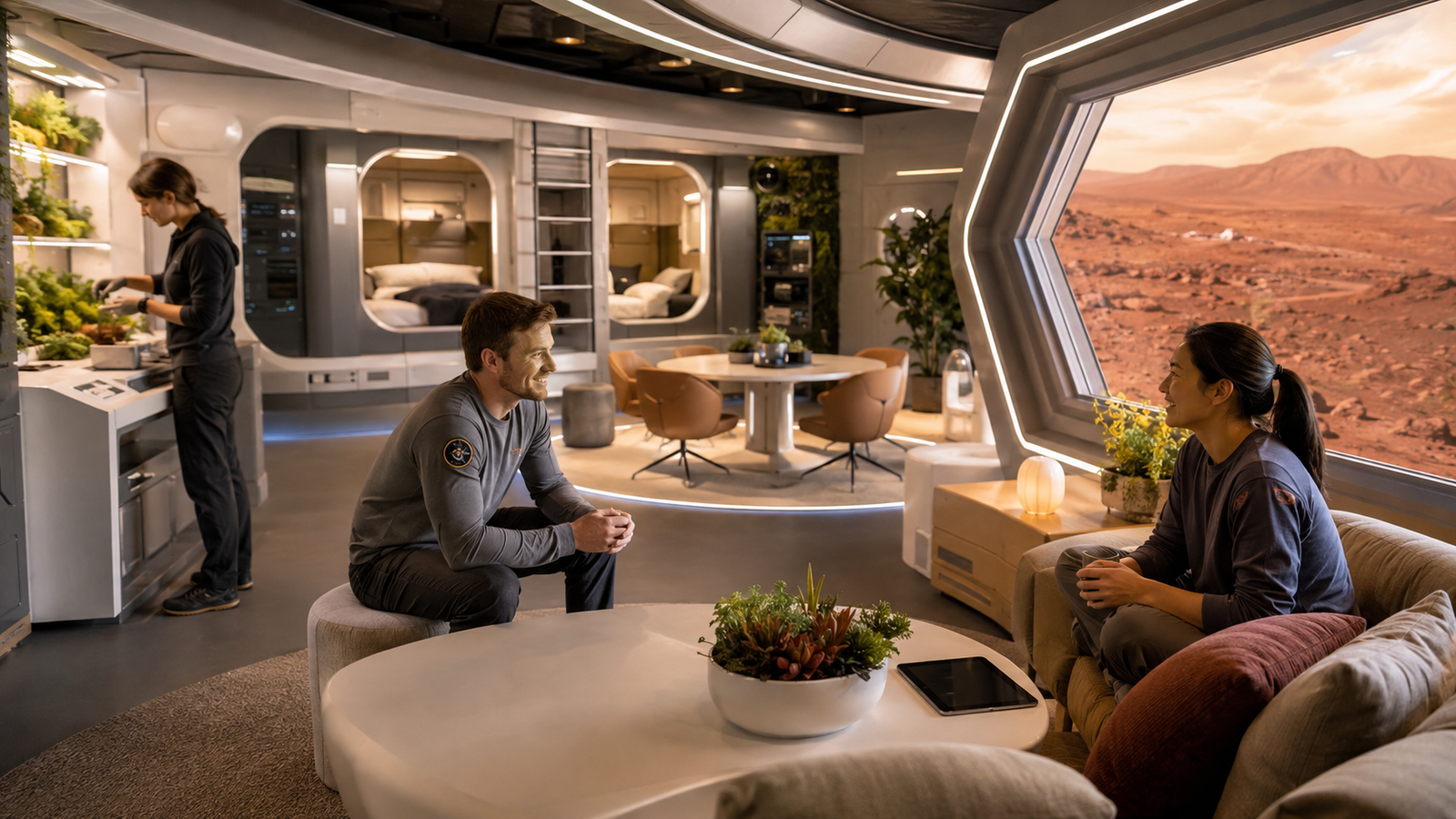
Space habitat design could shape astronaut mental health on long missions by influencing sleep, privacy, connection, and homesickness. (CREDIT: Shutterstock)
- Space habitats may need to protect astronauts’ mental and social wellbeing, not just shield them from physical hazards.
- An MIT-led team mapped how design choices such as lighting, privacy, layout, and reconfigurable spaces connect with stress, sleep, homesickness, and social bonds.
- The interactive tool could help designers weigh behavioral health alongside engineering risks, though it does not prescribe one solution for every habitat.
Space habitats can shield astronauts from physical danger, yet survival alone may not be enough for journeys lasting months or years. The arrangement of walls, lighting, privacy, and shared spaces could also shape how crews feel and function
Engineers at MIT and other institutions have created a framework linking habitat design choices with behavioral health outcomes such as stress, anxiety, fatigue, homesickness, curiosity, and social connection. Their work centers on an interactive tool called the Human-Environment Connection and Interaction Atlas, or HECIA
The project brings together scientific literature and expert interviews, then maps relationships between features of an extreme habitat and the people living inside it. The goal is to make psychological and social considerations easier to see during design decisions
“The awareness has been there for some time that living in space is difficult,” says Mich Lin, a PhD candidate in the Human Systems Lab and the Engineering Systems Lab at MIT. “We’ve come a long way from the human in a tin can. Asour priorities shift toward long-duration exploration missions, making sure a crew is safe, healthy, happy, and productive becomes even more important.”
Lin and colleagues modeled the system after a risk-mapping format used by NASA. The agency uses directed acyclic graphs, or DAGs, to show how one mission constraint can lead to downstream effects
A NASA graph might connect distance from Earth with outcomes involving sleep, cardiovascular health, or cognitive function. Each link can help planners see where a problem begins and where intervention may be possible
“By mapping risks, we can identify points of intervention to characterize and mitigate them,” Lin explains. “NASA uses DAGs as a countermeasure to the risky business that is human spaceflight.”
The team applied that logic to less tangible outcomes, including boredom, trust, nostalgia, stress, curiosity, and kinship
“The connection between habitat and behavioral health has not been made in this format before,” Lin emphasizes. “So we made those connections for the first time.”
To decide which experiences belonged in the atlas, the researchers drew from aerospace and human-factors reHouston professor and social work researcher Brené Brown, which identifies 87 emotions and experiences
The team narrowed that list to 14 emotions or experiences considered especially relevant to isolated, confined, and extreme habitats. Among them were anxiety, autonomy, nostalgia, curiosity, fatigue, and kinship
The researchers searched widely through scientific studies on habitability in extreme environments. Existing work has examined how lighting affects sleep, circadian rhythms, and productivity. Other research has explored how circulation paths and habitat layouts influence privacy, social connection, and crew performance
Those findings became links in a larger web showing how design choices may affect mental, emotional, and social wellbeing. Experts from industry, academia, and NASA reviewed the map and provided feedback
The study was led by Lin, with former MIT undergraduate Lu Chen and University of Colorado Boulder professor Katya Arquilla as co-authors. Contributors included Lauren Blackwell Landon at KBR/NASA, Jeffrey Montes of Different Systems, and MIT undergraduate Kara Chou
HECIA turns the network into an interactive platform. Designers can follow connections forward from a mission constraint or backward from a behavioral outcome they want to address
A Mars mission offers one example. A designer could begin with “distance from Earth,” then follow its connections to limited access to food, medical capability, family, and friends. Those constraints can connect with nostalgia or homesickness
A designer concerned about homesickness could instead start with that outcome and trace it toward factors that might influence it
One route leads to “place attachment,” meaning an emotional attachment to a place. From there, the atlas points toward upstream design elements such as reconfigurability and privacy
Each term also includes a research-based summary and examples of possible design interventions. For social isolation, Lin gives an example involving circulation through a habitat
“They may read that research has found ‘access paths, stairs, entrances, contribute to the formation of friendships and social cohesion,’” Lin offers. “So that would give them an idea of connecting public spaces in the habitat
The researchers stress that HECIA is not a universal blueprint. A habitat’s design still depends on its mission, specifications, and constraints. The atlas instead highlights relationships whose consequences may not be immediately obvious
“Rather, this helps you think about connections that might be important, but that aren’t immediately obvious,” Lin says. “As we envision truly becoming an off-planet species, or creating places we want to live in in space, there is so much potential for us to reimagine habitats that make us happy and productive.”
The framework gives habitat designers a way to consider behavioral health alongside familiar engineering risks. For long-duration missions increasingly independent from Earth, that could help teams identify choices affecting crew wellbeing before those choices become fixed
Its usefulness may extend beyond spacecraft. Lin points to submarines, oil rigs, polar expeditions, refugee camps, and war zones as other isolated or stressful settings where the physical environment can shape daily experience
“Submarines, oil rigs, polar expeditions, and even refugee camps or war zones are incredibly stressful environments,” Lin says. “We try to make this work applicable to a lot of scenarios and identify points of intervention in habitat design to reduce stress in those extreme environments.”
The project does not claim that one layout, lighting system, or privacy feature will solve behavioral health problems everywhere. Its value lies in organizing existing evidence so designers can see relationships and weigh tradeoffs
For crews traveling far from Earth, that could broaden the definition of a successful habitat. Protection from physical hazards remains essential, but living spaces may also need to support connection, comfort, autonomy, and belonging
The research was supported in part by NASA
These rehting and mission architecture can shape astronaut health and performance during long-duration spaceflight
Evaluating the impact of mission architecture on crew dynamics in space explorationResearchers compared two analog missions and found that mission architecture influenced several measures of crew socioemotional health, showing that the way people and living spaces are organized can affect team dynamics during Mars-like missions. (npj Microgravity, 2026)
Exploring light and colour in space habitats: A scoping review of habitability studiesThis review examines how lighting and color can affect psychological and physiological responses in space habitats and proposes a framework for designing environments that better support human needs during extended missions. (Indoor and Built Environment, 2026)
Biopsychosocial Health Considerations for Astronauts in Long-Duration Spaceflight: A Narrative ReviewThis review considers the intertwined biological, psychological and social challenges of long-duration spaceflight, including isolation, communication difficulties and interpersonal dynamics, and argues for a more integrated approach to astronaut health. (Wilderness & Environmental Medicine, 2025)
Social support from different ironmentsData from 64 people across five spaceflight analog campaigns showed that perceived social support generally declined during prolonged isolation, while stronger support from fellow crew members was associated with lower evening stress. (Frontiers in Psychology, 2025)
Optimise behavioural health and human factors research for deep space missions by classifying analogue scenarios and fidelityThe authors evaluate how well different Earth environments reproduce the isolation, confinement and behavioral challenges of deep-space missions, identifying submarines, polar expeditions and other settings as valuable laboratories for improving astronaut health research. (Frontiers in Space Technologies, 2025)
Research findings are available online in the journal npj Microgravity
The original story “Space habitat design could shape astronaut mental health on Mars missions” is published in The Brighter Side of News
- NASA is looking for four volunteers willing to spend a year inside a simulated Mars mission
- NASA’s first nuclear-powered spacecraft is heading to Mars, and its bringing helicopters
- Scientists develop new process to build homes on Mars using fungi and bacteria
Like these kind of feel good stories? Get The Brighter Side of News’ newsletter
astronaut mental healthbehavioral healthCircadian Rhythmscrew wellbeingdirected acyclic graphshabitat designHECIAhuman spaceflightInnovation Newslong-duration spaceflightMars missionsMITNASAResearchSciencesocial isolationspace habitat designspace habitatsSpace NewsTechnology
Joseph ShavitScience News Writer, Editor and Publisher
Joseph ShavitWriter, Editor-At-Large and Publisher
Joseph Shavit, based in Los Angeles, is a seasoned science journalist, editor and co-founder of The Brighter Side of News, where he transforms complex discoveries into clear, engaging stories for general readers. With vast experience at major media companies like The Los Angeles Times, Times Mirror and Tribune Publishing, he writes with both authority and curiosity. His writing focuses on space science, planetary science, quantum mechanics, geology. Known for linking breakthroughs to real-world markets, he highlights how research transitions into products and industries that shape daily life.
Latest Stories
 Space2-kiloparsec trail of stars could reveal how dark matter shapes galaxiesJoseph Shavit
 DiscoveriesGolden deep-sea coral off Costa Rica adds a new branch to the tree of lifeRebecca Shavit
 HealthNewer blood thinners linked to slower Alzheimer’s declineMac Oliveau
