


Promoting sleep health in future healthcare professionals: development and validation of a multi-component lifestyle intervention module for nursing students
1. Taishan Vocational College of Nursing, Taian, Shandong, China
2. Center for Toxicology and Health Risk, Faculty of Health Sciences, Universiti Kebangsaan Malaysia, Kuala Lumpur, Malaysia
3. Center for Healthy Ageing and Wellness, Faculty of Health Sciences, Universiti Kebangsaan Malaysia, Kuala Lumpur, Malaysia
4. Centre for Community Health Studies, Faculty of Health Sciences, Universiti Kebangsaan Malaysia, Kuala Lumpur, Malaysia
5. College of Biotechnology and Pharmaceutical Engineering, Nanjing Tech University, Nanjing, China
Article metrics
View details
Abstract
Background:
Sleep disturbances are a widespread public health concern among nursing and healthcare students globally, with consequences for academic performance, mental health, and long-term professional competence. Despite evidence linking multiple lifestyle factors, such as physical activity, diet, stress management, and relaxation techniques, to sleep quality, comprehensive interventions integrating these elements remain limited in nursing education. We plan to conduct a pre-registered 4-week pre–post effectiveness pilot and will report effect sizes (Cohen’s d, 95% CI).
Methods:
This study applied the Sidek Module Development Model (SMDM) to design and validate a multi-component lifestyle intervention module aimed at improving sleep quality among vocational nursing students in China. The module integrated five evidence-based components: physical activity, psychoeducation, music therapy, meditation, and nutrition. Content validity and educational quality were assessed by six independent experts using the Content Validity Index (CVI) and the Template for Evaluating Patient Education Documents (TEMPtED). Reliability and acceptability were further evaluated among 47 nursing students through a Likert-scale questionnaire, with Cronbach’s alpha computed for internal consistency.
Results:
The module demonstrated strong psychometric properties. The overall scale-level content validity index (S-CVI/Ave) was 0.985, exceeding the recommended threshold and confirming excellent content validity. All five sub-modules were rated as “Excellent” in educational quality based on the TEMPtED evaluation. Student feedback yielded a Cronbach’s alpha of 0.980, reflecting high internal consistency and suggesting that the module’s structure and materials were coherent and well-received. These results indicate strong preliminary evidence supporting the module’s validity and reliability during the development and validation phase.
Conclusion:
This study developed and validated a scientifically robust, educationally feasible, and culturally responsive lifestyle module designed to promote sleep health among nursing students. While the findings demonstrate strong content validity, educational quality, and internal consistency, they represent an initial validation stage rather than evidence of intervention effectiveness. The validated framework provides a solid foundation for future implementation, cross-cultural adaptation, and evaluation studies aimed at examining its impact and long-term sustainability across diverse educational contexts.
1 Introduction
For Sleep quality has become a critical public health concern, particularly among university and vocational students in health-related fields. Nursing students are especially vulnerable due to their heavy academic workload, irregular class and clinical schedules, and the psychological demands of caring for patients in training environments. Numerous studies have demonstrated that insufficient or poor-quality sleep negatively affects cognitive performance, attention span, memory consolidation, emotional regulation, and overall mental health (). In the context of nursing education, these impairments may directly compromise professional learning outcomes, reduce clinical competence, and ultimately impact the quality of patient care (, ).
Emerging evidence further indicates that lifestyle-related factors play a substantial role in the prevalence of sleep disturbances among young adults. Behaviors such as insufficient or irregular physical activity, poor dietary habits, maladaptive stress management, prolonged screen time, and lack of effective relaxation techniques are strongly correlated with sleep disorders (). Consequently, interventions focusing on a single factor, such as exercise or diet alone, often yield limited improvements. In contrast, multi-component lifestyle interventions that integrate diverse elements such as physical exercise, mindfulness or meditation, music therapy, nutrition education, and psychoeducation have been shown to produce more robust and sustainable effects on sleep quality ().
Despite the growing body of international research, structured intervention programs tailored to the needs of Chinese vocational nursing students remain scarce. Existing sleep health initiatives are often fragmented, overly generalized, or lack systematic guidance and measurable outcomes (, ). In contrast, module-based interventions provide unique advantages. The delivery of structured learning materials, step-by-step activities, explicit objectives, and evaluation criteria provides a systematic and replicable framework that can be readily adopted by educators and students alike. Furthermore, the modular design allows for flexibility in adaptation to different educational settings, enhancing scalability and sustainability ().
The Sidek Module Development Model (SMDM) has been widely acknowledged as a rigorous framework for the systematic design, development, and validation of educational modules. Its two-phase structure, which comprises module drafting through expert consultation followed by testing and validation with the target audience, ensures that the final product is theoretically grounded, content-valid, and reliable in real-world applications (). SMDM has been successfully applied across a range of educational and health-related contexts, further supporting its utility for developing interventions addressing sleep health among nursing students.
Therefore, the present study sought to develop and validate a multi-component lifestyle intervention module intended to enhance sleep quality among vocational nursing students. The specific objectives were: (1) to design and refine the intervention module through an iterative process of expert consultation, (2) to evaluate its content validity and educational quality using expert assessments with the Content Validity Index (CVI) and the Template for Evaluating Patient Education Documents (TEMPtED) instrument, and (3) to assess its internal consistency and acceptability through a structured Likert-scale questionnaire administered to nursing students.
While the study is grounded in the context of Chinese vocational nursing education, its implications extend far beyond national boundaries. Sleep disturbances among nursing and healthcare students are a global challenge, affecting academic performance, clinical competence, and long-term professional well-being. By integrating physical activity, psychoeducation, music therapy, meditation, and nutrition into a structured and culturally sensitive framework, this study provides not only a locally relevant solution but also a potentially adaptable model for nursing and health education programs worldwide. In doing so, it contributes to the broader international effort to improve student health, enhance the quality of professional training, and strengthen the resilience of the future healthcare workforce.
2 Methodology
2.1 Research design
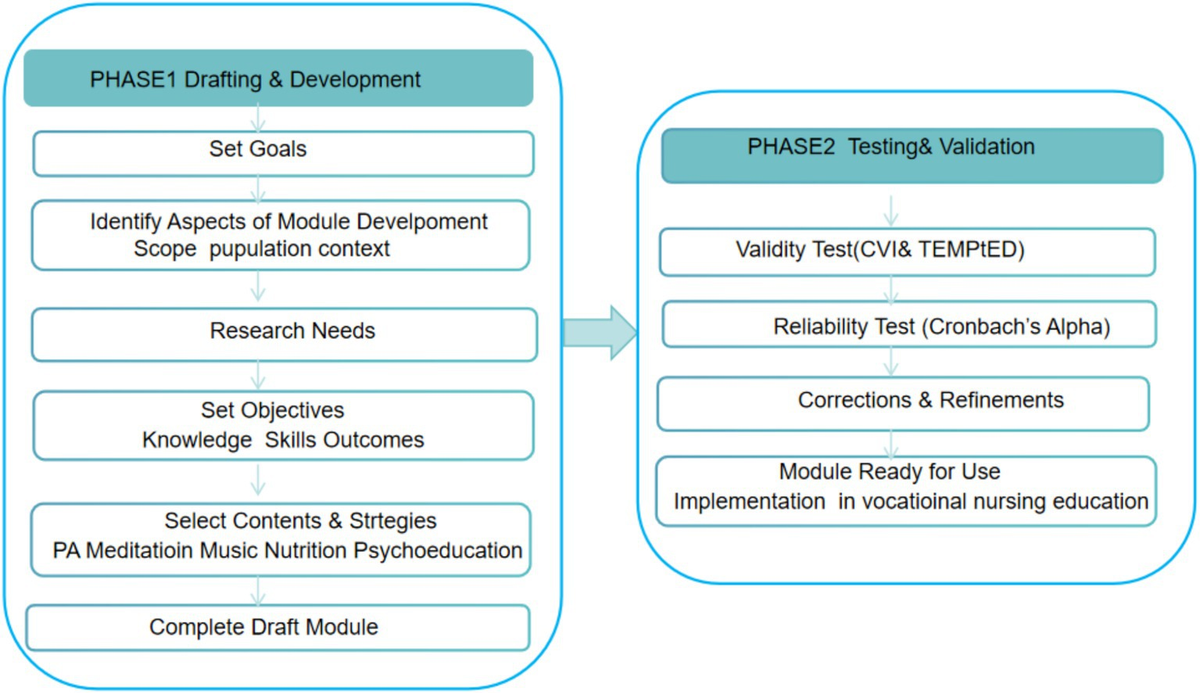
This study was conducted based on the Sidek Module Development Model (SMDM), which emphasizes a systematic two-phase approach: module development followed by validation. The first phase involved drafting the module by generating preliminary content through a comprehensive literature review and initial expert input, after which the draft underwent multiple rounds of consultation and refinement until consensus was reached. The second phase focused on testing and validation, which comprised two components: expert assessments of content validity and educational quality, and student-based evaluations of reliability and acceptability. This structured design ensured that the developed module was both theoretically grounded and practically feasible for implementation in vocational nursing education. Figure 1 illustrates the overall research process following the SMDM framework.
2.2 Participants
The participants in this study comprised both experts and nursing students. For the development phase, six experts were purposively selected to represent a multidisciplinary perspective encompassing sleep medicine, psychology, physical activity, nutrition, music therapy, and meditation. The use of 5–10 experts is recommended in module development and validation studies to balance diversity and manageability (). A total of six was deemed sufficient to ensure comprehensive evaluation across relevant domains. In the event of disagreement (e.g., a 50:50 split in expert ratings), the item was retained and discussed until a consensus (at least 80% agreement) was achieved through iterative consultation, consistent with the content validation procedures outlined by Grant and Davis Grant and Davis ().
For the validation phase, another six experts, distinct from those involved in development, were engaged to evaluate the module’s content validity and educational quality. The use of separate panels for development and validation has been recommended to minimize confirmation bias and to enhance the credibility of content validation results (). The six validation experts included one specialist each in (1) sleep medicine, (2) psychology, (3) nursing education, (4) physical activity, (5) music therapy, and (6) nutrition. All held doctoral or senior professional qualifications and had more than ten years of experience in their respective fields.
To test internal consistency reliability (Cronbach’s α) of the module acceptance scale, a sample size was calculated using the single population proportion formula with a margin of error (δ) of 0.15, appropriate for reliability pilot studies ():
Accounting for 10% attrition, the final recommended sample was 47 students. This number satisfies minimum thresholds for preliminary scale validation and reliability analysis using Cronbach’s alpha ()
Three instruments were utilized to evaluate the developed module
First, the Content Validity Questionnaire was distributed to the six validation experts. Each module item was rated on a five-point Likert scale, ranging from 1 (not relevant) to 5 (highly relevant). From these ratings, both the Item-level Content Validity Index (I-CVI) and the Scale-level CVI (S-CVI/Ave) were calculated. Items with I-CVI values above 0.80 were considered acceptable, and an S-CVI/Ave value of 0.90 or above was interpreted as strong evidence of overall content validity.
Second, the TEMPtED instrument (Template for Evaluating Patient Education Documents) was used to assess the educational quality of the module. This tool comprises five dimensions, namely Content, Motivational Principles, Literacy, Layout and Typography, and Graphics. Each item within these dimensions was scored on a four-point scale from 0 (not met) to 3 (fully met). Dimension scores were summed to produce an overall total score, which was then classified according to established thresholds: 49–54 (Excellent), 44–48 (Good), 38–43 (Moderate), and ≤37 (Not suitable).
Third, a Student Acceptability Questionnaire was administered to the 47 nursing students. The questionnaire used a five-point Likert scale to evaluate the clarity, relevance, and feasibility of the module. Responses were used to compute Cronbach’s alpha, a measure of internal consistency reliability
2.3 Procedure
The module development process followed a structured sequence. Based on findings from Phase I and relevant literature, five sub-modules were drafted:
Physical activity, addressing exercise type, frequency, and duration
Psychoeducation, focusing on stress and anxiety management and responsible smartphone use
Music therapy, guiding students in selecting and applying therapeutic music
Meditation, providing step-by-step techniques for mindfulness practices
Nutrition, emphasizing dietary balance, caffeine regulation, and practical implementation
Detailed descriptions of the intervention design and implementation are provided in Supplementary Table S1. Drafts of these sub-modules were presented in workshops involving the six development experts, who reviewed the materials and suggested revisions. Iterative modifications were made until consensus was achieved. In Phase 2, the finalized module was distributed to the validation experts, who assessed content validity and educational quality using the CVI and TEMPtED instruments. Simultaneously, 47 nursing students completed the acceptability questionnaire, which generated data for reliability analysis.
2.4 Data analysis
Data analysis followed a multi-step process. I-CVI was defined as the proportion of experts rating an item ≥3 on a five-point scale. Items with I-CVI between 0.78 and 0.89 were discussed, revised for clarity, and retained after consensus was reached. S-CVI/Ave was computed as the mean of all I-CVI values. Discrepancies were resolved when at least 80% agreement was achieved. TEMPtED scores were averaged across six independent raters. For the Content Validity Index, I-CVI was calculated as the proportion of experts rating each item with a score of 3 or higher, while S-CVI/Ave was computed as the average of all I-CVI values across items. For the TEMPtED evaluation, individual dimension scores and total scores were calculated and interpreted according to the classification thresholds described earlier. For the student acceptability data, Cronbach’s alpha was computed to assess internal consistency reliability. Following conventional benchmarks, values ≥0.90 were interpreted as excellent, 0.80–0.89 as good, 0.70–0.79 as acceptable, and values below 0.70 as poor.
3 Results
3.1 Module development outcomes
The final intervention module was structured around five interrelated sub-modules: physical activity, psychoeducation, music therapy, meditation, and nutrition. Each sub-module incorporated objectives, theoretical justification, recommended strategies, and implementation guidelines. For example, the physical activity module emphasized moderate-intensity aerobic exercise and muscle-strengthening routines, while the nutrition module highlighted balanced dietary intake and caffeine management. The psychoeducation sub-module focused on stress management and smartphone use, the music therapy sub-module guided students in selecting and applying therapeutic music, and the meditation sub-module introduced mindfulness practices with step-by-step exercises.
The module drafting process required several iterative rounds of expert review. Six validation experts were selected based on doctoral or senior clinical qualifications and at least 10 years of experience in sleep medicine, psychology, nursing education, physical activity, or nutrition. These experts were not affiliated with the authors’ institution and had no involvement in module development to ensure independence. The development and validation panels were distinct to reduce confirmation bias. Experts highlighted the importance of aligning the content with the daily schedules of nursing students, who often face irregular sleep–wake patterns due to clinical training. Revisions were made to ensure feasibility, such as recommending 20–30 min of physical activity per day instead of longer sessions. Experts also emphasized cultural appropriateness, for example by suggesting familiar forms of meditation and music genres more acceptable to Chinese students. The final consensus confirmed that the module not only reflected scientific evidence but also met the needs of the specific target population.
This systematic development process aligns with prior research emphasizing that health education modules are most effective when co-designed with multidisciplinary input and tailored to the lived experiences of the intended learners. Thus, the present module represents a significant advancement in bridging theory and practice for sleep health promotion among nursing students
3.2 Content validity (CVI analysis)
The content validity of the module was rigorously evaluated by six independent experts who were not involved in the development stage. Each expert rated the relevance of the module items using a five-point Likert scale. The item-level CVI (I-CVI) values ranged from 0.833 to 1.000, indicating that almost all items were consistently judged as relevant or highly relevant by the majority of experts. The scale-level CVI (S-CVI/Ave) reached 0.985, which is substantially higher than the recommended threshold of 0.80 and suggests excellent overall content validity.
As shown in Table 1, the detailed results highlight the breadth and appropriateness of the module content. The consistently high I-CVI and S-CVI values demonstrate that the expert panel considered the module to be conceptually clear, comprehensive, and reflective of the essential domains required for effective sleep quality interventions
| No. | Submodule/Category | Item content | I-CVI |
|---|---|---|---|
| 1 | Overall module evaluation | The proposed multi-component lifestyle module is likely to improve college students’ sleep quality. | 1 |
| 2 | Physical activity | Physical activity within the lifestyle module is feasible. | 1 |
| 3 | Music | Music within the lifestyle module is feasible. | 1 |
| 4 | Psychoeducation | Psychoeducation within the lifestyle module is feasible. | 1 |
| 5 | Nutrition | Nutrition within the lifestyle module is feasible. | 1 |
| 6 | Meditation | Meditation within the lifestyle module is feasible. | 0.833 |
| 7 | Synergistic effect | Integrating physical activity, psychology, music, meditation, and nutrition into a single module will generate a synergistic effect on sleep quality. | 1 |
| 8 | Relevance of intervention | The proposed interventions are evidence-based and relevant to the target population. | 1 |
| 9 | Importance of physical activity | Regular physical activity is a key factor in improving college students’ sleep quality. | 1 |
| 10 | Aerobic exercise suitability | The aerobic exercise recommended in this module is appropriate for college students. | 1 |
| 11 | Resistance training suitability | The resistance training recommended in this module is appropriate for college students. | 0.833 |
| 12 | Frequency and intensity | The frequency and intensity of the recommended physical activity are appropriate for college students. | 1 |
| 13 | Likelihood of sustained participation | As part of this module, students are likely to continue engaging in physical activity. | 1 |
| 14 | Psychological impact | Addressing psychological factors such as stress and anxiety will significantly improve sleep quality in this population. | 1 |
| 15 | Practicality of psychological intervention | The group-based mental health education included in this module is practical and effective for vocational nursing students. | 1 |
| 16 | Feasibility of psychological support | Students will find psychological support in this module feasible and beneficial. | 1 |
| 17 | Smartphone use guidance | The module will guide students to use smartphones appropriately through group psychoeducation. | 1 |
| 18 | Effect of music therapy | Music therapy is an effective method to enhance relaxation and sleep quality. | 1 |
| 19 | Music selection | The choice of music in the intervention module helps to improve sleep. | 1 |
| 20 | Appropriateness of duration | The recommended duration of the intervention in this module is suitable for improving sleep. | 1 |
| 21 | Formation of music habit | Students are likely to continue using music for sleep and develop it into a habitual practice. | 1 |
| 22 | Positive impact of meditation | Integrating meditation into daily life will have a positive effect on sleep quality. | 1 |
| 23 | Suitability of meditation techniques | The meditation techniques recommended in this module are appropriate for college students. | 1 |
| 24 | Feasibility of daily practice | Practicing meditation for 5 min before bedtime each day is feasible and beneficial for sleep. | 1 |
| 25 | Sustainability of meditation practice | As part of this module, students are likely to adopt and maintain meditation practices. | 1 |
| 26 | Importance of healthy diet | A healthy diet plays an important role in improving sleep. | 1 |
| 27 | Appropriateness of dietary recommendations | The dietary recommendations in this module are scientifically sound and suitable for the target population. | 1 |
| 28 | Feasibility of nutrition implementation | Students will be able to easily implement the nutritional guidelines provided in the module. | 0.833 |
| 29 | Dietary Structure Suggestions | Dietary structure should be reasonably arranged, including intake of staples, vegetables, fruits, proteins, and fats. | 1 |
| 30 | Awareness of coffee’s impact | Coffee has a certain impact on sleep. | 1 |
| 31 | Feasibility of implementation | The overall module is meaningful and feasible to implement in vocational college settings. | 1 |
| 32 | Likelihood of student adoption | The module is likely to be welcomed and adopted by vocational college students. | 1 |
| 33 | Prediction of long-term impact | The module will have long-term positive effects on nursing students’ sleep quality. | 1 |
| S-CVI/Ave | 0.985 |
Content validity index (CVI) for module items (N = 6 experts)
I-CVI, Item-level Content Validity Index; S-CVI, Scale-level Content Validity Index. Acceptable threshold ≥0.80. Items with I-CVI, 0.833 were revised according to expert suggestions and retained, as they remained within acceptable methodological thresholds and did not affect the overall S-CVI/Ave (0.985)
These results align with prior studies in health education, where S-CVI values above 0.90 are generally regarded as strong evidence of content validity. Comparable findings have been reported in module development research related to stress management, physical activity, and nutrition education, further supporting the robustness of the present results. The high content validity established in this study provides confidence that the module’s learning materials and activities are well aligned with its intended objectives and are directly relevant to improving sleep quality among nursing students.
3.3 Educational quality (TEMPtED evaluation)
The quality of the developed module was further evaluated through the application of the Template for Evaluating Patient Education Documents (TEMPtED) instrument. This tool measures five key dimensions, namely content, motivational principles, literacy, layout and typography, and graphics. Each dimension is composed of multiple items that were rated on a four-point scale, producing a maximum total score of 54 points for each sub-module. A total of 6 experts independently completed the evaluation, and their scores were averaged to generate the results for each dimension and sub-module.
The evaluation outcomes, as summarized in Table 2, demonstrate that all 5 sub-modules of the intervention achieved mean total scores ranging from 50.0 to 51.5. According to TEMPtED classification thresholds, scores between 49 and 54 indicate excellence, thereby placing every sub-module within the “Excellent” category. The content dimension consistently achieved the highest scores, ranging from 19.0 to 20.3 out of 21, which indicates that experts considered the instructional material to be accurate, comprehensive, and highly relevant to the target population. Motivational principles also received high ratings, with averages between 5.5 and 5.8 out of 6, reflecting that the module successfully incorporated strategies such as goal setting and reinforcement to stimulate student engagement. The literacy dimension was scored between 11.0 and 11.3 out of 12, confirming that the materials were presented using accessible language and appropriate terminology for vocational nursing students. Layout and typography obtained scores of 5.5 to 5.7 out of 6, showing that the overall structure was clear and logically organized, although experts suggested minor adjustments to font size consistency to further enhance readability. The graphics dimension received slightly lower averages, between 8.2 and 8.7 out of 9, with experts recommending the inclusion of more culturally tailored images to strengthen relevance.
| Sub-module | Dimension | Max score | Mean score (Experts) | Classification |
|---|---|---|---|---|
| Physical activity | Content | 21 | 19 | – |
| Motivational Principles | 6 | 5.7 | – | |
| Literacy | 12 | 11.2 | – | |
| Layout & Typography | 6 | 5.6 | – | |
| Graphics | 9 | 8.7 | – | |
| Total | 54 | 50 | Excellent | |
| Music | Content | 21 | 20 | – |
| Motivational Principles | 6 | 5.7 | – | |
| Literacy | 12 | 11.3 | – | |
| Layout & Typography | 6 | 5.5 | – | |
| Graphics | 9 | 8.7 | – | |
| Total | 54 | 51.2 | Excellent | |
| Psychoeducation | Content | 21 | 20.3 | – |
| Motivational Principles | 6 | 5.8 | – | |
| Literacy | 12 | 11 | – | |
| Layout & Typography | 6 | 5.7 | – | |
| Graphics | 9 | 8.7 | – | |
| Total | 54 | 51.5 | Excellent | |
| Meditation | Content | 21 | 20 | – |
| Motivational Principles | 6 | 5.5 | – | |
| Literacy | 12 | 11.2 | – | |
| Layout & Typography | 6 | 5.5 | – | |
| Graphics | 9 | 8.5 | – | |
| Total | 54 | 50.7 | Excellent | |
| Nutrition | Content | 21 | 20.2 | – |
| Motivational Principles | 6 | 5.8 | – | |
| Literacy | 12 | 11.3 | – | |
| Layout & Typography | 6 | 5.7 | – | |
| Graphics | 9 | 8.2 | – | |
| Total | 54 | 51.2 | Excellent |
TEMPtED expert evaluation results by sub-module (N = 6)
According to the adapted TEMPtED cut-off criteria for a maximum score of 54, classifications are defined as follows: 49–54 = Excellent, 44–48 = Good, 38–43 = Moderate, and ≤37 = Not suitable
Despite these minor recommendations, the consistently high ratings across all dimensions confirmed that the module is both scientifically robust and practically applicable. The results provide strong evidence that the educational materials are not only accurate and complete but also user-friendly, visually appealing, and motivational in nature. Achieving “Excellent” scores in TEMPtED across all 5 sub-modules is particularly meaningful because it affirms that the intervention meets the highest standards of educational material design. Prior research in health education has shown that materials classified as excellent in TEMPtED evaluations are more likely to be adopted effectively in educational and clinical environments. Therefore, the current findings strengthen confidence in the feasibility and potential impact of this lifestyle intervention module for improving sleep quality among vocational nursing students.
3.4 Reliability analysis (student acceptability)
Reliability testing was conducted with 47 nursing students who evaluated the clarity, relevance, and feasibility of the module through a structured 38-item questionnaire based on a five-point Likert scale. The internal consistency analysis yielded a Cronbach’s alpha coefficient of 0.980, which exceeds the conventional threshold of 0.90 and indicates excellent reliability (Table 3). This result demonstrates that the questionnaire items consistently measured a coherent construct and that student responses were highly internally consistent.
| Sample size (N) | Number of items | Cronbach’s alpha | Interpretation |
|---|---|---|---|
| 47 | 38 | 0.980 | Excellent (≥0.90) |
Reliability analysis of student acceptability questionnaire (N = 47)
Interpretation based on conventional benchmarks: ≥0.90 = Excellent, 0.80–0.89 = Good, 0.70–0.79 = Acceptable, <0.70 = Poor
The very high alpha coefficient suggests that the instrument was well-structured and that the items were strongly correlated with each other, reflecting a unified perception of the module’s clarity, relevance, and feasibility. Future module iterations will streamline items to reduce redundancy while maintaining adequate construct coverage and content comprehensiveness. This finding provides strong support for the reliability of the student acceptability questionnaire and reinforces the robustness of the evaluation process. It further indicates that the module was perceived by students as a cohesive and feasible intervention, thereby affirming the consistency of the measurement tool and the stability of the responses.
To further evaluate internal consistency, reliability coefficients were computed for each subscale of the Student Acceptability Questionnaire. Cronbach’s alpha values across subscales ranged from 0.931 to 0.959, demonstrating excellent and consistent internal reliability. Item–total correlations ranged from 0.030 to 0.892, with most items showing moderate to strong positive relationships with the total score. These results confirm the coherence of each subscale and the strong homogeneity of most items, while suggesting that a few items within the Clarity subscale may require refinement in future revisions (Table 4).
| Subscale | No. of items | Cronbach’s α | Item–total correlation (Min–Max) | Interpretation |
|---|---|---|---|---|
| Clarity | 12 | 0.931 | 0.030–0.861 | Excellent |
| Relevance | 12 | 0.955 | 0.619–0.892 | Excellent |
| Feasibility | 14 | 0.959 | 0.637–0.870 | Excellent |
Subscale reliability and item analysis
Cronbach’s α values above 0.90 indicate excellent internal consistency reliability. All three subscales of the Student Acceptability Questionnaire demonstrated high reliability, suggesting that the items within each dimension consistently measure their intended constructs. The Clarity subscale showed slightly wider variability in item–total correlations (0.030–0.861), indicating that a few items may contribute less strongly to the total scale. Future revisions will review these items to enhance overall measurement precision.
4 Discussion
Taken together, the findings indicate that the developed module demonstrates strong psychometric properties across multiple dimensions, including content validity, educational quality, and reliability. The high I-CVI and S-CVI/Ave values confirmed that the content was judged by experts as accurate, comprehensive, and directly relevant to the needs of vocational nursing students (). Similarly, the TEMPtED evaluation results placed all five sub-modules within the “Excellent” category, confirming that the educational materials met rigorous standards for accuracy, usability, motivation, and visual design (). These outcomes underscore the importance of combining multidisciplinary expertise and structured evaluation frameworks in developing effective health education modules. We plan to conduct a pre-registered 4-week pre–post effectiveness pilot and will report effect sizes (Cohen’s d, 95% CI).
Importantly, this study contributes to the scarce body of literature on sleep health promotion in nursing education. Most prior interventions have focused on single factors, such as physical activity or stress management, with relatively modest outcomes. By contrast, the present study adopted a multi-component approach, integrating physical activity, psychoeducation, music therapy, meditation, and nutrition into a single structured framework. This holistic perspective reflects international best practices in health promotion and highlights the value of addressing sleep health through comprehensive lifestyle interventions ().
Another important contribution lies in the use of the Sidek Module Development Model (SMDM), which provided a systematic framework to ensure that the module is theoretically grounded, culturally relevant, and educationally feasible. The rigorous validation process enhances its transferability, not only within Chinese vocational colleges but also to other nursing education contexts globally, where students face similar challenges such as heavy workloads, irregular schedules, and poor sleep hygiene (, ). By tailoring the intervention to a culturally specific population while ensuring methodological rigor, this study offers a model that can be adapted and scaled across diverse educational and healthcare systems.
These findings are consistent with previous module validation studies emphasizing multidisciplinary collaboration for health education interventions (, , ). Similar validation frameworks have demonstrated the importance of combining expert consensus and pilot reliability testing in nursing education (, )
From a public health perspective, improving sleep health among nursing students holds significant long-term importance. Nursing students represent the future healthcare workforce, and inadequate sleep is closely associated with diminished academic performance, increased burnout, and reduced clinical competence. Addressing sleep-related issues early in professional education may therefore contribute to improved well-being, enhanced learning outcomes, and ultimately safer patient care.
This study focused on the development and validation of a multi-component lifestyle intervention module designed to promote sleep health among vocational nursing students in China. Guided by the Sidek Module Development Model, the module demonstrated strong content validity, high educational quality, and excellent internal consistency, providing evidence of its scientific soundness and practical feasibility. These findings represent an essential preliminary step toward establishing a structured and culturally responsive framework for sleep health education in nursing programs.
While the study was conducted within a specific national context, the validated framework may serve as a reference for adaptation in other cultural and educational environments. Given that sleep problems among healthcare and university students are a global public health issue, this module offers a potentially adaptable foundation for future implementation and evaluation. Its modular and low-cost structure allows flexible integration into existing nursing curricula and digital learning platforms, supporting future multi-institutional and cross-cultural research on its effectiveness and sustainability.
This pilot was limited to 47 participants from a single vocational nursing college. Findings should therefore be interpreted as preliminary and context-specific. The module framework, while promising, requires replication across multiple institutions, disciplines, and cultural settings to establish generalizability and ensure applicability to broader nursing education contexts
In conclusion, the present study developed and validated a multi-component lifestyle intervention module designed to promote sleep health among vocational nursing students in China. By establishing strong evidence of content validity, educational quality, and internal consistency, this research provides a solid methodological foundation for subsequent implementation and effectiveness studies. Rather than claiming proven impact, the findings should be viewed as preliminary validation results that demonstrate the feasibility of the module. Future research should focus on multi-institutional pilots, cross-cultural adaptations, and longitudinal evaluations to confirm its effectiveness and sustainability across diverse educational contexts.
Statements
Data availability statement
The original contributions presented in the study are included in the article/Supplementary material, further inquiries can be directed to the corresponding author
Ethics statement
The studies involving humans were approved by the Ethics Committee of University Kebangsaan Malaysia (Approval number: JEP-2024-914) and Taishan Vocational College of Nursing (Approval number: TSVCN20240105). The studies were conducted in accordance with the local legislation and institutional requirements. Written informed consent for participation was not required from the participants or the participants’ legal guardians/next of kin in accordance with the national legislation and institutional requirements.
Funding
The author(s) declare that no financial support was received for the research and/or publication of this article
Acknowledgments
We thank the participating students and faculty for their time and support. We are grateful to the expert panel for conducting the CVI and TEMPtED evaluations, and to the administrative staff of [Taishan Vocational College of Nursing, Taishan City, Shandong Province, China] for facilitating logistics and classroom access. Any remaining errors are our own
Conflict of interest
The authors declare that the research was conducted in the absence of any commercial or financial relationships that could be construed as a potential conflict of interest
Generative AI statement
The authors declare that no Gen AI was used in the creation of this manuscript
Any alternative text (alt text) provided alongside figures in this article has been generated by Frontiers with the support of artificial intelligence and reasonable efforts have been made to ensure accuracy, including review by the authors wherever possible. If you identify any issues, please contact us
Publisher’s note
All claims expressed in this article are solely those of the authors and do not necessarily represent those of their affiliated organizations, or those of the publisher, the editors and the reviewers. Any product that may be evaluated in this article, or claim that may be made by its manufacturer, is not guaranteed or endorsed by the publisher
Supplementary material
The Supplementary material for this article can be found online at: https://www.frontiersin.org/articles/10.3389/fpubh.2025.1698558/full#supplementary-material
References
Summary
Keywords
sleep health, nursing education, lifestyle intervention, module validation, public health
Citation
Wang J, Ishak I, Mazri FH, Siau CS, Xin F and Mat Ludin AF (2025) Promoting sleep health in future healthcare professionals: development and validation of a multi-component lifestyle intervention module for nursing students. Front. Public Health 13:1698558. doi: 10.3389/fpubh.2025.1698558
Received
03 September 2025
Revised
05 November 2025
Accepted
06 November 2025
Published
27 November 2025
Volume
13 – 2025
Edited by
Carlos Alberto De Oliveira Magalhães Júnior, State University of Maringá, Brazil
Reviewed by
Dursun Alper Yilmaz, Ağrı İbrahim Çeçen University, Türkiye
Syahruramdhani Syahruramdhani, Muhammadiyah University of Yogyakarta, Indonesia
Updates
Copyright
© 2025 Wang, Ishak, Mazri, Siau, Xin and Mat Ludin
This is an open-access article distributed under the terms of the Creative Commons Attribution License (CC BY). The use, distribution or reproduction in other forums is permitted, provided the original author(s) and the copyright owner(s) are credited and that the original publication in this journal is cited, in accordance with accepted academic practice. No use, distribution or reproduction is permitted which does not comply with these terms.
Disclaimer
All claims expressed in this article are solely those of the authors and do not necessarily represent those of their affiliated organizations, or those of the publisher, the editors and the reviewers. Any product that may be evaluated in this article or claim that may be made by its manufacturer is not guaranteed or endorsed by the publisher
