


Gut microbiota in obesity management: from microbial clocks to precision microbial therapies
Division of Endocrinology and Department of Internal Medicine, Zhongnan Hospital of Wuhan University, Wuhan, China
Article metrics
View details
Abstract
The gut microbiota exhibits robust circadian oscillations that synchronize with host metabolic cycles. Disruption of these microbial rhythms is increasingly recognized as a factor contributing to the pathogenesis of obesity. Clinical evidence supports that chrono-modulated interventions, including chrono-nutrition, temporal fecal microbiota transplantation (FMT), and engineered microbial systems, represent promising approaches in obesity management. This review synthesizes the features of gut microbiota circadian dynamics, the intrinsic and extrinsic factors regulating microbiota oscillations, and the precise microbial intervention measures targeting temporal patterns. Through the integration of insights into the microbiota-clock-metabolism axis, this review emphasizes the necessity of time-specific strategies in translating microbial circadian biology into effective, personalized obesity therapies.
1 Introduction
The global prevalence of obesity constitutes a significant public health challenge. Projections indicate that by 2030, 20% of the global population will be classified as obese. Associated healthcare costs are expected to reach 3 trillion US dollars annually (; ). This growing crisis is exacerbated by its metabolic comorbidities, including type 2 diabetes mellitus(T2DM), cardiovascular diseases, and non-alcoholic fatty liver disease (; ). Traditional weight management strategies, such as lifestyle modifications, pharmacotherapy, and bariatric surgery, often prove insufficient due to problems related to long-term adherence, adverse effects and surgical risks (). These limitations highlight the urgent need for innovative approaches that address the fundamental causes of energy imbalance.
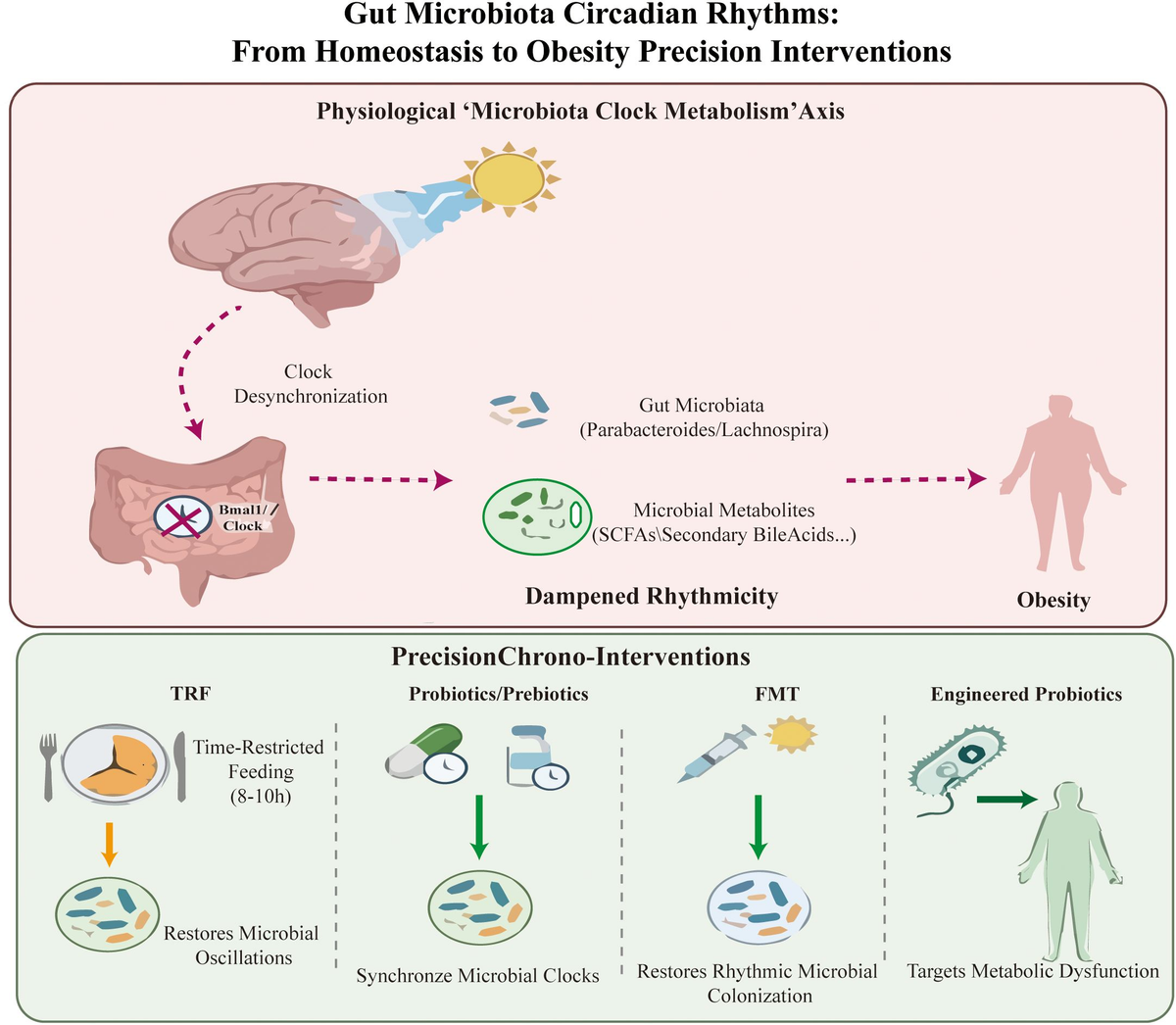
The gut microbiota acts as a key ecological determinant of obesity, influencing host metabolism through the extraction of dietary energy, the production of bioactive metabolites (e.g., short-chain fatty acids, secondary bile acids), and the interaction with immune and neuroendocrine systems. Recent advances underscore the gut microbiota and host’s intrinsic circadian rhythmicity (; ). Diurnal oscillations in microbial abundance and function synchronize with host circadian rhythms, thereby maintaining the host’s metabolic homeostasis. A defining feature of this microbial clock is the circadian rhythm of the Firmicutes/Bacteroidetes (F/B) ratio—the two dominant gut microbial phyla linked to obesity pathogenesis. Notably, impaired microbial rhythmicity in obesity is characterized not merely by a shifted F/B ratio, but by a dampened amplitude of its circadian oscillations, alongside reduced gut microbiome diversity and richness (; ; ). This distinct rhythmic disruption, rather than simple compositional imbalance, is emerging as a key driver of metabolic dysregulation.
However, current probiotic and dietary interventions usually fail to utilize time specificity. The mechanistic links between microbial clocks and host metabolic regulation remain poorly defined, which to some extent impedes the translation of microbial clocks into precision obesity therapies. This review explores the microbiota-clock-metabolism axis, where disrupted microbial oscillations drive metabolic dysregulation. We evaluate evidence linking microbial chrono-disruption to obesity and examine innovative microbial therapeutic approaches for resetting host-microbial rhythms.
2 Circadian regulation of gut microbiota and host metabolism
2.1 Diurnal rhythm characteristics of the gut microbiota
The gut microbiota is a dynamic ecosystem shaped by host circadian rhythms and dietary cycles. Its composition and function exhibit hourly fluctuations, following a 24-hour rhythm. This generates robust diurnal oscillations and time-of-day-specific profiles over the course of a day (; )
Up to 60% of rodent gut bacteria display circadian rhythms in relative and absolute abundance (). And the periodic shifts in the gut microbiome are evident in all major phyla (). In particular, the two dominant phyla of the gut microbiome, Firmicutes and Bacteroides, display the most pronounced diurnal fluctuations. In humans, the relative abundance of Bacteroidetes at night is approximately 6% higher than during the day, whereas the abundance of Firmicutes is elevated in the daytime (). In mice, the Firmicutes phylum peaks at the end of the feeding period, while Bacteroidetes has a significant peak during the fasting period. Both phyla exhibit stable diurnal alternating fluctuations (; ; ). further reported that the overall rhythmicity of the gut microbiota is driven by Bacteroidetes, whereas Firmicutes maintains relatively constant absolute abundance.
Additionally, approximately 10%-20% of human microbial taxa exhibit diurnal oscillations, including the genera Parabacteroides, Lachnospira, and Bulleidia (). The individual variations in microbiota structure potentially influenced by defecation timing. Interestingly, the gut microbiota also modulates the rhythmic patterns of microbial metabolite production. As the primary microbial metabolites, short-chain fatty acids (SCFAs) and secondary bile acids exhibit circadian oscillations in the intestine and serum (; ; ).The research have reported that cecal contents from mice fed a regular chow diet display a distinct, diurnal pattern of SCFAs concentration ().
2.2 Disrupted rhythmicity of gut microbiota in obesity
Circadian desynchronization of the gut microbiota is closely associated with obesity, T2DM and related metabolic disorders (; ).Studies have demonstrated that obese humans and mice have different intestinal microbiota from the lean controls. Transfer of microbiota from obese humans or mice to lean mice undergoing jetlag induces obesity-related phenotypes (; ).The core rhythmic imbalance of the F/B ratio is a hallmark of the obese state. Even some studies report no significant shift in the absolute F/B ratio, the amplitude of its circadian oscillations is reduced by 30% to 50% in obese individuals (). In obese mice, the rhythmic dominance of the Firmicutes phylum was enhanced, and the amplitude of the Bacteroidetes phylum rhythm decreased by approximately 40% compared with that in normal mice, with the peak disappearing during the fasting period. This F/B rhythmic dysregulation is directly associated with obesity-related metabolic abnormalities (; ). Furthermore, metabolic disorders related to obesity can lead to a significant decrease in the proportion of periodic OTUs (operational taxonomic units) in the gut microbiota (). Of note, the metabolic derivatives of the gut microbiota in obese individuals also show different circadian rhythm changes. The metabolomics determination results show that the circadian rhythms of bile acids in the serum, cecal contents, intestine and liver of ob/ob mice were disrupted compared with those of ob/m mice (). The obese mice lose circadian coordination between microbial bile acid metabolism and hepatic FXR signaling ().
These observations confirm that circadian oscillations in the gut microbiota and metabolites is closely related to obesity. Humans and obese mice both exhibit an imbalance in the F/B ratio rhythm and a decrease in the alpha diversity of the microbiota. The difference is that the disappearance of the rhythm of Verrucomicrobia (such as the genus Akkermansia) in mice is a typical feature of obesity (; ), while the rhythm changes of this phylum in obese humans have not yet reached a unified conclusion. Some studies have only observed a reduction in its abundance rather than rhythmic disorder ().
2.3 Rhythmic regulation of the gut microbiota
The circadian rhythm of host, regulated by gene-encoded molecular clocks, plays a pivotal role in coordinating the rhythmic fluctuations in both the composition and function of the gut microbiota (). Microbial oscillations are not directly entrained by light-dark cycles but are instead affected by the host’s circadian adaptive mechanisms, including the light-dark cycles, feeding behavior and sleep-wake patterns (; ). As observed in mice, the fluctuations of Bacteroidetes exhibits particularly pronounced diurnal fluctuations. However, there was the disruption of microbiota rhythmicity in the Bmal1-deficient mice (; ), and a loss of microbial richness and diversity in ClockΔ19 individuals (). Knockout of the biological clock gene Bmal1 alters the diurnal fluctuations of Bacteroidetes, Firmicutes, and Proteobacteria, while concurrently increasing the abundance of the genus Rikenella (). Moreover, environmental light cycles entrain circadian feeding behaviors in animals, which subsequently generates rhythms in exposure to food-borne bacteria (). For instance, mice with scheduled eating exhibit cyclical fluctuations in 17% of detected operational taxonomic units(OTUs) ().
Dietary changes within a 24-hour period rapidly alter gut microbiome composition (). Misaligned meal timing, such as skipping breakfast, overeating at night, or ad libitum feeding without defined fasting-feeding cycles, disrupted the circadian rhythm and the gut microbiota clock, inducing the occurrence of metabolic disorders such as obesity and T2DM ().Therefore, dietary composition and rhythms critically modulate the microbiota-clock axis. Specifically, HFD disrupts specific host factors (e.g., Reg3γ) and microbial circadian rhythms associated with the circadian pattern of microorganisms, which in turn promotes metabolic dysfunction (). Conversely, time-restricted feeding (TRF), an 8-hour feeding window in obese mice, restores periodic oscillations in microbial community structure and mitigates metabolic dysfunction, including rescuing the oscillations of the F/B ratio ()., Microbial functions differ markedly between satiation and starvation conditions. The abundance of protective genera such as Lactobacillus, Oscillibacter, Romboutsia and Lachnoclostridium peaks in the feeding phase, while the fattening genera such as Faecalibaculum, Lactococcus and Streptococcus peaked in the starvation phase. Notably, the bacterial communities that colonize the gut during the feeding phase exert distinct beneficial metabolic effects, unlike those present during fasting ().However, Reitmeier et al. proposed that dietary habits and dietary intake may not be represent the primary drivers of the abnormal microbiota composition ().
Rhythmic feeding is critical for maintaining the homeostasis of microbial community structure and sustaining diurnal fluctuations in microbial abundance ().Recent studies have shown that dietary-timing induces diurnal oscillations of P. distasonis, which in turn modulates the host’s inflammatory rhythms (). Importantly, the regulation of microbial rhythms by eating times is closely linked to host circadian rhythm genes. TRF exerts a more pronounced effect on restoring the amplitude of microbial rhythms when host clock genes(e.g., Clock) function normally. Conversely, even regular feeding patterns fails to effectively restore the rhythmic fluctuations of key microbial taxa in hosts with impaired clock gene function (; ). These findings indicate that host intrinsic circadian genes form the molecular basis for microbial rhythm regulation, with dietary timing acting as a key a key modifiable external factor. Disordered meal timing additionally leads to asynchronous circadian rhythms and gut microbiota oscillations, which is associated with insulin resistance and abnormal glycolipid metabolism (; ; ).In contrast, a balanced, time-structured diet preserves intestinal circadian rhythm homeostasis, especially by regulating the rhythm fluctuations of specific obesity-related bacteria. Importantly, the first meal after a long fast, most commonly breakfast, resets the phase of the peripheral clock ().This resetting effect is mediated by the rhythmic exposure of gut microbiota to dietary components, thereby enhancing the synchronization between microbial oscillations and host metabolic cycles. For example, morning intake of prebiotics or Helianthus tuberosus modulates Bacteroidetes more effectively than evening intake, which may be attributed to the phase-resetting role of breakfast in the peripheral clock (; ).
Collectively, the host circadian genes, feeding rhythms, and dietary components constitute a regulatory network for gut microbiota rhythms. Among these factors, feeding timing emerges as a core modifiable target, as it directly modulates microbial oscillations by resetting the peripheral clock. This regulatory mechanism not only explains the link between disordered eating patterns and microbial rhythm disruption but also provides a mechanistic basis for innovative obesity interventions including chrono-nutrition and TRF.
3 Precision microbiota-targeted interventions
3.1 Timed administration of probiotics and prebiotics
Probiotic or prebiotic supplements targeting gut microbiota are emerging as a promising approach to comprehensive nutritional intervention for managing obesity. With the increasing emphasis on microbial clocks, the timing of administration has gradually drawn attention. However, there is no clear definition of the time to take probiotics or prebiotics
The survival rate of probiotics at different administration times has been investigated through an in vitro digestion model. Probiotic survival rate was the highest when administered with a meal or 30 minutes preprandially, multi-strain probiotics containing Lactobacillus helveticus R0052 and Lactobacillus rhamnosus R0011, Bifidobacterium longum R0175 and Saccharomyces cerevisiae boulardii exhibit the highest intestinal survival rates ().Conversely, Wang J et al. believe that co-ingestion with food may buffer gastrointestinal stress and enhance the survival rate of probiotics. The survival rate of probiotics taken with or after meals is higher than that on an empty stomach ().In humans, taking multi-strain probiotic capsules after meals reduced the BMI of overweight/obese adults by approximately 2.50% (). Further, probiotic of Bifidobacterium animalis lactis BL-99 taken with each of three meals and at 21:00 before going to sleep ameliorated lipid metabolism through elevating short-chain fatty acids ().A clinical study has shown that taking Lactobacillus reuteri in the evening can improve blood sugar control and sleep quality in people with circadian rhythm disorders ().The differences in these results may be the interaction between probiotic cells and the surrounding food matrix. Currently, there are few clinical trials describing the specific administration methods of probiotics. Overall, ensuring the alignment of probiotic activity with the host’s circadian rhythm can optimize the therapeutic efficacy of probiotics. In the future, more in-vitro and clinical studies are required to clarify these methods.
In addition, the supplementation of prebiotics exerts time-dependent differences in therapeutic outcomes. The animal experiment results indicate that supplementing inulin at night is more beneficial than in the morning ().Supplementation of sodium butyrate in the morning during the peak period of SCFAs receptor activity in the circadian rhythm is more effective than at non-rhythmically matched times ().However, mice and humans exhibit different circadian rhythms, which leads to differences in human results compared to animal experiments. For instance, inulin intake in the morning rather than the evening strongly impacted on the composition of the microbiota ().The relative abundance of Bacteroidetes was significantly higher and Firmicutes was significantly lower in the morning inulin group than in the evening group ().Therefore, this is also more conducive to improving the loss of rhythm of Bacteroides and Firmicutes in obese individuals. Moreover, taking Helianthus tuberosus at breakfast rather than at dinner is more effective for improving the intestinal environment and intestinal microbiota ().The first meal after a long fast, most often breakfast, resets the phase of the peripheral clock. And, appropriate administration time enhances the effectiveness of the intervention. Taking prebiotics at different times may lead to different microbial environments and host physiological states, thereby resulting in differences in intervention effects.
3.2 Chrono-nutrition: synchronizing microbial clocks
Diet patterns and meal timing as a determinant of microbial rhythmicity, reduced the risk of underlying diseases by synchronizing food intake with the circadian rhythm cycle. It is reported that eating at the appropriate time in biology, especially earlier in the day when the circadian metabolic is at its peak, greatly improved the intestinal microbiota rhythm and promoted the production of SCFAs. Dietary-timing-induced gut microbiota diurnal oscillations modulate inflammatory rhythm, especially the fluctuation of P.distasonis ().Therefore, it is crucial to pay attention to the eating window for targeted management of the gut microbiota.
Intermittent fasting(IF), including periodic fasting and TRF, has been increasingly suggested to alleviate obesity, steatohepatitis and other conditions by resynchronizing the rhythmic oscillations of the gut microbiota (; ; ). In HFD-induced obese mice, an 8-hour TRF regimen restored the diurnal oscillations of Bacteroidetes and Firmicutes, whose rhythmic imbalance is a hallmark of obesity (). Metagenomic analysis further revealed that during the feeding stage, TRF enriched the probiotic species involved in the synthesis of short-chain fatty acids, such as lactic acid bacteria and Oscillibacter. The fasting stage is associated with an increase in the abundance of potential fattening bacteria, such as Faecalibaculum and Streptococcus ().Oolong tea polyphenols, as a natural antioxidant, improved the circadian rhythm disorder of specific gut microbiota in mice and alleviated the disorder of hepatic clock gene expression induced by constant darkness ().Similarly, a methionine-restricted diet partially restored the arrhythmicity of the gut microbiota caused by a high-fat diet in mice ().This experimental evidence collectively demonstrate that TRF and targeted dietary interventions have the potential to reset microbial clocks. However, the translational significance of this findings to humans remain to be validated due to interspecies differences in circadian physiology. Early clinical studies have explored the feasibility of chrono-nutrition among overweight or obese populations. For instance, the 12-week restricted feeding with an average duration of 10.47 hours from the start to the end of each day reduces the average weight of overweight or obese individuals by about 5% (). Metagenomic analysis of the microflora showed that TRF intervention partially restores these cyclical fluctuations, and increased the abundance of probiotic species Parabacteroides distasonis, Bacteroides intestinalis, Parabacteroides goldsteinii, and Escherichia coli in obese individuals (). Furthermore, 8-hours TRF achieved a greater reduction in BMI and soft lean body mass loss by enriching the abundance of probiotic species involved in the synthesis of SCFAs, and elevated fecal DCA and IAA concentrations compared with eating throughout the day (). Notably, only the microbiota derived from the TRF feeding phase, rather than that derived from the TRF fasting phase, restored the rhythm of the microbiota, confirming that the microbiota improves obesity in a specific manner at a times of the day (). Large-scale randomized controlled trials further demonstrated the great potential of timed nutrition in obesity management. A meta-analyses of 11 RCTs in overweight or obese patients displayed that intermittent energy restriction improved weight loss and reduced body fat versus continuous energy restriction (; ).
Therefore, early TRF, which restricts food consumption to the regular window of 8 to 10 hours each day, is one of the most promising non-pharmaceutical treatment methods for management of obesity. Future research in chrono-nutrition should focus on developing personalized meal times and dietary strategies to adapt to individual chronotypes and the characteristics of their gut microbiota
3.3 Fecal microbiota transplantation
Fecal microbiota transplantation (FMT), which restored the function and structure of the gut microbiota by transferring specific microbial communities from healthy donors through capsules or endoscopy, has emerged as a potential therapeutic strategy for obesity (; ; ; ; ). FMT reconstructs the homeostasis of the gut microbiota and exerts beneficial effects by introducing a variety of beneficial bacteria to patients (; ). Preclinical studies have provided foundational insights into FMT’s metabolic effects. For instance, FMT regulated glucose and lipid metabolism of mice by enhancing the abundance of anti-obesity bacterial strains such as Akkermansia, Bacteroides and Blautia ().Notably, the temporal dynamic characteristics of donor microorganisms may influence the therapeutic efficacy. Morning FMT was more effective in improving insulin sensitivity and body weight than evening FMT ().Additionally, germ-free mice receiving FMT showed that the colonization process of the microbiota was controlled by the host’s biological clock, emphasizing the importance of timing in FMT protocols (). In a chronic unpredictable mild stress mouse model, an appropriate FMT time window enhanced the colonization and functional exertion of beneficial bacteria ().This further supports that the therapeutic effect of FMT is dependent on the circadian rhythm.
Currently, preliminary clinical investigations have explored the feasibility of FMT in obese populations. Randomized controlled trials have provided more robust evidence for the effect of FMT. A small-scale study reported that repeated FMT administrations or combination with lifestyle interventions enhanced the level and duration of microbiota implantation in obese patients, which was associated with improvements in lipid profiles and liver stiffness ().Large-scale RCTs have provided more robust evidence for FMT’s effects. An RCT demonstrated that FMT from lean donors reduces the proportion of abdominal fat in obese adolescents and improves their insulin sensitivity (). Meanwhile, the enrichment effect of FMT on Paraprevotella, Longibaculum and C. hylemonae may have contributed to enhancing the intestinal microbiota bile acid metabolism and/or slow the development of glucose intolerance in obese patients ().Meta-analyses of early RCTs also suggest that FMT may modulate key metabolic pathways, though consistent effects on BMI remains to be established (; ; ; ).
Nevertheless, due to the complexity of microbial composition and individual differences, there are fluctuations in their efficacy and stability. The donor selection, individual patient variations, and rhythmic stability lead to the implantation and therapeutic effects of FMT. Healthy donors with higher microbial diversity and stable microbiota rhythms enhance the colonization ability of the recipient’s gut microbiota improve the efficacy of FMT (; ; ).However, the degree of donor strain engraftment varied substantially between FMT recipients ().Studies shown that oral capsule microbiota transplantation has delayed implantation, despite the clinical efficacy is similar compared with the endoscopic FMT. Within 1 week following colonoscopy microbiota transplantation, the patient’s microbiota was similar to normalization (), while engraftment levels of oral capsule transplantation similar to that of colonoscopy until 2–4 weeks following administration (). Additionally, as observed in animal studies, FMT time may modulate therapeutic efficacy, but this factor has not been systematically evaluated in human trials (; ).The effects of FMT on body weight vary with concurrent dietary interventions. For example, the effects of autologous FMT show greater weight loss benefits when combined with calorie restriction compared to FMT alone (). Conversely, some trials report no significant improvement in BMI or metabolic parameters after FMT. This may be due to inadequate adjunct support or poor donor-recipient matching (; ; ).
In summary, FMT shows potential for the management of obesity, especially when customized according to the circadian rhythms of donors and recipients and integrated with lifestyle interventions. Future research should focus on optimizing the selection of donors, considering the “chrono-FMT” approaches, which maximize metabolic benefits in obesity treatment by matching the donor’s microbial rhythm with the recipient’s circadian cycle.
3.4 Personalized biotherapy: engineered probiotics
Advances in genetic engineering technologies has enabled probiotics to exhibit targeted therapeutic properties. Targeted modification of strains may enhance the therapeutic efficacy in disease treatment, including obesity. For example, modified Escherichia coli Nissle 1917 (E coli.N 1917) that exerted great potential in obesity and cardiometabolic diseases secrete dipeptidyl peptidase 4-degradation-resistant glucagon-like peptide(GLP-1) or N-acyl phosphatidylethanolamine ().Administration of E coli.N 1917 for 8 weeks significantly decreased body weight, body weight gain, food intake, fat pad weight, and hepatic weight of HFD mice ().Similarly, engineered Lactobacillus paracasei F19 enables localized therapeutic delivery. Strains modified to overexpress N-acylphosphatidylethanolamine (NAPE) directly in the colon demonstrated significant anti-obesity effects, including decreased appetite, reduced body weight gain, and improved glucose metabolism and fat mass deposition (; ). And the research observed enrichment of Prevotella and Parabacteroides and modulation of the microbiota biodiversity in mice treated with oleoylethanolamide-producing Lactobacillus paracasei F19 ().The administration of Lactobacillus paracasei F19 expressing NAPE and oleate elicited a sustainable decrease in body weight of mice on a high-fat diet and markedly improved metabolic syndrome by significantly reducing energy intake ().However, no such significant effects were observed in obese mice treated with the native probiotic alone (). Additionally, the modified Lactobacillus improved the metabolic dysfunction induced by a high-fat diet by secreting glucagon-like peptide ().Engineered probiotic Escherichia coli targets indoleacetic acid production and detect specific inflammation markers like thiosulfate and nitrate to deploy therapy ().A great deal of experimental evidence shows that engineered probiotics perform significantly better than traditional probiotics in terms of colonization ability, pathogen rejection, barrier protection and immune regulation.
However, despite the encouraging results of preclinical studies, there is still a risk of translational failure in later clinical trials. The development of engineered beneficial bacteria requires comprehensive consideration of multiple aspects, such as the selection of chassis strains and the application of genetic engineering technology. At the same time, the clinical application of engineered probiotics still faces major challenges in terms of biosafety, regulatory compliance and environmental ethics. For instance, the long-term colonization of engineered bacteria may lead to their entry into the external environment, posing ecological risks.
4 Conclusion
The gut microbiota is a dynamic ecosystem that interacts with the host’s integrated circadian physiological network. The robust diurnal oscillations in microbial composition and metabolite production form the basis of metabolic homeostasis. Critically, obesity is driven not by simple gut microbial compositional imbalance, but by circadian desynchronization of the microbiota-clock-metabolism axis. This rhythmic disruption, accompanied by reduced microbial diversity and disordered metabolite oscillations, represents a core ecological determinant of obesity and its metabolic comorbidities that has been underappreciated in traditional weight management strategies.
This review systematically integrates and advances the field by constructing a time-centric precision microbial intervention framework targeting the microbiota-clock-metabolism axis for obesity management. We comprehensively summarize the therapeutic potential of time-specific interventions, including timed probiotic/prebiotic administration, chrono-nutrition, chrono-FMT, and engineered probiotics, all of which act by resynchronizing microbial circadian oscillations (Figure 1).
Despite the promising evidence for clock-targeted microbial therapies, significant gaps remain in this field. First, the causality in microbiota rhythms and obesity requires validation in large-scale longitudinal human studies. Second, the molecular mechanisms underlying the crosstalk between host circadian genes and microbial rhythmicity remain incompletely elucidated, particularly the downstream signaling pathways mediating microbial clock regulation of host metabolism. Third, the biosafety and ethical implications of engineered microbes demand rigorous preclinical and clinical evaluation. The precise therapy of gut microbiota and microbiota rhythm in obesity-related metabolic diseases still needs further exploration.
Statements
Funding
The author(s) declared that financial support was received for this work and/or its publication. ZNYB2023019 grant from the Excellent Doctoral Program of Zhongnan Hospital of Wuhan University
Conflict of interest
The author(s) declared that this work was conducted in the absence of any commercial or financial relationships that could be construed as a potential conflict of interest
Generative AI statement
The author(s) declared that generative AI was not used in the creation of this manuscript
Any alternative text (alt text) provided alongside figures in this article has been generated by Frontiers with the support of artificial intelligence and reasonable efforts have been made to ensure accuracy, including review by the authors wherever possible. If you identify any issues, please contact us
Publisher’s note
All claims expressed in this article are solely those of the authors and do not necessarily represent those of their affiliated organizations, or those of the publisher, the editors and the reviewers. Any product that may be evaluated in this article, or claim that may be made by its manufacturer, is not guaranteed or endorsed by the publisher
Abbre
TRF, time-restricted feeding; FMT, fecal microbiota transplantation; SCFAs, short-chain fatty acids
References
Summary
Keywords
circadian dynamics, gut microbiota, microbial clocks, obesity, therapies
Citation
Luo L, Xue M, Sun L and Dai Z (2026) Gut microbiota in obesity management: from microbial clocks to precision microbial therapies. Front. Cell. Infect. Microbiol. 16:1705021. doi: 10.3389/fcimb.2026.1705021
Received
14 September 2025
Revised
09 February 2026
Accepted
10 February 2026
Published
25 February 2026
Volume
16 – 2026
Edited by
Adriyan Pramono, Diponegoro University, Indonesia
Reviewed by
Fawzi Mohamad Mahomoodally, University of Mauritius, Mauritius
Shaimaa Hassan Negm, Faculty of Specific Education, Egypt
Updates
Copyright
© 2026 Luo, Xue, Sun and Dai
This is an open-access article distributed under the terms of the Creative Commons Attribution License (CC BY). The use, distribution or reproduction in other forums is permitted, provided the original author(s) and the copyright owner(s) are credited and that the original publication in this journal is cited, in accordance with accepted academic practice. No use, distribution or reproduction is permitted which does not comply with these terms.
Disclaimer
All claims expressed in this article are solely those of the authors and do not necessarily represent those of their affiliated organizations, or those of the publisher, the editors and the reviewers. Any product that may be evaluated in this article or claim that may be made by its manufacturer is not guaranteed or endorsed by the publisher
