
Wellness-Washing At Work: Do Corporate Mental Health Programmes Deliver?
Mahek AsgharOct 10, 2026
Employers count logins and webinar seats, but trust, workload and managers decide whether anyone is actually helped
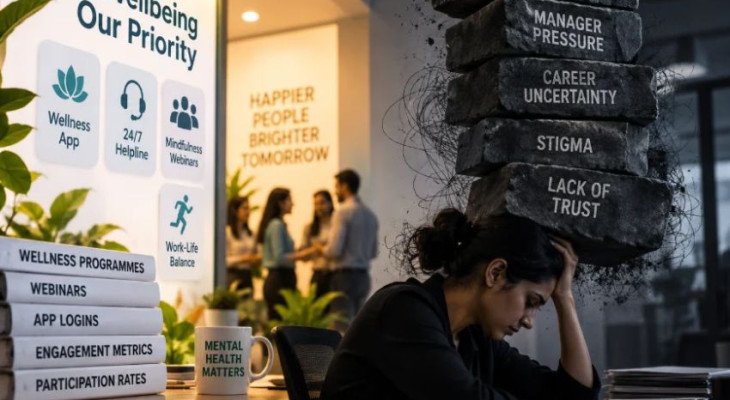
On World Mental Health Day, observed on 10 October, many Indian employers can point to a helpline, a wellbeing app and a calendar of webinars. Far fewer can demonstrate that these initiatives have left employees better supported. That gap between what companies offer and what employees experience gives this year’s theme, ‘Lived Experiences Heard: Real Voices, Real Change’, its sharpest workplace test. It is also where the charge of wellness-washing — a tick-box approach that looks caring without changing much — begins.
The case for action is clear. The World Health Organization (WHO) and the International Labour Organization (ILO) estimate that 12 billion workdays are lost every year to depression and anxiety, costing the global economy nearly USD 1 trillion. They also estimate that 15 per cent of working-age adults live with a mental disorder. India’s gap between need and care is wider still: a post on the community platform of the National Association of Software and Service Companies (Nasscom) cites the National Mental Health Survey (2016) in putting the treatment gap for common mental disorders at more than 85 per cent.
For Arindam Chakraborty, Chief Human Reealth a business question. “With an estimated 12 billion working days lost globally each year to depression and anxiety, organisations need to view mental health as a business and people priority, not simply a benefits metric,” he said
The senior people leaders who responded to BW People’s questions agree on the premise but are candid about its limits. Set against the research, their answers point to an uncomfortable conclusion: the measures employers report most readily are often the ones that reveal the least about whether employees are better supported
The Number Everyone CountsUsage is the figure employers can report most easily, and Titan Company’s figures are substantial. Adoption of Maithri, the company’s employee support programme, grew from 18 per cent to 31 per cent last year, while its floor-walk initiatives recorded more than 4,300 touchpoints. Yet Titan’s leadership treats those numbers as a beginning rather than a result
“Usage numbers are an important starting point, but they don’t tell us the whole story,” said Priya Mathilakath Pillai, Chief People Officer at Titan Company. “However, participation alone doesn’t establish effectiveness,” she added
The World Economic Forum (WEF) makes a similar point in its February 2024 report, ‘Measuring What Matters: Assessing Workplace Mental Health and Well-being’, led by Richard Heron and Ruma Bharava. The report advises employers against treating participation rates, health-check data and similar figures as evidence of lasting improvement. It also notes that workplace screening has not been shown to reduce symptoms or improve productivity, and cites early findings from the Mental Health at Work Index suggesting that only one in four organisations has a mental health strategy.
Titan does not claim to have closed that gap. “Our red-flag SOPs support early identification and intervention, though we recognise that measuring long-term impact remains a work in progress,” Pillai said
What Employees Are Really AskingThe leaders agree that stigma remains a barrier, but it is not the only one. Employees, Pillai said, are essentially asking themselves three questions: “Is it safe? Is it confidential? Is it worth my time?”
Confidentiality and concerns about managers’ perceptions can weigh as heavily as stigma, and sometimes more. “Employees may hesitate if seeking help could affect how they are perceived or influence performance evaluations and future opportunities,” Pillai said
“While stigma remains a significant barrier, concerns around confidentiality and how managers may perceive employees seeking help can be equally important,” said Remya Thomas, Group HR Head at Embassy Services
Survey data from India points in the same direction. In ‘Naukri Pulse 2025’, a survey of 19,650 jobseekers across 80 industries released by job portal Naukri on 10 October 2025, nearly three in four respondents said they hesitated to be open about taking time off for mental health reasons. Some 45 per cent would record it as general sick leave, 19 per cent would rather not take leave at all and 9 per cent would give a different excuse.
The most common fear, cited by 31 per cent, was being seen as incapable, while 21 per cent feared an impact on career growth. Among respondents with up to five years of experience, only around 25 per cent would identify a mental health day as such, compared with 43 per cent who would record it as sick leave
For Chakraborty, availability is not the same as safety. “Recent research found that while 75% of employees said their supervisors were consistently available and responsive, only 41% felt comfortable discussing mental health concerns with managers or HR. This gap shows that accessibility alone is insufficient; psychological safety and credible confidentiality are what build trust,” he said
Programme design is another factor. “If access is difficult, responses are slow, communication is unclear, or support feels generic, employees disengage. Even the best programme cannot succeed without trust and accessibility,” Pillai said. Even tools intended to detect distress can fuel concerns: the WEF report flags risks involving false positives, bias and breaches of confidentiality in workplace screening.
When Programmes Miss The PointIf trust is the barrier, adding more programmes will not necessarily remove it. Writing on the WEF platform in March 2025, Anthea Ong, Chairperson and Founder of WorkWell Leaders, cited a study of 46,000 employees in the United Kingdom that found individual support, from counselling services to mindfulness sessions, had no significant effect on overall mental wellbeing. Ong argued that such programmes often treat symptoms rather than causes and see limited take-up. She called for changes in leadership and manager behaviour, workload and work design. The article presents her views, rather than those of the WEF itself.
Indian research points to a similar gap. A review of 30 records published in Frontiers in Public Health in May 2022 by Apurvakumar Pandya, Niharika Khanal and Mudita Upadhyaya found that most workplace mental health interventions in India were curative, primarily involving counselling. Few included a needs assessment, impact evaluation or changes to workplace policy
Employees are more direct about what would help. Asked to select the single change that would help most, 60 per cent of Naukri’s respondents chose flexible work options, compared with 22 per cent for stress-management workshops, 10 per cent for paid mental health days and 9 per cent for managerial training
The last figure highlights a difference between employee preferences and expert recommendations. The WHO’s 2022 guidelines on mental health at work, supported by a joint WHO/ILO policy brief, recommend manager training alongside action on heavy workloads and negative workplace behaviours
That is the logic behind Chakraborty’s warning. “A counselling helpline, for instance, has limited value if employees continue to face excessive workloads, poor manager support or a culture where speaking about stress is seen as a weakness,” he said
“The more effective approach combines confidential access to professional support with manager training, mental health awareness, flexibility and mechanisms for employees to voice concerns safely,” he added
Where The Law StopsOne legal analysis suggests that existing legislation does little to close the gap. The four Labour Codes, including the Occupational Safety, Health and Working Conditions (OSH) Code, 2020, came into effect on 21 November 2025, according to the Ministry of Labour and Employment
Writing on a Wolters Kluwer legal blog three days earlier, Neha Vyas of Newcastle University argued that the OSH Code addresses physical injury but leaves psychosocial hazards out. If that interpretation holds, workplace mental health support remains largely a matter of employer choice, making the quality of that choice more consequential
The Economic Survey 2024-25, released on 31 January 2025, also highlighted the relationship between work and mental wellbeing. As reported by Business Standard, the Survey cited research by the Sapien Labs Centre for Human Brain and Mind suggesting that people with the strongest relationships with managers and colleagues report mental wellbeing scores 100 points higher than those with the weakest relationships. It also warned that working more than 55 to 60 hours a week can seriously harm health.
The findings lend weight to what Pillai and Thomas described: how a manager responds can determine whether an employee ever uses a helpline
What Better Looks LikeChakraborty’s test is straightforward. “The success of a workplace mental health programme should not be measured by how many employees download an app or attend a webinar, but by whether it creates a healthier and more supportive workplace,” he said
He would track employees’ confidence in seeking support, psychological safety, absenteeism, retention, engagement, and the effectiveness of return-to-work and workplace accommodation measures. “Equally important is whether employees feel heard and whether managers are better equipped to recognise and respond to distress,” he said
Thomas offers a similar yardstick. Embassy Services creates regular opportunities for open conversations, mindfulness and wellbeing engagement to normalise the subject, she said, with a clear aim: “The objective should be to create an environment where seeking support is viewed as a positive step, rather than a sign of weakness.”
On measurement, Thomas said, “Participation numbers offer only one part of the picture.” Employers should also assess whether employees feel more comfortable discussing wellbeing, know where to seek support and have managers equipped to respond
“For us, the measure of success is not simply how many people attend a session, but whether these initiatives help create a culture where wellbeing becomes part of everyday conversations and behaviours,” she said
Titan has layered other measures over its usage data. On its internal listening platform, Tell Me, the managing director and chief people officer spend more than 80 hours with different employee groups, while Heartbeat measures wellbeing and drives manager- and function-level action plans
Employee feedback led Titan to extend its support programme to off-roll employees. Its wellbeing score rose by four points this year, and its campaign ‘It’s Okay to NOT be Okay’, in which senior leaders share personal experiences, was followed by higher uptake, Pillai said. The company also examines trends over time
“Over time, trends in absenteeism, burnout, attrition and engagement can help us understand whether employees are better supported, not just whether they are using the programme,” she said
The evidence does not suggest that workplace programmes never help. Rather, it shows that employers often struggle to demonstrate their impact, that participation figures alone offer limited proof of effectiveness, and that trust, managers and workload shape outcomes
Three tests follow: whether employees believe seeking help will remain confidential and will not count against them during performance appraisals; whether managers are trained to recognise distress and respond appropriately; and whether employers track absenteeism, attrition and the proportion of employees who say they feel heard, rather than relying on logins alone
“My advice to companies is simple: do not ask only whether a programme exists; ask whether employees feel safer, heard and better supported because it exists,” Chakraborty said

EMPLOYEE WELLBEING & SAFETY
Oct 09, 2026
Mental Health At Work: Are Organisations Overlooking The Wellbeing Of Managers?0 mins read

EMPLOYEE WELLBEING & SAFETY
Oct 09, 2026
India Inc’s Mental Health Policy Has A Missing Author: The Employee0 mins read

EMPLOYEE WELLBEING & SAFETY
Oct 08, 2026
54.3% Of Startup Employees Report Low Wellbeing, Study Finds0 mins read

EMPLOYEE WELLBEING & SAFETY
Oct 08, 2026
IndianOil Manager Killed During Pump Sealing Operation0 mins read

EMPLOYEE WELLBEING & SAFETY
Sep 28, 2026
22 Recruiters Face 2-Year IIT Non-Cooperation Period Over Unfulfilled Offers0 mins read

EMPLOYEE WELLBEING & SAFETY
Sep 26, 2026
On HR Professionals Day, CHROs Ask: Who Supports The Supporters?0 mins read
