


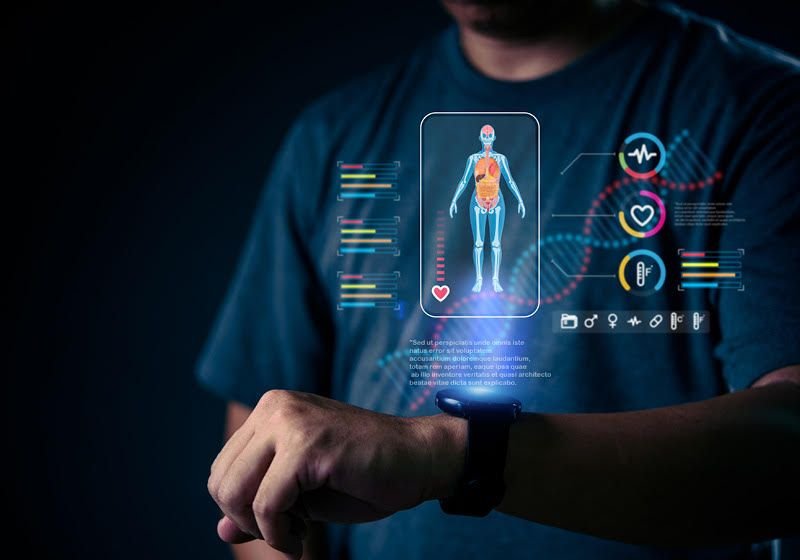
Whether people use them to check notifications in the office or track their workouts in the gym, devices like Fitbits and Oura rings have become a default part of daily wear. According to a recent survey, nearly 45 percent of Americans own wearables, giving them access to their health data at their fingertips—or wrists.1 Given this, researchers and clinicians hope to tap into the continuous data the devices collect to monitor the health of people with cancer.
“Because users tend to wear these 24/7, we really are able to get a glimpse into the 99 percent of patients’ lives when they are not in our clinical spaces in front of us,” said Carissa Low, a clinical health psychologist who studies management of physical and psychological symptoms during and after cancer treatment at the University of Pittsburgh. “We’re able to capture their behavior and physiology between clinical visits as they’re going about their usual daily routines,” said Low.
In a session at the American Association for Cancer Research (AACR) 2026 annual meeting, Low, along with other experts discussed the applications of wearable devices in oncology and beyond, and how artificial intelligence (AI)-based tools could help in clinical decisions. They also shed light on how researchers, clinicians, patients, and caregivers can best utilize wearable-derived information for cancer care, and they highlighted continuous monitoring frameworks that would advance personalized oncology approaches.
Data From Wearables Provides Greater Confidence in Clinical Decisions
Wearable devices use sensors to collect continuous data about a person’s health, such as their average heart rate, oxygen saturation and skin temperature, as well as their behavior, including sleep habits and physical activity. The devices often sync this information with cloud-based servers for storing, analysis, and monitoring.2
This means that the data can be accessed remotely in real time, regardless of where the patient or clinician are, giving a snapshot into what is normal for each patient, said Low. “We can pick up pretty quickly if something is going on with a patient,” she explained
To investigate the feasibility of collecting data from older patients who may not be comfortable with technology, Low and her team distributed Fitbits to 162 people undergoing chemotherapy. The researchers observed that patients kept the wearable on for at least eight hours each day for nearly 70 percent of the 90-day study.3 “It suggests that we’re getting a pretty good sense of how active people are being in the real world between their clinical visits and chemotherapy infusions,” said Low.
The team then examined the data’s clinical value by monitoring the step counts of a separate group of patients who had undergone cancer surgeries. Higher activity during recovery predicted lower risk of hospital readmission in one or two months.4 They also analyzed patients’ maximum steps per minute—reflecting their stamina—and observed a correlation between this and reduced fall risk as well as higher overall survival.5,6
When Low and her team interviewed some clinicians about using wearable device data, the doctors said that while the information did not necessarily change their recommendations, it provided greater confidence in these decisions. “What we heard from a lot of clinicians was that this wearable device data was a nice complementary piece of information that could corroborate or help resolve discrepancies in reports,” said Low.
AI Can Augment Patient-Generated Health Data to Drive Clinical Decisions
Despite the enthusiasm in remote monitoring by collecting wearable data, there has been a lag in adopting this in clinics. According to a recent study, remote patient monitoring was limited to less than one percent of commercially insured cancer patients between 2019 and 2023.7
Further, patients with cancer who reported their symptoms to clinicians ficant survival benefits compared to those who received routine care.8 However, the former group did experience improved quality of life and fewer emergency department visits
“Remote patient monitoring does work,” said Jorge Nieva, a medical oncologist at the University of Southern California. He added that integrating AI-based analytical tools could help strengthen the clinical outcomes of using remote patient monitoring
For instance, one clinical trial revealed that people who monitored their symptoms remotely increased their physical activity and lost more weight than those who received only routine care.9 However, they lost only a couple of pounds of weight, indicating that the degree of benefit was not very high. In contrast, when another research team signed up some people for a phone application using a customized AI-based feature to coach them on weight loss, they lost up to five percent of their body weight.10 “This is what AI can do,” said Nieva.
Despite the promise of integrating AI and wearable data to advance digital medicine, some gaps remain. For instance, many clinicians have observed that people do not stick to their wearables over time, leaving a gap in tracking their physical activity and performance.11 Clinicians and patients do not often agree with each other about the latter’s physical performance, leading to over- or under-treatment, Nieva noted.12
To bridge this gap, Nieva and his team applied an AI-based tool to track people’s movement as they shift from the chair to the table in an examination room. This helped them calculate a physical performance status score that would help in clinical decisions
“I’m very excited about wearables and patient-generated health data,” said Nieva. “But I really do think that it needs a layer of artificial intelligence in order to make these continuous results interpretable, in order to get them to be adopted, and in order to get that adoption to be acceptable to the health system.”
Wearables and Remote Patient Monitoring Beyond Oncology
Giorgio Quer, a researcher studying digital medicine and artificial intelligence at Scripps Research, agreed that data from wearable devices can offer important insights into health. As someone who uses a wearable to track his resting heart rate, Quer noticed that these values were all over the place from July to November 2022
His average heart rate, which was 55 beats per minute in July, steadily increased to 66 in August, before coming back to the baseline in September and increasing again in October and reducing in November. What changed through the months?
His increased heart rate coincided with an international trip, returning to its usual levels when he was back home. It then increased again when he experienced an infection and took a course of antibiotics; it returned to the baseline when his health was back to normal
“[A] really important thing that we need to keep in mind every time we use these wearable devices [is that] this is not specific,” said Quer. “There are a lot of factors that influence how the sensor changes, from travel to long weekend to an illness, and stress, and much more.” This highlights that wearable devices can be leveraged for monitoring a number of conditions, including infectious diseases, maternal health, nutrition, and sleep health, he noted.
For instance, in a fully remote digital trial, Quer and his team tracked wearable data from more than 30,000 participants and observed that it could accurately distinguish between symptomatic people with and without a COVID-19 diagnosis.13
In another remote trial, Quer and his team used AI in combination with data from real-time glucose levels and resting heart rates from wearable monitors to provide insights into individuals’ diabetes risk.14 They found that such a multimodal approach offers more detailed information than that provided by glycated hemoglobin alone, which could potentially improve type 2 diabetes prevention, diagnosis, and treatment.
Similarly, the researchers tracked wearable data from hundreds of women and found that this helped them monitor pregnancy-related physiological and behavioral changes that align with hormonal shifts.15
“This general physiological representation may also turn out to be super important if we finetune it for oncology tasks,” said Quer. “The field is changing so rapidly. Just a couple of years ago…we were not even thinking about the possibility of this unsupervised learning from data that has nothing to do with our studies.”
- Nagappan A, et al. Patterns of ownership and usage of wearable devices in the United States, 2020-2022: Survey study. J Med Internet Res. 2024;26:e56504.
- Low CA. Harnessing consumer smartphone and wearable sensors for clinical cancer research. NPJ Digit Med. 2020;3:140.
- McClaine S, et al. Engagement with daily symptom reporting, passive smartphone sensing, and wearable device data collection during chemotherapy: Longitudinal observational study. JMIR Cancer. 2024;10:e57347.
- Low CA, et al. Fitbit step counts during inpatient recovery from cancer surgery as a predictor of readmission. Ann Behav Med. 2018;52(1):88-92.
- Low CA, et al. Associations between performance-based and patient-reported physical functioning and real-world mobile sensor metrics in older cancer survivors: A pilot study. J Geriatr Oncol. 2024;15(2):101708.
- Low CA, et al. Consumer wearable device measures of gait cadence and activity fragmentation as predictors of survival among patients undergoing chemotherapy. JCO Clin Cancer Inform. 2025;9:e2500111.
- Joo JH, et al. Remote patient monitoring use among commercially insured adults with cancer. JMIR Cancer. 2026;12:e84788.
- Basch E, et al. Symptom monitoring with electronic patient-reported outcomes during cancer treatment: Final results of the PRO-TECT cluster-randomized trial. Nat Med. 2025;31(4):1225-1232.
- Noah B, et al. Impact of remote patient monitoring on clinical outcomes: An updated meta-analysis of randomized controlled trials. NPJ Digit Med. 2018;1:20172.
- Shen S, et al. Evaluation of a mobile behavior change program for weight loss in breast cancer survivors. NPJ Breast Cancer. 2024;10(1):53.
- Huang Y, et al. A scoping review to assess adherence to and clinical outcomes of wearable devices in the cancer population. Cancers (Basel). 2022;14(18):4437.
- Schnadig ID, et al. Patient-physician disagreement regarding performance status is associated with worse survivorship in patients with advanced cancer. Cancer. 2008;113(8):2205-2214.
- Quer G, et al. Wearable sensor data and self-reported symptoms for COVID-19 detection. Nat Med. 2021;27(1):73-77.
- Carletti M, et al. Multimodal AI correlates of glucose spikes in people with normal glucose regulation, pre-diabetes and type 2 diabetes. Nat Med. 2025;31(9):3121-3127.
- Milan G, et al. Association between wearable sensor signals and expected hormonal changes in pregnancy. EBioMedicine. 2025;119:105888.
