



Women on regimens of estrogen-only menopausal hormone therapy are at reduced risk of Alzheimer’s disease, a study by Stanford Medicine investigators has found
Because estrogen-only therapy is generally prescribed for women without a uterus, most of these users presumably had had hysterectomies
The study, published Aug. 12 in Neurology, is the first to measure the connection between menopausal hormone therapy, or MHT, and reductions in Alzheimer’s-related pathological deposits in autopsied brains.

Hadi Hosseini
Jennifer Bruno, PhD, an instructor in psychiatry and behavioral sciences, and former postdoctoral scholar Jacob Shaw, PhD, share lead co-authorship
“Many conditions impact memory. Clinical diagnoses are often not accurate,” Hosseini said. “Although there’s been great progress with bloodborne and cerebrospinal fluid biomarkers, they don’t tell you the amount and precise location of the brain damage. By looking where the actual damage is done — the brain — you can see where the Alzheimer’s-associated defining features are and how many of them are there.”
Evidence from analysis of living participants’ cerebrospinal fluid and blood samples supported the study’s autopsy findings. Estrogen-only menopausal hormone therapy users had 39% lower odds than non-users of receiving a clinical diagnosis of dementia during their lifetimes, and they performed better on memory tests and in their overall ability to function independently.
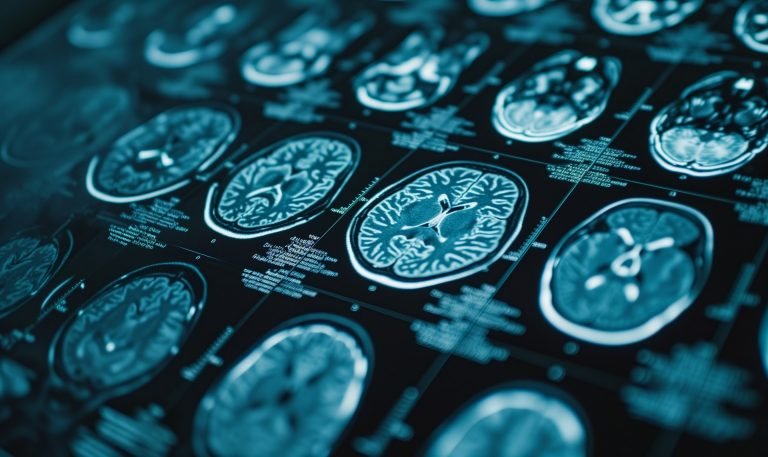
The researchers explored two existing databases, numbering 21,462 participants in all, for data on deceased female participants whose brains were autopsied for the presence of two defining pathological features of Alzheimer’s disease: so-called amyloid plaques and neurofibrillary tangles.
Although there’s been great progress with bloodborne and cerebral-spinal-fluid biomarkers, they don’t tell you the amount and precise location of the brain damage”
— Hadi Hosseini
Analyzing results from 258 brain autopsies of women who had reported using menopausal hormone therapy in an estrogen-only formulation, the scientists compared the levels and locations of these two Alzheimer’s hallmarks, along with a third one — the density of individual amyloid plaques — with those in the brains of some 2,701 women who had reported no use of any form of menopausal hormone therapy, and assigned scores to the result.
They found that estrogen-only MHT use was associated with a statistically significant decrease in the presence of these defining Alzheimer’s hallmarks.

Jennifer Bruno
Using a measure known as the odds ratio, the Stanford Medicine team reported a 35% reduction in the odds of a woman’s developing Alzheimer’s disease among estrogen-only menopausal hormone therapy users
“MHT appears to exert a modest but meaningful and statistically significant protective effect on the risk of developing Alzheimer’s pathology,” Bruno said. “While this is by no means more powerful than such very well-known factors as age, possession of the genetic variant knowns as APOE4 or a history of hypertension, it’s nonetheless quite a consistent effect, spanning multiple Alzheimer’s-related outcomes.”
The Stanford Medicine study adjusted for these factors, as well as for education and race. The finding of a cognitive benefit for estrogen-only menopausal hormone therapy users carries direct implications for about one-third of all women of menopausal age. By age 60, more than 30% of women have had hysterectomies and no longer have a uterus. Estrogen-only treatment is specifically recommended for these women.
The women in the study skewed older (their average age was 70), and many had had hysterectomies. So, most of them were on estrogen-only regimens. The researchers couldn’t obtain conclusive autopsy findings for dementia risk of women on estrogen-plus-progestin formulations, because the number of autopsied women on such formulations was too small to reach a conclusion about its effect.
In addition, topical estrogen-only users rather than those on oral estrogen therapy were not counted.
As a result, the findings are applicable only to estrogen-only formulation, not to estrogen-plus-progestin formulation and not to topical as opposed to oral estrogen administration. And while the association with reduced Alzheimer’s risk is clear, it still doesn’t amount to definitive proof of causality
“There have been a lot of conflicting findings about MHT’s effects on Alzheimer’s disease outcomes.” Hosseini said. “Different studies may have involved different age ranges of initiating MHT. They may have focused on varying clinical outcomes, used divergent biomarkers or lumped together different MHT formulations, or studied different routes of administration or different durations of use. Some of those studies may not have adequately corrected for various genetic, cardiovascular or other risk factors.”
“Assessments of ‘cognitive decline’ are necessarily somewhat subjective,” Bruno concurred, noting that such declines may depend on who is doing the assessment and may result from any number of different physiological causes ranging from a severe stroke to a bad night’s sleep.
Early studies suggested that menopausal hormone therapy might be useful for protecting menopausal women from dementia. But other studies that followed yielded inconclusive results. A large analysis published in 2003, the Women’s Health Initiative Memory Study, indicated the opposite effect — estrogen-plus-progestin formulations seemed to increase dementia risk, at least when initiated at an older age.
The Women’s Health Initiative study also tied the estrogen-plus-progestin combination to increased risk of breast cancer and heart disease. In 2025, the Food and Drug Administration announced the removal of a black-box warning to this effect. But the publicity surrounding the 2003 report had long since sent overall menopausal hormone therapy usage on a roller coaster ride that has yet to be completed. Estimates of women’s use of the therapy during their lifetimes were once close to 27%.
“Now that use estimate has plummeted to below 5%,” Hosseini said.
“The recent medical literature suggests that MHT is more beneficial when initiated during or soon after menopause,” he said. “The women in our study tended to be older. If anything, our finding underestimated the benefit due to their late initiation of therapy.”
“For a long time,” Bruno said, “the going recommendation was ‘Don’t use MHT for memory decline.’ This study flies in the face of that recommendation.”
The study was funded by National Institutes of Health (grants R01AG072470, R21AG073973, R21AG064263, R01AG073362, R61MH119289, R01MH123873 and 1K01AG083224)
Rethinking Alzheimer’s
RETHINKING ALZHEIMER’S
Stanford Medicine researchers are exploring alternative approaches to understanding — and, possibly, treating — Alzheimer’s disease
- Series
