



Press release
Mobile Health Fitness Sensors Market to Reach US$ 13.00 Billion by 2033, Growing at 11.2% CAGR
11-25-2026 06:21 AM CET | IT, New Media & Software
Press release from: Persistence Market Research
Mobile Health Fitness Sensors Market
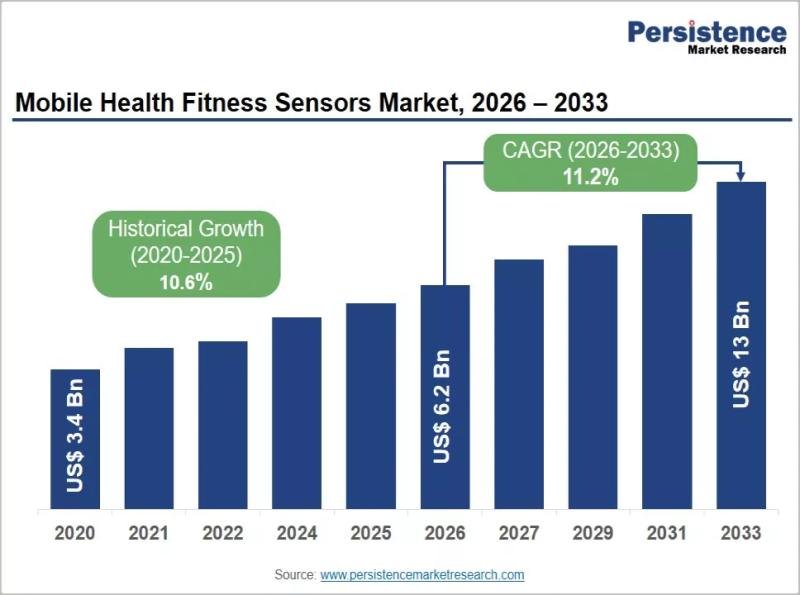
The global mobile health fitness sensors market size is likely to be valued at US$ 6.20 billion in 2026 and is projected to reach US$ 13.00 billion by 2033, growing at a CAGR of 11.2% during the forecast period between 2026 and 2033. Market growth is driven by increasing health consciousness, rising adoption of wearable fitness devices, and growing demand for continuous health monitoring solutions. Mobile health fitness sensors enable users to track vital health parameters, including heart rate, blood oxygen levels, body temperature, sleep patterns, physical activity, and calorie expenditure. The increasing popularity of connected healthcare technologies and personalized fitness monitoring is encouraging consumers to adopt sensor-enabled mobile health devices.
The growing adoption of smartwatches, fitness bands, smart rings, and connected health monitoring devices is creating significant demand for advanced mobile health fitness sensors. Consumers are increasingly using sensor-enabled devices to monitor their daily activities, evaluate fitness performance, and maintain healthier lifestyles. Furthermore, advancements in biosensing technologies, artificial intelligence (AI), machine learning (ML), and wireless connectivity are improving sensor accuracy and enabling real-time health insights. The increasing integration of mobile health sensors with telehealth platforms, remote patient monitoring systems, and digital healthcare applications is expected to create lucrative opportunities for market participants.
Download Your Free Sample & Explore Key Insights:https://www.persistencemarketresearch.com/samples/3728
➤ Key Highlights
– The global mobile health fitness sensors market is projected to increase from US$ 6.20 billion in 2026 to US$ 13.00 billion by 2033, registering a CAGR of 11.2%.
– Increasing health awareness and growing emphasis on preventive healthcare are driving demand for mobile health fitness sensors.
– Rising adoption of smartwatches, fitness bands, and smart rings is supporting market expansion.
– Growing demand for continuous monitoring of heart rate, blood oxygen levels, sleep patterns, and physical activity is strengthening sensor adoption.
– Integration of artificial intelligence and machine learning is improving health data analysis and personalized fitness recommendations.
– Increasing adoption of remote patient monitoring and connected healthcare solutions is creating new growth opportunities.
– Advancements in miniaturization, biosensing technologies, and wireless connectivity are improving the functionality of mobile health fitness devices.
Increasing Health Awareness and Preventive Healthcare Adoption Driving Market Growth
Growing awareness regarding personal health and preventive healthcare is one of the major factors supporting the expansion of the mobile health fitness sensors market.
Consumers are increasingly prioritizing physical fitness, wellness management, and regular health monitoring to reduce the risk of lifestyle-related health conditions.
Mobile health fitness sensors enable individuals to monitor important health indicators without requiring frequent visits to healthcare facilities.
These sensors are increasingly integrated into wearable devices that track heart rate, blood oxygen saturation, body temperature, respiratory rate, and physical activity.
The availability of real-time health information allows consumers to understand their fitness levels and make informed lifestyle decisions.
Furthermore, increasing awareness of cardiovascular health, obesity management, sleep quality, and physical inactivity is encouraging individuals to adopt connected fitness technologies.
Fitness-conscious consumers are increasingly using sensor-enabled devices to monitor workout intensity, evaluate exercise performance, and maintain daily activity goals.
The growing emphasis on preventive healthcare and personalized wellness management is expected to strengthen demand for mobile health fitness sensors throughout the forecast period.
Rising Adoption of Wearable Fitness Devices Supporting Sensor Demand
The increasing popularity of wearable fitness devices is creating significant growth opportunities for mobile health fitness sensor manufacturers.
Smartwatches, fitness trackers, smart rings, and connected sports accessories are becoming important tools for monitoring personal health and physical activity.
These devices integrate multiple sensors that collect information about movement, heart rate, sleep patterns, and other physiological parameters.
Consumers are increasingly adopting wearable devices because they offer convenient access to health information and support continuous monitoring throughout the day.
Manufacturers are introducing advanced wearable products with improved sensor accuracy, longer battery life, enhanced connectivity, and user-friendly interfaces.
The integration of multiple sensing technologies into compact wearable devices is also improving the ability to monitor different health parameters simultaneously.
Furthermore, growing demand for personalized fitness tracking among athletes, fitness enthusiasts, and health-conscious consumers is encouraging manufacturers to expand their sensor capabilities.
As wearable technology adoption continues to increase, demand for advanced mobile health fitness sensors is expected to remain strong.
Increasing Demand for Continuous Health Monitoring and Real-Time Tracking
Continuous health monitoring is becoming an important factor influencing the adoption of mobile health fitness sensors.
Traditional health monitoring methods generally depend on periodic measurements, which may not provide a complete understanding of an individual’s daily health patterns.
Mobile health fitness sensors address this limitation by enabling continuous or frequent monitoring through connected wearable devices.
Optical heart rate sensors, pulse oximeters, accelerometers, gyroscopes, and temperature sensors are increasingly being integrated into mobile health devices.
These technologies help users monitor physiological changes, physical activity levels, and sleep-related patterns.
Real-time monitoring also allows users to receive alerts when certain health measurements move outside predefined thresholds, depending on device capabilities.
The growing importance of continuous monitoring is particularly relevant for individuals managing fitness goals and those seeking greater visibility into their daily health indicators.
Furthermore, the increasing integration of mobile sensors with smartphone applications allows users to access historical health information and evaluate long-term wellness trends.
The rising demand for convenient and continuous health tracking is expected to support market growth.
Integration of Artificial Intelligence and Machine Learning Enhancing Sensor Capabilities
Artificial intelligence and machine learning are transforming mobile health fitness sensors by improving data interpretation and enabling personalized health insights.
Traditional fitness sensors primarily collect physiological and activity-related information.
However, AI-powered technologies can analyze collected data to identify patterns, evaluate trends, and generate personalized recommendations.
Machine learning algorithms can process information from multiple sensors to provide more comprehensive insights into physical activity, sleep quality, and fitness performance.
AI-based analytics can also help identify unusual changes in monitored health parameters and support early awareness of potential health concerns.
For example, intelligent algorithms can analyze heart rate patterns, movement data, and sleep information to provide insights into daily wellness trends.
The integration of predictive analytics is also improving personalized fitness recommendations by considering individual activity levels and behavioral patterns.
Furthermore, AI-powered mobile health applications are enabling users to receive customized exercise suggestions, recovery recommendations, and wellness guidance.
As manufacturers increasingly incorporate intelligent analytics into wearable devices, demand for advanced mobile health fitness sensors is expected to increase.
Growing Popularity of Personalized Fitness and Wellness Solutions
Personalized fitness management is emerging as an important driver of the mobile health fitness sensors market.
Consumers are increasingly seeking fitness solutions that align with their individual health goals, physical capabilities, and daily routines.
Mobile health fitness sensors support personalized wellness by collecting information about activity levels, heart rate, workout intensity, sleep duration, and recovery patterns.
These insights allow users to evaluate their fitness progress and modify exercise routines according to their individual requirements.
Fitness applications integrated with wearable sensors can provide customized workout plans, activity reminders, and performance tracking features.
Athletes and professional fitness enthusiasts are also adopting advanced sensor-enabled devices to evaluate training intensity and optimize recovery.
The growing popularity of home workouts, digital fitness platforms, and subscription-based wellness applications is further supporting adoption.
Fitness service providers are increasingly integrating wearable data into digital coaching platforms to improve user engagement and deliver personalized experiences.
As consumers continue prioritizing individualized fitness and wellness management, demand for sophisticated mobile health fitness sensors is expected to strengthen.
Expansion of Remote Patient Monitoring and Connected Healthcare
The growing adoption of remote patient monitoring is creating additional opportunities for mobile health fitness sensor manufacturers.
Healthcare providers are increasingly exploring connected technologies to monitor patients outside traditional clinical environments.
Wearable health devices equipped with mobile fitness sensors can collect physiological information and transmit relevant data to connected applications and healthcare platforms.
These capabilities can support remote monitoring of selected health indicators, depending on device accuracy, regulatory clearance, and intended medical use.
Heart rate sensors, temperature sensors, pulse oximeters, and movement sensors are increasingly being incorporated into connected healthcare devices.
Remote monitoring technologies can help healthcare professionals access patient-generated health information and support ongoing care management.
The growing prevalence of chronic health conditions and increasing demand for convenient healthcare services are encouraging investments in digital health infrastructure.
Furthermore, the expansion of telehealth services is supporting the integration of wearable monitoring devices with virtual healthcare platforms.
The increasing adoption of connected healthcare technologies is expected to create significant growth opportunities for mobile health fitness sensor providers.
Technological Advancements in Biosensing and Sensor Miniaturization
Continuous innovation in sensor technologies is strengthening the development of advanced mobile health fitness devices.
Manufacturers are investing in miniaturized sensing components that can be integrated into compact wearable products without compromising comfort or functionality.
Optical sensors, electrochemical sensors, temperature sensors, and motion sensors are improving the ability of wearable devices to monitor different physiological and activity-related parameters.
Advancements in photoplethysmography (PPG) technology are supporting optical measurement of heart rate and related cardiovascular indicators.
Microelectromechanical systems (MEMS) technologies are also playing an important role in the development of compact accelerometers and gyroscopes.
These sensors enable wearable devices to measure movement, identify physical activities, and evaluate exercise patterns.
Furthermore, improvements in energy efficiency and sensor integration are helping manufacturers develop devices with enhanced battery performance and continuous monitoring capabilities.
The growing focus on accuracy, miniaturization, and multifunctional sensing technologies is expected to create new opportunities in the market.
Increasing Integration with Smartphones and Digital Health Applications
The expanding smartphone ecosystem is supporting the adoption of mobile health fitness sensors.
Smartphones increasingly function as central platforms for collecting, displaying, and analyzing health information generated by connected wearable devices.
Mobile applications allow users to access fitness measurements, evaluate activity trends, and monitor changes in health indicators.
Bluetooth Low Energy (BLE) and other wireless communication technologies enable wearable devices to transmit sensor-generated information to smartphones and connected platforms.
The integration of health sensors with mobile applications is improving accessibility and making personal health monitoring more convenient.
Consumers can use connected applications to track exercise performance, monitor sleep quality, establish fitness goals, and review historical health information.
Furthermore, integration with cloud-based platforms enables users to access health and fitness information across multiple connected devices.
The growing popularity of digital health ecosystems and smartphone-connected wearables is expected to strengthen demand for mobile health fitness sensors.
Growing Adoption Among Athletes and Sports Organizations
The increasing use of wearable technologies in professional sports and athletic training is creating additional demand for advanced mobile health fitness sensors.
Athletes and sports organizations are increasingly using sensor-enabled devices to monitor physical performance, training intensity, and recovery patterns.
Motion sensors, accelerometers, gyroscopes, and heart rate monitoring technologies help evaluate movement patterns and exercise intensity.
These insights allow coaches and trainers to understand training workloads and adjust fitness programs according to individual performance requirements.
Wearable sensors are also being used in recreational sports and fitness activities to improve performance tracking and support personalized training programs.
Sports technology companies are increasingly integrating health and activity monitoring capabilities into wearable devices and connected applications.
Furthermore, the growing popularity of endurance sports, running, cycling, and professional fitness training is supporting demand for specialized sensor technologies.
As sports organizations increasingly emphasize performance optimization and data-driven training, the adoption of mobile health fitness sensors is expected to expand.
Data Privacy, Sensor Accuracy, and High Device Costs Restraining Market Expansion
Despite strong growth opportunities, the mobile health fitness sensors market faces challenges associated with data privacy, measurement accuracy, and device affordability.
Mobile health fitness devices collect sensitive information, including physiological measurements, activity records, and personal health-related data.
Organizations must ensure that collected information is stored and processed securely while complying with applicable data protection regulations.
Cybersecurity risks and unauthorized access to personal health information may affect consumer confidence and limit adoption.
Sensor accuracy is another important consideration, particularly when wearable devices are used for monitoring health parameters.
Variations in skin characteristics, device positioning, movement, environmental conditions, and sensor quality can influence measurement reliability.
Furthermore, advanced wearable devices incorporating multiple sensors and sophisticated monitoring capabilities may carry relatively high prices.
This can restrict adoption among price-sensitive consumers, particularly in emerging economies.
Battery limitations, device compatibility, and integration challenges may also affect user experiences.
Companies that prioritize sensor accuracy, affordable product development, data protection, and seamless connectivity are expected to strengthen their competitive positions.
Customize This Report for Your Exact Requirements:https://www.persistencemarketresearch.com/request-customization/3728
Regional Demand and Market Opportunities
North America
North America represents an important market for mobile health fitness sensors, supported by high consumer awareness regarding personal wellness, strong wearable technology adoption, and advanced digital healthcare infrastructure.
The United States is a major contributor to regional demand due to its established technology ecosystem and growing adoption of connected health monitoring devices.
Consumers are increasingly using smartwatches, fitness trackers, and other wearable devices to monitor physical activity and health indicators.
The presence of major technology companies and wearable device manufacturers is supporting innovation in sensor technologies.
Healthcare organizations are also exploring connected monitoring solutions to improve patient engagement and support remote healthcare services.
Canada is witnessing increasing adoption of wearable fitness devices across personal wellness, sports, and digital healthcare applications.
Growing investments in digital health platforms, AI-based health analytics, and connected medical technologies are expected to support regional market growth.
Europe
Europe offers significant opportunities for mobile health fitness sensor providers due to increasing health awareness, expanding wearable device adoption, and growing interest in preventive healthcare.
Germany, the United Kingdom, France, Italy, and other European countries represent important markets for sensor-enabled fitness devices.
The United Kingdom is witnessing increasing adoption of smartwatches and connected fitness technologies among health-conscious consumers.
Germany’s established healthcare and technology industries are supporting demand for advanced health monitoring solutions.
France is experiencing growing interest in personalized wellness technologies and digital fitness applications.
Furthermore, increasing investments in digital healthcare infrastructure and connected medical devices are encouraging the development of innovative monitoring solutions.
The growing emphasis on preventive healthcare, sports performance monitoring, and personalized fitness management is expected to create additional opportunities across Europe.
Asia Pacific
Asia Pacific represents a significant growth opportunity for the mobile health fitness sensors market due to increasing smartphone penetration, expanding middle-class populations, and rising adoption of wearable technologies.
China, India, Japan, and South Korea are important markets for mobile health fitness sensor solutions.
China’s large consumer electronics manufacturing ecosystem and expanding wearable device market are supporting regional demand.
India is witnessing rapid growth in fitness awareness, smartphone adoption, and demand for affordable smartwatches and fitness bands.
Japan’s advanced electronics industry and aging population are encouraging the development of innovative health monitoring technologies.
South Korea is benefiting from strong digital infrastructure, advanced consumer electronics manufacturing, and widespread adoption of connected devices.
The growing popularity of digital fitness applications, online wellness platforms, and remote healthcare services is expected to create substantial opportunities across Asia Pacific.
Latin America
Latin America is experiencing increasing adoption of wearable fitness devices and digital healthcare technologies, creating emerging opportunities for mobile health fitness sensor providers.
Brazil and Mexico represent important regional markets due to their expanding consumer electronics industries and growing smartphone adoption.
Brazil’s increasing interest in fitness tracking, sports activities, and personal wellness is supporting demand for connected wearable devices.
Mexico is witnessing growing adoption of smartwatches and fitness bands among consumers seeking convenient health monitoring solutions.
Other countries in the region are gradually expanding their digital health and fitness ecosystems.
The increasing availability of affordable wearable devices and growing awareness regarding preventive healthcare are expected to support market development.
However, differences in purchasing power, digital infrastructure, and healthcare technology investments may influence regional adoption rates.
Middle East & Africa
The Middle East & Africa region is creating emerging opportunities for mobile health fitness sensors through increasing health awareness, digital transformation initiatives, and investments in healthcare infrastructure.
The United Arab Emirates, Saudi Arabia, Israel, and South Africa represent important markets for sensor-enabled wearable technologies.
The UAE is witnessing increasing adoption of smartwatches and connected wellness devices among technology-oriented consumers.
Saudi Arabia’s healthcare transformation initiatives and growing focus on preventive wellness are encouraging investments in digital health technologies.
Israel represents an important technology innovation market, supported by its established healthcare technology and startup ecosystem.
South Africa is experiencing increasing interest in wearable fitness devices and mobile health applications.
The expansion of digital healthcare services, rising smartphone adoption, and growing awareness of fitness monitoring are expected to create additional opportunities across the region.
Company Insights
The mobile health fitness sensors market includes consumer electronics manufacturers, wearable technology companies, semiconductor developers, and healthcare technology providers. These companies develop optical sensors, motion sensors, temperature sensors, biosensing technologies, and integrated wearable monitoring solutions.
Apple Inc.
Apple develops sensor-enabled wearable devices through its Apple Watch portfolio, offering health and fitness monitoring capabilities, including heart rate tracking, activity monitoring, and selected cardiovascular health features.
Samsung Electronics Co., Ltd.
Samsung offers wearable devices incorporating advanced health and fitness sensors through its Galaxy Watch portfolio, supporting activity tracking, sleep monitoring, and other wellness features.
Google LLC (Fitbit)
Google provides wearable fitness tracking technologies through Fitbit products, offering activity monitoring, heart rate tracking, sleep insights, and connected wellness solutions.
Garmin Ltd.
Garmin develops advanced wearable devices and fitness monitoring technologies for athletes, outdoor enthusiasts, and health-conscious consumers.
Huawei Technologies Co., Ltd.
Huawei offers smartwatches and fitness bands featuring integrated health and activity monitoring technologies, supporting continuous wellness tracking.
Xiaomi Corporation
Xiaomi provides affordable wearable fitness devices incorporating activity tracking, heart rate monitoring, and other health-related sensing capabilities.
Polar Electro Oy
Polar specializes in sports and fitness monitoring technologies, offering wearable devices and heart rate measurement solutions for athletes and fitness enthusiasts.
WHOOP, Inc.
WHOOP develops wearable health and fitness monitoring devices focused on activity tracking, recovery insights, sleep analysis, and performance optimization.
Oura Health Oy
Oura develops smart ring technologies that integrate multiple sensors to monitor sleep, activity, and selected physiological indicators.
Masimo Corporation
Masimo develops noninvasive monitoring technologies, including optical sensing solutions used in health monitoring applications.
Other companies and technology providers involved in the broader mobile health fitness sensors ecosystem include:
– STMicroelectronics N.V.
– Texas Instruments Incorporated
– Analog Devices, Inc.
– Bosch Sensortec GmbH
– ams-OSRAM AG
– NXP Semiconductors N.V.
– Murata Manufacturing Co., Ltd.
– Qualcomm Technologies, Inc.
– ON Semiconductor Corporation
– Sony Semiconductor Solutions Corporation
Checkout Now & Download Complete Market Report:https://www.persistencemarketresearch.com/checkout/3728
Market Segmentation
The mobile health fitness sensors market can be analyzed across the following dimensions:
By Sensor Type
– Heart Rate Sensors
– Blood Oxygen Sensors
– Temperature Sensors
– Motion Sensors
– Accelerometers
– Gyroscopes
– Electrocardiogram (ECG) Sensors
– Sleep Monitoring Sensors
– Other Sensor Types
By Technology
– Optical Sensing
– Inertial Sensing
– Electrochemical Sensing
– Temperature Sensing
– Electrical Biosensing
– Other Technologies
By Device Type
– Smartwatches
– Fitness Bands and Trackers
– Smart Rings
– Wearable Health Monitors
– Connected Sports Devices
– Other Wearable Devices
By Application
– Heart Rate Monitoring
– Physical Activity Tracking
– Sleep Monitoring
– Blood Oxygen Monitoring
– Fitness Performance Monitoring
– Body Temperature Monitoring
– Stress and Wellness Monitoring
– Other Applications
By End User
– Individual Consumers
– Athletes and Sports Professionals
– Healthcare Providers
– Fitness Centers and Gyms
– Sports Organizations
– Other End Users
By Distribution Channel
– Online Retail
– Offline Retail
– Specialty Fitness Stores
– Electronics Stores
– Direct Sales
– Other Distribution Channels
By Region
– North America
– Europe
– East Asia
– South Asia & Oceania
– Latin America
– Middle East & Africa
Report Highlights
– Market Forecast and Trends
– Competitive Intelligence and Share Analysis
– Growth Drivers and Market Challenges
– Strategic Growth Initiatives
– Wearable Health Sensor Innovation
– AI and Machine Learning Integration
– Continuous Health Monitoring Technologies
– Fitness Tracking and Performance Optimization
– Remote Patient Monitoring Opportunities
– Optical and Biosensing Technology Advancements
– Smartwatch and Fitness Band Adoption
– Personalized Wellness and Preventive Healthcare
– Regional Market Opportunities
– Future Opportunities and Revenue Pockets
– Market Analysis Tools
Recent Developments and Industry Trends
– AI-Powered Health Monitoring: Wearable technology manufacturers are increasingly integrating AI and machine learning to analyze health data and deliver personalized wellness insights.
– Advanced Optical Sensing: Improvements in photoplethysmography technology are supporting more sophisticated heart rate and blood oxygen monitoring capabilities.
– Smart Ring Innovation: Growing interest in compact wearable devices is encouraging the development of smart rings featuring integrated health and fitness sensors.
– Continuous Health Tracking: Consumers are increasingly adopting wearable devices that provide continuous monitoring of physical activity, sleep, and selected physiological parameters.
– Remote Patient Monitoring: Healthcare providers are exploring connected wearable technologies to support remote monitoring and digital healthcare services.
– Sensor Miniaturization: Manufacturers are developing smaller and more energy-efficient sensing components to improve wearable device comfort and functionality.
– Personalized Fitness Solutions: Integration of sensor-generated data with digital fitness applications is enabling customized workout recommendations and performance insights.
– Improved Wireless Connectivity: Advancements in Bluetooth Low Energy and connected device technologies are improving communication between wearable sensors and smartphones.
– Sports Performance Analytics: Athletes and sports organizations are increasingly using wearable sensors to evaluate training intensity, activity levels, and recovery patterns.
– Privacy-Focused Health Technologies: Increasing concerns regarding personal health information are encouraging manufacturers to strengthen data security and privacy management capabilities.
Frequently Asked Questions
➤ Q.1 What is the projected size of the global mobile health fitness sensors market by 2033?
➤ Q.2 What are the major factors driving growth in the mobile health fitness sensors market?
➤ Q.3 What are the key types of mobile health fitness sensors?
➤ Q.4 How are artificial intelligence and machine learning transforming mobile health fitness sensors?
➤ Q.5 Which regions offer significant growth opportunities in the mobile health fitness sensors market?
➤ Q.6 Who are the major companies operating in the mobile health fitness sensors market?
Future Opportunities and Growth Prospects
The global mobile health fitness sensors market is positioned for significant expansion as consumers increasingly prioritize personal wellness, preventive healthcare, and continuous health monitoring. The market is expected to grow from US$ 6.20 billion in 2026 to US$ 13.00 billion by 2033, registering a CAGR of 11.2% between 2026 and 2033.
Increasing health awareness, expanding wearable device adoption, and growing demand for personalized fitness management are expected to remain important contributors to market development. Consumers are increasingly relying on smartwatches, fitness bands, and smart rings to monitor physical activity, sleep patterns, heart rate, and other health indicators.
Technological innovation will remain a major factor shaping market growth. Artificial intelligence, machine learning, advanced optical sensing, and miniaturized sensor technologies are expected to improve measurement capabilities and enable more comprehensive health insights.
The expansion of remote patient monitoring and connected healthcare services is expected to create additional opportunities. As healthcare providers increasingly explore digital monitoring solutions, wearable devices equipped with advanced sensors may support patient engagement and ongoing health management.
The growing popularity of personalized fitness and sports performance monitoring is also expected to strengthen demand. Athletes, fitness enthusiasts, and recreational users are increasingly adopting sensor-enabled devices to evaluate physical performance, monitor recovery, and optimize exercise routines.
Asia Pacific is expected to offer substantial growth opportunities due to increasing smartphone penetration, expanding consumer electronics manufacturing, and rising adoption of wearable technologies. North America and Europe will also remain important markets due to their advanced healthcare infrastructure, strong technology ecosystems, and growing investments in digital health solutions.
However, data privacy concerns, sensor accuracy limitations, high device costs, and integration challenges will remain important considerations for market participants.
Companies that prioritize advanced biosensing technologies, AI-powered health analytics, affordable wearable solutions, and secure data management are expected to strengthen their competitive positions.
As consumers and healthcare organizations continue embracing connected wellness technologies, the global mobile health fitness sensors market is expected to expand significantly through 2033, creating opportunities for wearable device manufacturers, semiconductor companies, sensor developers, and digital healthcare technology providers.
Related Reports:
Pedestrian Entrance Control Systems Market https://www.persistencemarketresearch.com/market-research/pedestrian-entrance-control-systems-market.asp
Digital Vault Market https://www.persistencemarketresearch.com/market-research/digital-vault-market.asp
Nand Flash Market https://www.persistencemarketresearch.com/market-research/nand-flash-market.asp
About Persistence Market Research:
At Persistence Market Research, we specialize in creating research studies that serve as strategic tools for driving business growth. Established as a proprietary firm in 2012, we have evolved into a registered company in England and Wales in 2023 under the name Persistence Research & Consultancy Services Ltd. With a solid foundation, we have completed over 3600 custom and syndicate market research projects, and delivered more than 2700 projects for other leading market research companies’ clients.
Our approach combines traditional market research methods with modern tools to offer comprehensive research solutions. With a decade of experience, we pride ourselves on deriving actionable insights from data to help businesses stay ahead of the competition. Our client base spans multinational corporations, leading consulting firms, investment funds, and government departments. A significant portion of our sales comes from repeat clients, a testament to the value and trust we’ve built over the years.
Contact Us:
Persistence Market Research
Second Floor, 150 Fleet Street,
London, EC4A 2DQ, United Kingdom
USA Phone: +1 646-878-6329
UK Phone: +44 203-837-5656
Email: sales@persistencemarketresearch.com
Web: https://www.persistencemarketresearch.comThis release was published on openPR.
Permanent link to this press release:
Copy
Please set a link in the press area of your homepage to this press release on openPR. openPR disclaims liability for any content contained in this release.
You can edit or delete your press release Mobile Health Fitness Sensors Market to Reach US$ 13.00 Billion by 2033, Growing at 11.2% CAGR here
News-ID: 4699408 • Views: …
More Releases from Persistence Market Research
11-25-2026 | IT, New Media & SoftwarePersistence Market Research
Human Resource Outsourcing Market to Reach US$25.8 Billion by 2033, Growing at 7 …The global human resource outsourcing market size is likely to be valued at US$ 15.7 billion in 2026 and is estimated to reach US$ 25.8 billion by 2033, growing at a CAGR of 7.4% during the forecast period from 2026 to 2033. Market growth is driven by increasing demand for cost-effective HR operations, rising adoption of cloud-based human resource management solutions, and growing emphasis on workforce management efficiency. Human resource…
11-25-2026 | IT, New Media & SoftwarePersistence Market Research
Day/Night-Vision Data Display Systems Market to Reach US$9.1 Billion by 2033, Gr …The global day/night-vision data display systems market size is likely to be valued at US$ 6.1 billion in 2026 and is estimated to reach US$ 9.1 billion by 2033, growing at a CAGR of 5.8% during the forecast period between 2026 and 2033. Market growth is driven by increasing defense modernization programs, rising demand for advanced surveillance technologies, and growing adoption of night-vision capabilities across military, aerospace, and security applications.…
11-25-2026 | IT, New Media & SoftwarePersistence Market Research
TD-LTE Ecosystem Market to Reach US$ 11.55 Billion by 2033, Growing at 9.3% CAGRThe global TD-LTE ecosystem market size is likely to be valued at US$ 6.20 billion in 2026 and is projected to reach US$ 11.55 billion by 2033, growing at a CAGR of 9.3% during the forecast period between 2026 and 2033. Market growth is driven by increasing demand for high-speed mobile broadband, rising adoption of 4G LTE networks, and growing investments in telecommunications infrastructure. Time Division Long-Term Evolution (TD-LTE) technology…
11-25-2026 | IT, New Media & SoftwarePersistence Market Research
Metadata Management Tools Market to Reach US$58.7 Billion by 2033, Growing at 21 …The global metadata management tools market size is likely to be valued at US$ 15.1 billion in 2026 and is expected to reach US$ 58.7 billion by 2033, growing at a CAGR of 21.4% between 2026 and 2033. Market growth is driven by increasing enterprise data volumes, rising adoption of cloud computing, and growing demand for effective data governance solutions. Metadata management tools help organizations discover, classify, organize, track, and…
All 5 Releases
More Releases for Health
03-27-2025 | Health & MedicineCoherent Market Insights
Health Coach Market Positioned for Accelerated Growth with Iora Health, Virta He …Global health coach market is estimated to be valued at USD 18.83 Bn in 2025 and is expected to reach USD 30.65 Bn by 2032, exhibiting a compound annual growth rate (CAGR) of 7.2% from 2025 to 2032.
Latest Report on the Health Coach Market 2025-2032, focuses on a comprehensive analysis of the current and future prospects of the Health Coach Market industry. An in-depth analysis of historical trends, future trends,…
02-10-2025 | Health & MedicineInsightace Analytic Pvt Ltd.
Digital Musculoskeletal (MSK) Care Market Top Companies Study – Hinge Health, Sw …InsightAce Analytic Pvt. Ltd. announces the release of a market assessment report on the “Global Digital Musculoskeletal (MSK) Care Market Size, Share & Trends Analysis Report Solution (Online/Virtual Consultations, Pain Management Therapy Programs, Remote Monitoring, Others), Condition (Back Pain, Foot & Ankle Pain, Knee & Lower Leg Pain, Neck & Shoulder Pain, Pelvis, Hip & Thigh Pain, Others), End User (Healthcare Providers, Healthcare Payers, Employers, Individuals/Patients, Others)- Market Outlook And…
11-26-2018 | Science & EducationReportsWeb
Digital Therapeutics Market Outlook 2025 : Proteus Digital Health, Omada Health, …ReportsWeb.com has announced the addition of the “Global Digital Therapeutics Market Size, Status and Forecast 2025” The report focuses on major leading players with information such as company profiles, product picture and specification.
This report studies the global Digital Therapeutics market, analyzes and researches the Digital Therapeutics development status and forecast in United States, EU, Japan, China, India and Southeast Asia.
This report focuses on the top players in global market,…
11-08-2018 | Science & EducationThe Insight Partners
Digital Therapeutics Market Outlook to 2025 – Propeller Health, CANARY HEALTH, N …The global digital therapeutics market is segmented on the basis of application, distribution channel, and geography. The application segment includes, respiratory diseases, central nervous system disease, smoking cessation, medication adherence, cardiovascular diseases, musculoskeletal diseases, and other applications. Based on distribution channel, the digital therapeutics market is segmented as, B2B and B2C.
Digital therapeutics, a subset of digital health, is a health discipline and treatment option that utilizes a digital and…
10-29-2018 | Business, Economy, Finances, B …The Insight Partners
Digital Therapeutics Market Analysis 2018 | Growth by Top Companies: Proteus Dig …Global Digital Therapeutics Market to 2025
This report “Digital Therapeutics Market Analysis to 2025” provides an in-depth insight of medical device industry covering all important parameters including development trends, challenges, opportunities, key manufacturers and competitive analysis.
Digital therapeutics, a subset of digital health, is a health discipline and treatment option that utilizes a digital and often online health technologies to treat a medical or psychological condition. The treatment relies on behavioral and…
10-25-2018 | Health & MedicineThe Insight Partners
Digital Therapeutics Market 2018 Global Key Player Analysis – Omada Health, Twin …New Intelligence Report on “Digital Therapeutics Market to 2025” is recently published by The Insight Partners. The report aims to provide leading industry players with information such as company profiles, products and services offered, financial information of last 3 yesars, key development in past five years
North America is estimated to contribute to the largest share in the digital therapeutics market in the coming years, owing to factors such as, improved…
