


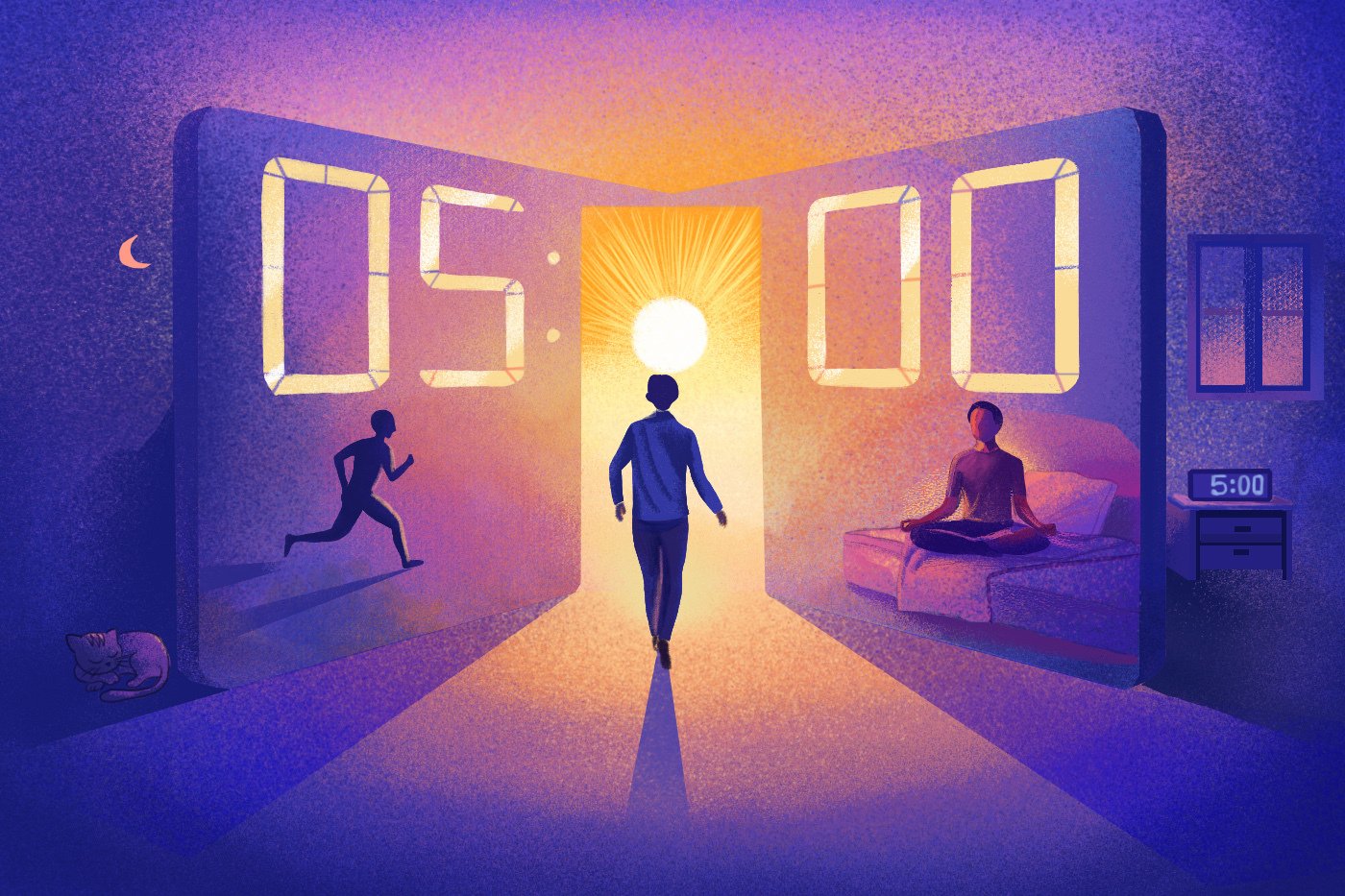
What do Jennifer Anniston, Michelle Obama and Richard Branson have in common?
Apart from the fact that they’re household names, they’re also members of the 5 AM Club, the morning routine that divides the first hour of the day into 20-minute sessions devoted to exercise, reflection and learning. First popularized by motivational speaker Robin Sharma in his 2018 book, “The 5 AM Club: Own Your Morning, Elevate Your Life,” it went viral a couple of years later, leading to 8.2 million posts and views on TikTok by June this year.
“Take excellent care of the front end of your day,” Sharma writes, “and the rest of your day will pretty much take care of itself.”
The idea of getting a head start on the day isn’t new. Before #5amclub was trending, Thomas Jefferson announced his intention to “rise with the sun” and Henry David Thoreau extolled the creative potential of mornings.
But when 5 a.m. rolls around, do experts think you should fight the urge to hit that snooze button?
Maybe.
When it comes to health, sleep is a non-negotiable, experts say. As Northeastern University professor Briana Taylor said: “Putting ourselves into a state of relative helplessness for a third of our lives” was preserved by evolution for a reason: this vulnerable time is “the most restorative biological process.”
She explained that sleep and wake cycles are governed by two systems. Homeostatic sleep pressure builds up from the moment you wake up and dissipates once you hit the sack on a particular day. Circadian rhythms serve as the body’s natural clock and establish your biological day and night over time and vary across individuals
“Some can be night owls, and others can be early birds,” Taylor explained, describing two basic chronotypes or natural tendencies
Ideally, the two systems work in harmony, she said. You feel sleepy during your biological nighttime and ready for action with the onset of your biological day. Forcing a 5 a.m. wake-up time that doesn’t match your chronotype, in turn, is a recipe for disaster — you won’t be at your physical or cognitive best.
Northeastern biology professor Matthias Schlichting warned that misalignment with your chronotype can even fuel addictive behaviors such as smoking and trigger depression
As for the 5 a.m. time itself, the consensus among experts is that there’s no biological magic in that or any particular hour. Instead, the magic is in consistency. Taylor said that sticking to the same sleep and wake times is “the greatest predictor of health outcomes, both mental and physical.”
Morning exercise also received a thumbs up because movement as well as light exposure are both external cues “that inform our biological clock it’s morning” and reinforce its wiring through the release and suppression of certain hormones, Taylor said. That makes movement one of the most direct ways you can tinker with your internal clock’s tuning
Schlichting said there’s some evidence suggesting that your highest fitness level correlates with your wake-up time. However, the fact that being active is itself a wake-up trigger makes for a chicken-and-egg dilemma. To further muddy the waters, some studies argue that “the best physical performance is in the evening,” he added.
Changing your sleep and wake times from day to day is asking for trouble, Taylor said. You could be setting yourself up for “a whole host of poor physical and mental health outcomes” associated with chronic misalignment, also known as social jet lag, if you get up at 5 a.m. on some days but hit snooze on others, she warned
Moreover, “the biggest concern is that people may focus on waking up earlier without moving their bedtime earlier, resulting in chronic sleep deprivation,” said Jennifer Martin, spokesperson for the American Academy of Sleep Medicine, a professional society that focuses on treating sleep disorders. Martin warned that although internal body clocks can be shifted gradually using strategies like consistent wake times and morning light exposure, “There’s a limit to how much an individual’s biological clock can be changed,” she said.
Those who fail to catch the requisite 7 to 8 hours could face a slew of problems ranging from cognitive and emotional to metabolic and cardiovascular issues, Taylor cautioned. Reflection and learning goals are likely to take a hit as well, she said
The fact that sleep disturbances come at such a high price is also why time changes every yearstir up heated debates.
Julie Flygare, president and CEO of sleep awareness nonprofit Project Sleep, worries that the “5 AM Club is a new iteration of a long-held myth in our hustle culture that we can accomplish more by sleeping less.” She warned that a “5 a.m. wake time would be especially out of sync for many high school and college students,” who have a naturally delayed body clock leaning more owl than early bird until their late teens or early twenties.
That said, there are alternative morning routines that don’t focus on exact times, such as Hal Elrod’s Miracle Mornings, which breaks down the first hour into six 10-minute activities.
To make sure that the routine works for you, Taylor suggested to “go with your own biological morning.” Make it a 9 a.m. club if you need to, and try to “get that morning physical exercise and morning bright light,” she said
In fact, light exposure, which suppresses the sleep hormone melatonin, can even offset some effects of social jet lag, Schlichting pointed out. On that note, make sure to dim lights and turn off screens at night, he added
Taylor suggested approaching the 5 AM Club as a project that’s “more about being proactive and purposeful with that time as opposed to the time itself.” In the end, “it’s about consistency and establishing a positive routine,” she explained
