


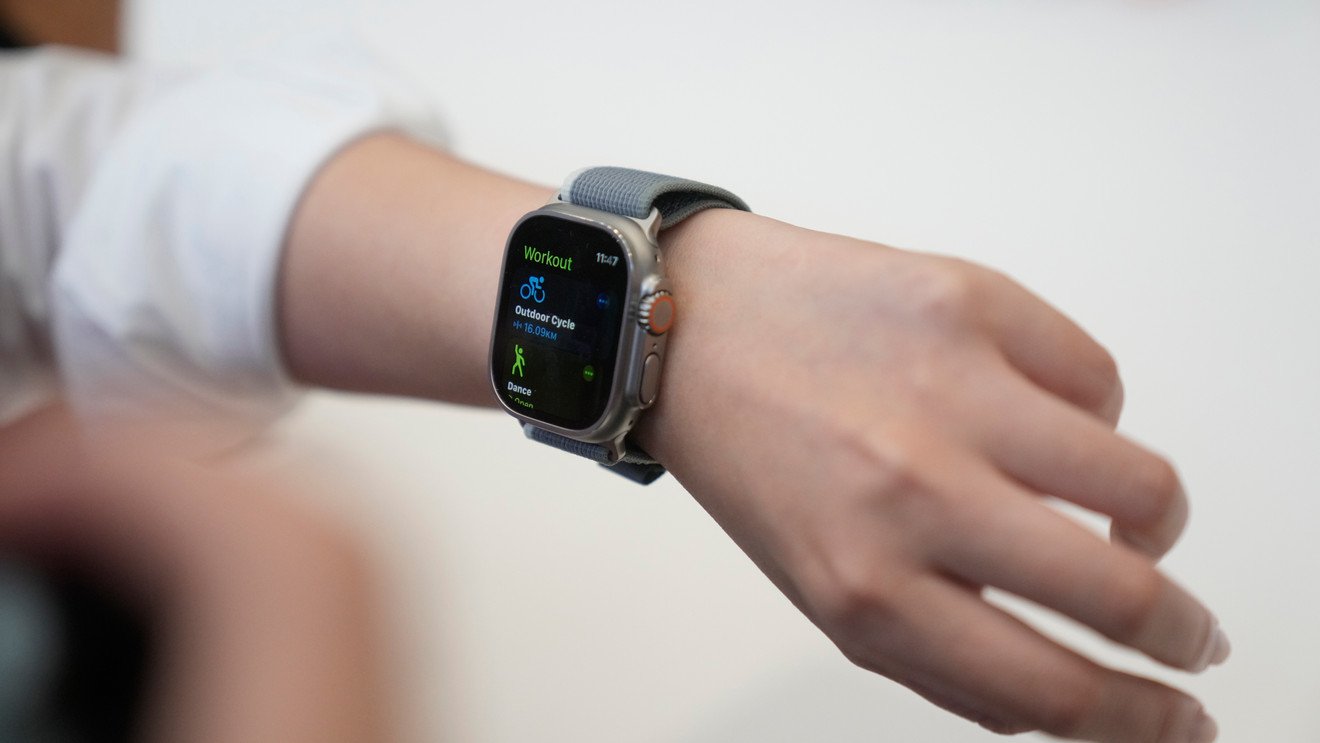
A person tries on an Apple Watch during an announcement of new products on the Apple campus, Tuesday, Sept. 12, 2023, in Cupertino, Calif. (AP Photo/Jeff Chiu)
WASHINGTON, D.C. (7News) —More Americans than ever are wearing smart devices that promise to help them live healthier lives
Whether it’s an Apple Watch, Garmin, Fitbit, Samsung Galaxy Watch, or Oura Ring,wearable technology can track everything from heart rate and exercise to sleep quality and stress levels
That growth is reflected in arecent study published in the journal NPJ Digital Medicine. Researchers from Yale School of Medicine analyzed national health survey data from 2020 through 2024 and found wearable device ownership among U.S. adults increased by 36.1%, rising to 41.1% in 2024
The study also found that while most wearable users said they would be willing to share their health data with their doctors, fewer than one in five had actually done so. Researchers concluded that wearable technology has enormous potential to improve healthcare, but its impact remains limited because many users don’t consistently wear their devices or integrate the information into their medical care.
SEE ALSO | Wearables: WebMD’s chief officer discusses AI’s growing role in home health tech
Dr. Sos Mboijana, an internal medicine physician with The Permanente Medical Group, says he’s seen that rapid growth firsthand
“Certainly the accessibility has gone up,” Mboijana said. “The cost has come down, which is not insignificant. With the prevalence of these devices, I’m seeing this much more in my office and in my own practice of internal medicine.”
Patients are asking: “Can I trust this?”
Dr. Mboijana says the questions he hears aren’t really about the gadgets themselves—they’re about whether the information can actually improve someone’s health
“A lot of the questions I get are, ‘Is this right? Does this help? Is this helping my health? How can I use this to better improve my outcomes?'” he said. “There’s usually a health question behind it.”
He views the growing interest as a positive sign
“When patients come to me like this, this is a patient who’s engaged, they’re plugged in, they’re interested in tracking their health status and some of the health metrics. So that’s a win right there.”
Sleep scores are interesting—but not medical diagnoses
Many smartwatches and smart rings now assign users a nightly sleep score based on how long they slept and the amount of time spent in various sleep stages
Dr. Mboijana said those scores should be viewed as helpful personal feedback—not as medical-grade measurements
“They are accurate in so much as they look at some of the data around your sleep and measuring the different sleep stages,” he explained. “But as far as validating them as a medical device and a medical tool, we’re not there yet with those.”
The reason is that many companies use proprietary algorithms to generate scores like “sleep readiness,” “recovery” or “sleep quality.” Because physicians don’t know exactly how those numbers are calculated, they can’t reliably use them to diagnose or treat medical conditions
“There are lots of reports and measures, like sleep scores and recovery scores,” Dr. Mboijana said. “A lot of those things are more proprietary and aren’t necessarily validated to speak to health outcomes.”
Some wearable features, however, have been clinically validated. Dr. Mboijana points to FDA-cleared electrocardiogram (ECG) functions found on some smartwatches and continuous glucose monitors used by people with diabetes as examples of wearable technology physicians can confidently use in medical care
Look for trends—not one bad night’s sleep
Rather than worrying about an individual sleep score, Dr. Mboijana encourages people to use wearables the way athletesoften do: watch for patterns over time
“It’s more around the idea of getting used to the device, use it long-term and look at trends,” he said. “This is all about trending.”
He notes that simply wearing a new device can temporarily affect sleepbecause people are conscious they’re being monitored
“You want to give it some time to settle in,” he said. “Take a look at the data, look at the trending data for you, and then look at it over time.”
Instead of focusing on one night’s sleep score, ask yourself what may have changed. Did you exercise later than usual? Drink alcohol? Travel? Get less sleep than normal? Over time, those trends may provide valuable insights into your health and habits
Can your doctor use all that data?
The Yale study found that most wearable users are willing to share data from their devices with healthcare providers, but relatively few actually do. Mboijana says even when patients share their data, healthcare systems are still learning how to make the most of it
“There is a lot of data,” he said. “The challenge that we have here is, what do you do with all this data? How do you organize the data in a manner that I can absorb it into my electronic health record and make sense out of it?”
Dr. Mboijana, who also serves as Medical Director for AI and Emerging Technology, believesartificial intelligencewill eventually help physicians analyze wearable data much more efficiently
“We’re kind of in that in-between stage where it’s a flood,” he said. “I need to be able to pull the insights in a manner that’s helpful—not just for me, but for your health as well.”
He says patients shouldn’t hesitate to bring wearable data to appointments—they just shouldn’t expect physicians to have immediate answers for every chart or graph their device produces
Choosing the right wearable
With dozens of watches, rings and fitness trackers on the market, Dr. Mboijana says consumers should resist flashy marketing and instead start with a simple question: What are you trying to accomplish?
“Am I looking to lose weight? Am I looking at my metabolic health? Am I looking to train for a marathon? What is my objective here in getting a device?” he said
He recommends talking with a primary care physician before making a purchase, especially because many wearables cost hundreds of dollars
“Manufacturers are great, but I would not start on a manufacturer’s website,” he said. “You’ll certainly drill down and get lost in the weeds.”
Instead, he says a doctorcan help match a device to a patient’s health goals and explain which measurements have the strongest medical evidence behind them
The future of wearable health
Researchers behind the Yale study say wearable devices have the potential to become an increasingly important part of preventive healthcare as technology improves and more people routinely use them
Dr. Mboijana agrees
“We’re moving from health tracking things that are just sort of trackers,” he said. “And now we’re looking into things that are more like physiologic monitors. They’re becoming much more sophisticated.”
He believes artificial intelligence and other emerging technologies will eventually help doctors transform the flood of wearable data into practical, personalized health advice
For now, his advice is simple: don’t obsess over a single sleep score or heart-rate reading. Instead, use wearable devices to understand your own patterns, stay engaged with your health and bring those longer-term trends to your healthcare provider. That’s where today’s wearable technologyoffers its greatest value—and where tomorrow’s innovations may make an even bigger difference
4
NEWDozens of Howard freshmen reinstated after being unenrolled ahead of fall semester5
NEWDC’s Attorney General challenges Washington Gas’ plan. Are costs to high?4
SE DC neighbors say parking lot where child struck was safer area to play than near street6
WATCH: Video shows response after wife of Chiefs coach shot, son arrested in Virginia
