



The story about the experience that changed Jeff Meloy’s life began with a poster above a urinal. “Do you like golf?” it read. And: “Do you want to learn more about mental health?”
One of Meloy’s colleagues spotted the poster. He knew the Watertown, Wisconsin police officer enjoyed the sport, so he snapped a photo and sent it to him
Meloy applied and was accepted into a three-and-a-half-day camp run by Next18, a Wisconsin-based nonprofit that combines the game of golf with mental wellness education for military veterans and first responders
That was four years ago. In 2024, Meloy retired as a captain after almost 30 years of service. Today, he helps facilitate camps for Next18 around the country
“Most cops are spending their entire career helping others and zero time taking care of themselves,” he said. “And we need to change that.”
Recreation-based therapy and education — using leisure activities to support physical, mental and social well-being — has long been used to help military veterans with post-traumatic stress disorder and other mental health challenges, and research has shown promising results
It’s been slower to catch on with police officers and other first responders, in part due to the decentralized nature of law enforcement in the U.S., said Matt McDonell, an Army combat veteran who founded Next18 in 2021
Mental health recounty by county, city by city,” he added
Studies suggest that rates of PTSD, depression and burnout are significantly higher among police officers than in the civilian population. In recent years, more officers have died by suicide than been killed in the line of duty, according to the first-responder advocacy group First H.E.L.P
Why recreation can open the door
Immersive recreational settings offer benefits that supplement employee assistance programs, in-house peer support and department-based wellness initiatives, said Dr. Carrie Steiner, a licensed clinical psychologist for public safety and a former Chicago police officer
“Law enforcement officers tend to be hesitant to seek therapy,” she added. Some fear that disclosing mental health struggles could affect their fitness-for-duty status. Also, the profession’s traditionally hard-charging culture can clash with the idea of opening up about emotional hardship, Steiner said, even though the narrative is slowly changing with a younger generation of officers
Therefore, easing into the mental health conversation through hiking, fishing or golfing “may be more acceptable to police officers than a formal, one-on-one sit-down session with a therapist,” she noted
Getting away from the workplace can offer another benefit: It removes distractions and gives participants a chance to disconnect from their daily routines
And unlike in-house peer support meetings, offsite retreats typically bring together strangers, allowing members of the group to share personal struggles, memories and fears with people they don’t work with, Steiner said
Photo/Katja Ridderbusch
Golf as the vehicle
In recent years, the number of nonprofits offering retreats for first responders has been steadily growing. Some focus on formal recreational therapy with clinical interventions, while others offer recreation-based wellness education or outdoor experiential programs. Activities include hiking, fishing, kayaking, mountain-biking or horseback riding
For Next18, it’s golf. “But golf is not the mission,” said McDonell, who has a master’s degree in clinical social work. “Golf is the vehicle, the catalyst, the conduit.”
Next18 grew out of McDonell’s own experience. An Army airborne infantryman, he deployed to Afghanistan in a combat role from 2012 to 2013 and left the military in 2015. As he transitioned into civilian life, he struggled with traumatic memories and chronic pain and, at one point, contemplated suicide. He eventually turned to golf, a game he had loved as a kid, and found that it helped him regain focus and stability. In 2021, he founded Next18 to bring that experience to others.
Five years later, the organization has organized over 40 camps for about 500 military veterans and first responders, mainly police officers, but also firefighters and EMTs, from 44 states. The waitlist has more than 1,000 people
Everyone who qualifies as active military, veteran or first responder can apply. Applicants are contacted by a clinician to determine whether the camp is a good fit. They are then added to a pool for upcoming camps. If selected, participants only pay for transportation
Most attendees are military veterans, said McDonell, but the number of first responders is growing
Next18, which is funded through corporate sponsorships, grants and donations, has partnered with the PGA Tour and holds most of its retreats at the Tour’s championship-caliber TPC courses
Photo/Katja Ridderbusch
Inside a Next18 retreat
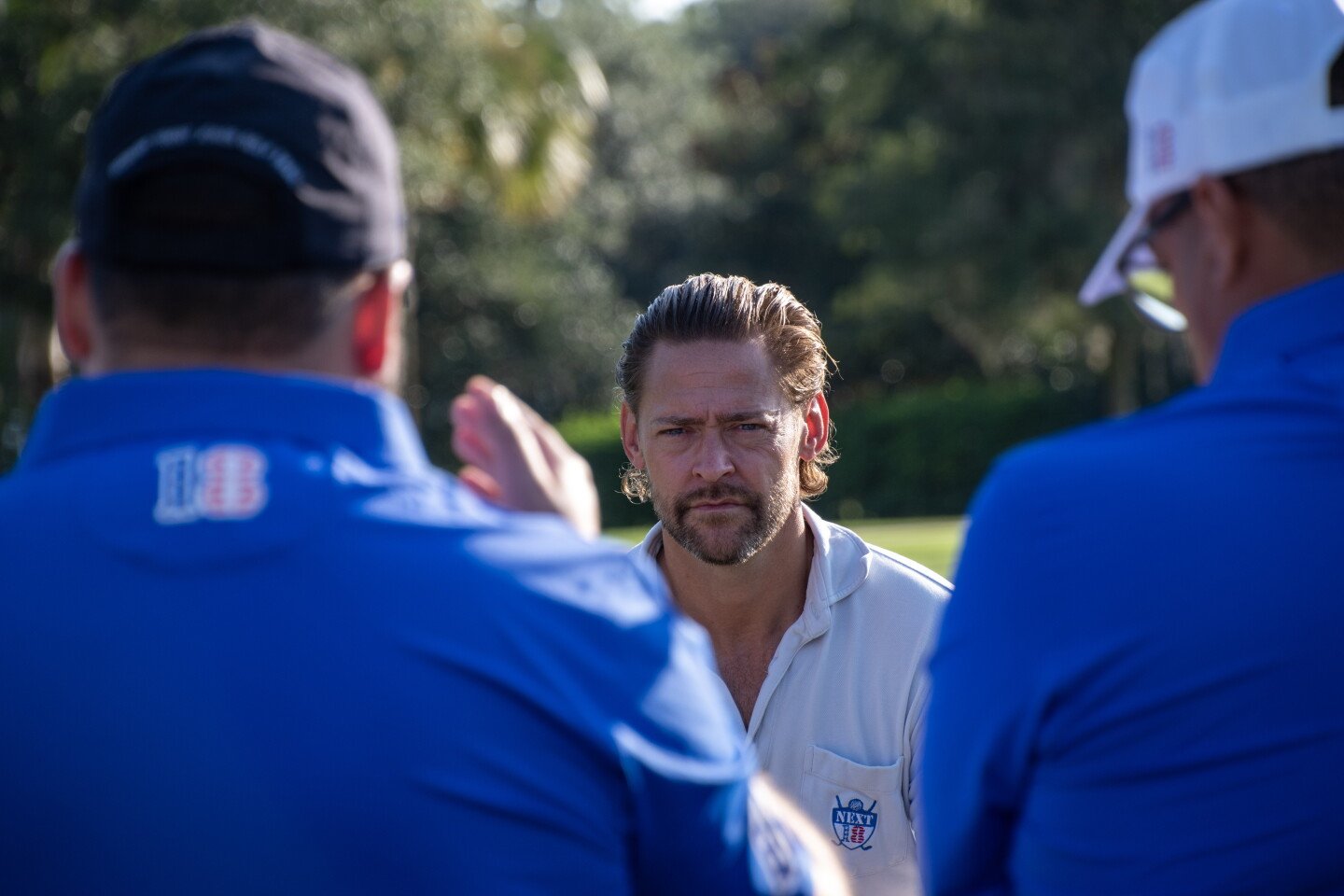
On a late summer day, the sun blasting from a cloudless sky, 12 men in bright blue polos sit in a circle on a wide grassy area between the manicured fairways and the Spanish Renaissance-style clubhouse at TPC Sawgrass in Ponte Vedra Beach, Florida. The course, host of the annual Players Championship, is home to the iconic 17th hole with its island green
The men are talking softly, some are hunched over; a few start to sob, shoulders trembling. “Your body knows when it’s safe,” said McDonell softly as he sits in a chair facing the group
During the retreats, McDonell and other facilitators lead sessions on post-traumatic stress, moral injury, childhood trauma and how it intersects with trauma acquired in adulthood and during service. Participants are introduced to journaling, yoga, meditation, mindfulness and breath work
In the afternoons, the group typically gets lessons from PGA instructors and plays a round of golf. The rhythm, alternating between educational sessions and physical activity, is intentional. “Energy needs an outlet,” said McDonell. On the golf course, participants also build camaraderie and connection
Next18 aims to provide clinical-minded mental health education in a non-clinical way, McDonell added. “We don’t diagnose. We don’t treat. We just put re
Groups usually include a mix of mental health novices and those who’ve seen a counselor for years
Meloy, the retired police captain from Wisconsin, had been in therapy for a while when he attended the Next18 camp in 2022. Decades working as a patrol officer, drug recognition expert and school rehad left him constantly on edge, “like a ball of anger,” he said
But he wouldn’t tell his bosses that he was seeking professional help. “That was still very taboo then,” he noted
It changed with the camp. Meloy went back to the department, shared his experience with other officers and encouraged them to talk about their own stressors and struggles. Today, Watertown Police gives its officers training credits for attending a Next18 retreat
Photo/Katja Ridderbusch
The cumulative toll of the job
Military veterans and first responders have a similar mindset about service, and both groups struggle with high rates of post-traumatic stress. But there are distinct differences, especially in how each group is exposed to traumatic events, said Steiner, the cop-turned-counselor
While combat veterans typically experience trauma in a highly concentrated way, police tend to be exposed to cumulative trauma that is building up, sometimes slowly, over the course of several decades
For law enforcement officers, traumatic events often “don’t occur in a far-away place,” Steiner said, “but in their own backyard, in the neighborhood they patrol every day.”
Or inside the prison walls where they work
As was the case for Tyler Grandstrand. A lieutenant with the Minnesota Department of Corrections, Grandstrand currently supervises detention officers in two living units and also investigates sex crimes. “I’ve seen things that no human should have to see,” he said, his voice calm and matter of fact
A law enforcement veteran of 21 years, he knew he needed help. For several months, he was unable to sleep more than an hour or two. Nightmares kept him up. He went to see a therapist but otherwise kept to himself
“I’m very reserved,” he said. “I don’t do vulnerable.”
But at the Next18 camp, he felt safe enough to let his guard down and talk about what haunted him
Grandstrand, an avid golfer, said he is grateful for the chance to play one of the most famous golf courses in the country. But he feels even more excited about what lies ahead, he added — about going home, getting better, and putting what he had learned into practice
For one, he is determined to openly share his experiences and struggles with his family and coworkers. And he wants to join a yoga studio
“I haven’t felt so relaxed in my entire adult life than during the two yoga sessions we did during the camp,” he said. Grandstrand, who describes himself as hyper-vigilant, was lying in the grass, eyes closed, while people were walking by. “And I just couldn’t care less,” he said with a faint smile
For Lt. Sean McCarthy, the retreat was equally transformative. The second-in-command at the Southborough Police Department in Massachusetts, McCarthy attended a Next18 camp at TPC Boston last fall. He had always considered himself a cop’s cop, jaded and a touch cynical, and he didn’t think he was in a bad place mentally when he arrived at the retreat. He now feels very differently
“I used to hate happy people,” he said. “And now I am one.”
But the experience resulted in more than a personal attitude reset. He’s since helped implement and support several officer wellness initiatives within his department. When he went to the camp, McCarthy’s chief had already started planning a wellness room, a quiet place for officers to catch a breath after a bad call or a long shift
Southborough police are also getting a comfort dog for community engagement and officer wellness. McCarthy will serve as handler
The retreat led McCarthy to join the regional Crisis Intervention and Stress Management team. That’s a structured, peer-supported approach to stabilize and mitigate the psychological impact of traumatic events on first responders
Photo/Katja Ridderbusch
What to look for in a retreat
With all the benefits, there are some things first responders should look for when deciding to sign up for a recreation-based mental health retreat, said Steiner
It is important to check whether the retreat has licensed mental health professionals on staff or among the facilitators. “If someone breaks down during the sessions, there should be other options than just taking them to the hospital,” added Steiner, “because that would be detrimental to the participant and ruin the facility’s reputation.”
Retreat facilitators should also have experience working with police and other first responders. Cultural competence is key, said Steiner, “and law enforcement has a very distinct culture.”
For example, almost every police officer will eventually share a devastating story of a child death that has deeply affected them. “And a mental health professional working with police needs to be prepared for that,” Steiner said
Next18 plans to add a separate program for spouses and make the educational content available to people on the waitlist. That way, the organization serves as a force multiplier, Meloy said, borrowing a term common in public safety
Yet the core mission remains the same: giving first responders tools to take better care of themselves
“It’s up to them to pick those tools up and put them to use,” he said
Next18 Sidebar
More retreats for first responders
The number of organizations offering immersive recreational mental health and wellness retreats for first responders is growing across the country. Programs range from clinically supported trauma retreats to recreational therapy and peer-based wellness programs. Here are a few examples:
Higher Ground
The six-day Veterans & First Responders Program uses recreational therapy and serves active, retired and volunteer law enforcement officers, firefighters and EMS personnel, including people dealing with PTSD, traumatic brain injury and other stress-related challenges. Activities across Higher Ground programs include skiing, kayaking, cycling, climbing and fishing
Big Red Barn Retreat
Serves first responders as well as military members, veterans and their families. It is a partner site for the Warrior PATHH program, developed by the Boulder Crest Foundation, which begins with a five-day residential experience followed by 85 days of virtual training, accountability and peer support. The organization also offers post-traumatic-growth programs, including equine-assisted therapy and learning.
White Heart Foundation
Offers multi-day outdoor excursions for first responders using an eco-therapy model. The retreats combine wilderness recreation, peer connection and mental health support, giving first responders dealing with post-traumatic stress and other occupational challenges a chance to step away from daily pressures and connect with others who share similar experiences
Camp Resilience
Founded in 2014, Camp Resilience has held more than 100 retreats and served hundreds of veterans, first responders and their family members. Its three- and four-day retreats combine outdoor experiential activities with facilitated peer-to-peer counseling and life-skills workshops. Past activities have included hiking, kayaking, scuba diving, skiing, rock climbing and equine programs
Camp Hero
Offers three- and four-day retreats for veterans and first responders in the Appalachian Mountains, using outdoor recreation and nature immersion as part of the healing process. Activities include hiking, fishing, cave exploration, ATV riding and hunting, with a strong emphasis on peer connection and decompression
Fitness & Health
